

TOAKS Titanium 750ml vs 550ml Pot: UK Freeze-Dried Guide
Chasing the absolute lowest pack weight often backfires the moment you light your burner in a blustery camp. On paper, weighing up the TOAKS titanium 750ml vs 550ml pot for freeze dried meals looks like a simple 31-gramme trade-off, but theoretical brim capacity rarely reflects practical performance on a exposed British hillside.
We completely understand the urge to trim every single gramme from your rucksack; saving weight keeps trail days enjoyable. Even so, nobody likes dealing with boiling water splashing over the rim, wrestling with awkward stove nesting, or running two separate boils just to hydrate dinner and make a well-earned evening brew. Camp cooking should be straightforward, fast, and completely fuss-free.
In this guide, you will discover whether the ultralight 550ml or the versatile 750ml pot best suits your freeze-dried backpacking menu. We will break down real-world usable water volumes, test 100g gas canister nesting options, and deliver a definitive verdict so you can pick the exact right pot first time.
Key Takeaways
- Understand why nominal pot volume is misleading; usable boiling capacity dictates whether you can rehydrate standard 300ml to 450ml meal pouches without messy boil-overs.
- When comparing the TOAKS titanium 750ml vs 550ml pot for freeze dried meals, internal clearance for your 100g fuel canister and stove is just as crucial as the 31-gramme weight difference.
- Discover how "one-boil" efficiency saves precious canister gas and reduces cook times when preparing dinner alongside an evening hot brew.
- Learn which pot profile suits your hiking style, whether you are prioritising minimalist speed or foul-weather camp comfort.
- Master the ideal ultralight kitchen setup, including simple packing tricks to prevent canister rattles and protect your titanium gear on the trail.
Freeze-Dried Meal Water Demands: Usable Capacity vs Brim Volume
Ultralight gear listings quote the maximum brim capacity of cookware, not how much liquid you can safely boil over a roaring flame. That distinction makes all the difference when evaluating the toaks titanium 750ml vs 550ml pot for freeze dried meals. While a 550ml cup technically holds over half a litre right to its edge, boiling that volume on a compact burner is a fast track to burnt fingertips and extinguished flames.
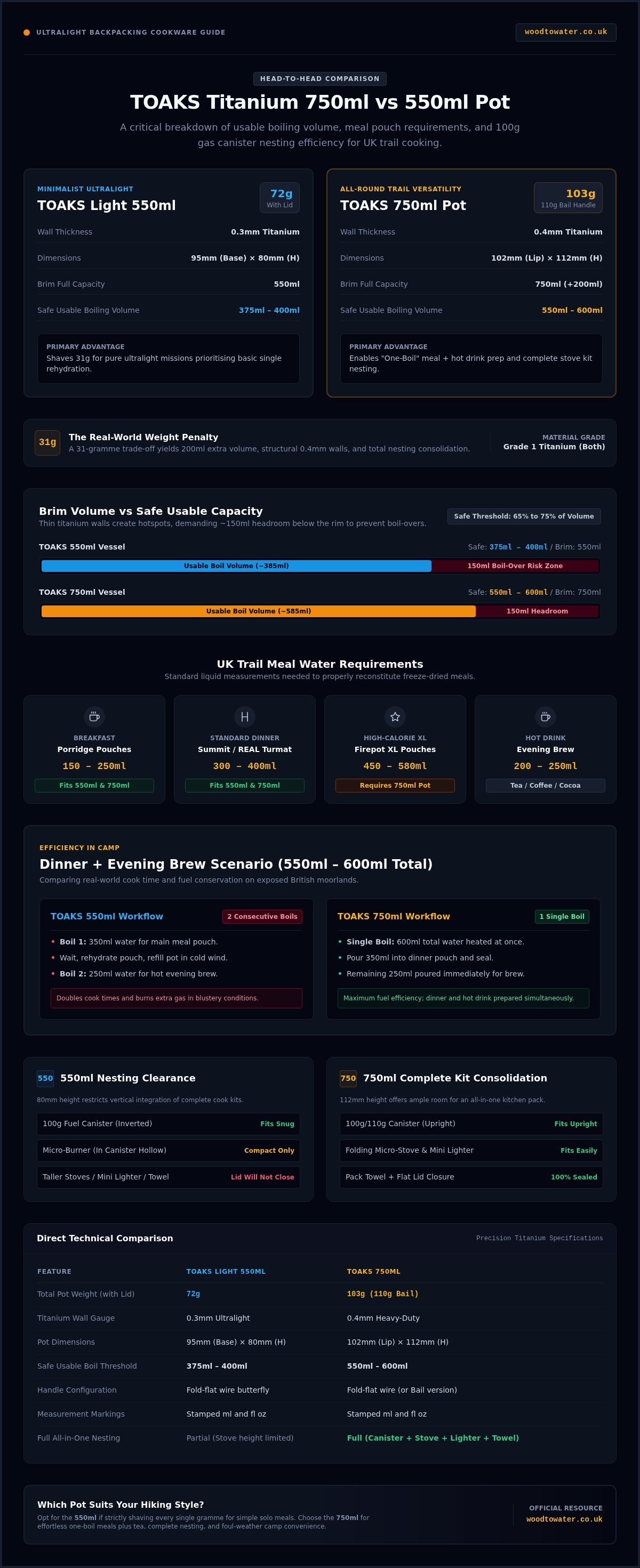
Thin titanium walls create intense hotspots directly above your stove head. Bubbles erupt violently from the centre of the pot rather than circulating smoothly. Because of this aggressive thermal transfer, you need roughly 150ml of free headroom below the rim to prevent boiling water surging over the sides. Safe, usable boil capacity is usually just 65% to 75% of the stated vessel volume.
Typical Water Requirements for Expedition Meal Pouches
Most commercial trail meals require precise liquid measurements to hydrate properly. The scientific freeze-drying process and rehydration rely on high water heat and sufficient liquid volume to penetrate vacuum-dried cells completely. Skimping on water leaves you with unpleasant, crunchy textures and slows down your body's digestion after a punishing trek.
Here is what standard UK trail food requires in camp:
- Breakfast porridge pouches: 150ml to 250ml of boiling water.
- Standard single-serving dinner pouches: 300ml to 400ml for thorough reconstitution (such as Summit to Eat or REAL Turmat meals).
- High-calorie "Big Pack" expedition pouches: 450ml to 580ml (brands like Firepot XL or high-energy options).
- Evening brew: 200ml to 250ml for tea, coffee, or hot chocolate.
The Crucial Difference Between Brim Volume and Safe Boiling Capacity
Pushing a pot past its safe limit is asking for trouble. In a 550ml vessel, your safe working threshold sits right around 375ml to 400ml. Try boiling 450ml, and the liquid will bubble furiously over the edge the second it hits rolling temperature. Uneven moorland pitches and blustery gusts only worsen this instability, making precision handling hazardous.
If you prefer a 350ml main pouch alongside an evening hot drink, you need roughly 550ml to 600ml of boiling liquid. The 750ml pot handles that volume in a single, stable boil, leaving ample headroom. With the smaller 550ml pot, you are forced to run two consecutive boils; that doubles your time spent fiddling with camping gas stoves and uses significantly more fuel in chilly weather.
TOAKS 750ml vs 550ml: Technical Specification and Nesting Comparison
Selecting the right vessel means looking beyond fluid volume to your pack geometry. When evaluating the toaks titanium 750ml vs 550ml pot for freeze dried meals, your decision comes down to 31 grammes of base weight versus complete kit integration. Both pots are built from premium grade 1 titanium, featuring fold-flat wire butterfly handles, snug-fitting lids with steam vents, and stamped volume gradations in millilitres and fluid ounces.
The TOAKS Light 550ml weighs a mere 72g with its lid, switch to 0.3mm ultralight titanium walls to shave every possible fraction of an ounce. In contrast, the standard TOAKS 750ml comes in at approximately 103g with its lid (or 110g for the bail-handle version) using durable 0.4mm titanium. That small 31g penalty awards you an extra 200ml of capacity, which significantly improves cooking versatility.
Canister and Stove Nesting Capabilities Compared
Nesting efficiency keeps your pack tidy and prevents hard edges from rubbing against delicate shelter fabrics. The 750ml pot measures 102mm across the outer lip with a height of 112mm. This generous profile swallows an upright 100g/110g screw-top gas canister, a folding micro-stove, a mini lighter, and a pack towel, allowing the titanium lid to sit perfectly flat.
The 550ml model stands just 80mm tall with an outer base diameter of 95mm. While a standard 100g canister drops neatly inside when inverted, it occupies almost all the vertical space. You can wedge a micro-burner into the canister's concave hollow, but taller stoves simply will not fit with the lid closed. If you require absolute single-pot consolidation, the 750ml provides the internal clearance you need.
Dimensions, Handle Ergonomics, and Packability
Base dimensions dictate handling stability on the trail. The slightly narrower footprint of the 550ml pot allows it to transition effortlessly into an insulated camp mug once your meal hydrates. It feels natural in hand, cutting out the requirement to pack a secondary cup for your morning caffeine.
Conversely, the 750ml model excels when treating untreated wild water. Following CDC backcountry water boiling guidelines requires maintaining a vigorous rolling boil for a full minute to neutralise pathogens, an exercise made much safer by the extra vertical clearance of the 750ml. If you plan to hang your cook system over camp embers, you can also select the 750ml bail-handle variant for effortless suspension. Explore our curated range of camping gas stoves to find the ideal burner to nest flush inside your chosen pot.
Trail Cooking Realities: Boil-Over Hazards, Wind, and Fuel Economy
Wild camping in the British uplands quickly exposes the practical limitations of minimalist cookware. When balancing the toaks titanium 750ml vs 550ml pot for freeze dried meals, ease of use on the hill matters just as much as pack weight. Boiling 400ml of water in a compact 550ml vessel demands your complete, undivided attention; let your eyes wander for twenty seconds, and surging water will douse your flame and waste precious fuel.
The taller 750ml pot provides effortless peace of mind. You can bring half a litre of stream water to a rolling boil whilst pitching your tent or organising wet layers inside your rucksack, confident that generous rim headroom prevents bubbling spills. Pairing quality titanium vessels with reliable camping gas stoves ensures precise simmer control, steady pot supports, and efficient flame distribution across the base.
The Single-Boil Advantage: Dinner and Hot Drink Combined
Nothing revives weary legs quite like a hot supper paired immediately with a warm mug of tea. Achieving this comfort requires roughly 550ml to 600ml of boiling water in total. The 750ml pot manages this demand in one single, uninterrupted heating cycle, saving both time and canister fuel.
Adhering to proper hygiene and safe outdoor meal preparation means ensuring your water hits high temperatures before rehydrating vacuum-packed provisions. With the 550ml model, you must execute two separate boiling cycles. While you wait for your second boil to heat your drink, your meal pouch is actively losing heat in the chilly air. Running two cold-water starts also requires extra gas to re-heat the titanium vessel, quickly cancelling out the original 31-gramme weight advantage over multi-day trips.
Thermal Dynamics and Wind Resistance in UK Conditions
Unprotected canister stoves battle severe efficiency losses in exposed British conditions. In a moderate breeze of 10 to 15 mph, wind strips away heat from thin titanium walls, which can easily double your boil times and cause a 50% to 200% surge in gas usage. A purpose-built folding foil windscreen is essential gear on blustery moors.
Pot height also changes thermal dynamics:
- The 750ml profile: Stands taller at 112mm, catching more cross-breeze unless placed in a sheltered porch or behind a rucksack windbreak.
- The 550ml profile: Sits low at 80mm, keeping a lower centre of gravity over micro-burners in gusty weather.
- Vented lids: Both models include stamped steam perforations, letting pressure escape smoothly without dislodging the lid during rapid boils.
Decision Matrix: Matching Pot Volume to Your Backpacking Style
Deciding between the toaks titanium 750ml vs 550ml pot for freeze dried meals ultimately hinges on how you approach trail nutrition and camp routines. Dedicated gram-counters and mountain marathoners obsess over pack base weight, happily sacrificing cooking comfort for a lighter load. Multi-day backpackers and long-distance walkers, however, usually value reliability, single-boil convenience, and a hot drink at sundown. You should also consider your dining style; eating straight from dehydrated foil pouches requires far less pot volume than cooking directly inside your vessel.
When the TOAKS 550ml is Your Perfect Trail Companion
The 550ml pot represents the gold standard for minimalist fastpackers. If your daily trail menu consists strictly of compact 300ml freeze-dried meals, this 72g pot handles your needs without adding unnecessary bulk to your pack. It shines on fast-and-light summer overnighters where you need minimal boiling capacity.
Beyond solo boil duty, the 550ml serves as a brilliant insulated mug if you share a larger stove system on group expeditions. When every single gramme counts on steep ridge scrambles, this featherweight vessel delivers pure ultralight utility.
When the TOAKS 750ml is the Smarter Investment
For most UK backpackers, the 750ml pot is the definitive choice. If you rely on 450ml to 500ml high-energy meal pouches after gruelling ascents across the fells, the extra capacity prevents frustrating boil-overs. It is also the ideal companion for anyone who insists on a warm cup of coffee alongside their freeze-dried dinner without waiting for a second boil.
Beyond standard dinner duties, the taller vertical clearance offers crucial safety margins when melting snow or purifying natural water supplies in unpredictable conditions. Its roomy dimensions house your entire cook kit, keeping your 100g gas cylinder, micro-burner, lighter, and spork neatly secured in one rattle-free bundle. Before heading out on your next fell expedition, check The Ultimate UK Camping Checklist to ensure your loadout remains balanced. If you want to streamline your trail kitchen, visit Wood To Water to secure your TOAKS titanium cookware today.
Assembling the Ultimate Ultralight Titanium Cook System
Creating an efficient camp kitchen requires harmonising your pot, heat source, fuel canister, and cutlery into a single, cohesive unit. When you compare the toaks titanium 750ml vs 550ml pot for freeze dried meals, the physical packaging of your gear dictates how smoothly your campsite operates. Arriving at a remote pitch in driving rain leaves little patience for digging through your pack to locate scattered cooking components.
Steel gas canisters can easily scratch bare titanium interiors when vibrated inside a moving rucksack. Over time, moisture trapped against these micro-abrasions causes cosmetic canister rust that transfers onto your cookware. Lining the pot base with a lightweight microfibre square solves this issue entirely; it prevents rattling, eliminates scratches, and doubles as a quick camp towel to dry your vessel after eating.
Step-by-Step Packing Routine for Rattle-Free Carrying
Organising your cook system logically ensures fast access when lighting up at dusk. Use this dependable packing order:
- Step 1: Drop a thin circular cut of microfibre cloth or a paper towel into the pot base to cushion metal surfaces.
- Step 2: Place your 100g gas canister inside. If packing the 750ml pot, place it upright; if using the 550ml, seat it inverted so the domed top rests downwards.
- Step 3: Slide your folding micro-stove and a compact mini lighter inside a small protective fabric pouch, placing them on top of the canister (or in the recessed base cavity if packing the 550ml).
- Step 4: Place the titanium lid flush on top and slide the entire unit into its padded mesh drawcord stuff sack, cinching the cord tightly to lock everything together.
Essential Camp Kitchen Accessories to Complete Your Setup
A few small, purposeful additions transform basic water boiling into a comfortable dining experience. Pairing your pot with high-grade bushcraft essentials like a long-handled titanium spork is a game-changer; the extended reach allows you to stir deep into dehydrated pouch corners without coating your knuckles in curry sauce.
To maximise fuel performance in breezy conditions, add an ultralight folding foil windscreen around your burner base to shield the flame. If you cook with the 550ml pot and drink hot tea directly from it, slip a removable silicone lip band over the rim. Titanium sheds heat rapidly, but that initial metal contact can easily scald your mouth without a barrier.
Dialling In Your Ultralight Trail Kitchen
Resolving the debate between the toaks titanium 750ml vs 550ml pot for freeze dried meals comes down to balancing pack weight against daily camp efficiency. If you are an uncompromising minimalist rehydrating smaller 300ml rations, the 72g 550ml model delivers pure featherweight utility. For most backpackers tackling unpredictable UK weather, the 103g 750ml pot is the undisputed champion. It prevents messy boil-overs, swallows your entire canister and stove setup, and boils enough water for dinner and a brew in one go.
Getting your cook kit right doesn't just save space; it transforms camp morale after long miles across wet fells. As an official UK stockist, Wood To Water provides field-proven hardware backed by dedicated outdoor advice, prompt nationwide delivery, and compatible micro-burners. Explore genuine TOAKS titanium cookware at Wood To Water to dial in your camp kitchen today. Pack light, eat well, and enjoy every sunset out on the trail!
Frequently Asked Questions
Can I boil enough water for an expedition freeze-dried meal in a TOAKS 550ml pot?
No, the 550ml vessel falls short for large calorie-dense pouches. High-energy expedition meals typically demand 450ml to 580ml of boiling water. Because the safe working boil capacity of the 550ml pot caps out around 375ml to 400ml, heating enough water for a large meal risks severe boil-overs. It suits standard single-serving pouches requiring 300ml, but larger portions demand the 750ml model.
Does a standard 100g gas canister fit inside the TOAKS 550ml pot with the lid closed?
Yes, a standard 100g screw-top gas canister fits inside the TOAKS 550ml pot, but you must place it inverted. The 80mm height leaves barely any leftover vertical space once the canister is seated. You can tuck a tiny folding micro-burner inside the canister's concave underside, but taller upright canister stoves prevent the lid from sitting flush.
How much weight do you actually save by choosing the TOAKS 550ml over the 750ml?
You save roughly 31 grammes by picking the smaller pot. The TOAKS Light 550ml pot weighs around 72g with its lid, whilst the standard 750ml model weighs approximately 103g with its lid. When considering the toaks titanium 750ml vs 550ml pot for freeze dried meals, deciding whether 31g justifies sacrificing 200ml of capacity depends entirely on your menu choices.
Why do titanium pots boil over more quickly than hard-anodised aluminium pans?
Titanium features relatively poor thermal conductivity compared to aluminium. It creates an intense, centralised hotspot directly over the stove burner head rather than spreading heat evenly across the base. This concentrated energy causes water to bubble aggressively from the middle of the pot, creating rapid surface eruptions that quickly boil over the rim without ample headroom.
Can you safely cook food directly inside a TOAKS titanium pot without burning it?
Direct cooking is challenging and not recommended for freeze-dried or fresh meals. Because thin titanium focuses intense heat directly over the burner, thick stews or porridge scorch onto the bottom within seconds. Rehydrating meals inside their original foil pouches by pouring hot water in directly preserves your cookware, saves fuel, and eliminates awkward camp washing-up entirely.
Which TOAKS pot size is better suited for melting snow on winter wild camps?
The 750ml pot is far superior for winter snow melting. Uncompressed snow has immense volume but yields very little liquid water, meaning you must repeatedly pack snow into your vessel as it liquefies. The 112mm height and wider capacity provide the working room needed to start a water base and melt fresh snow without constant spilling.
Will a 750ml TOAKS pot fit comfortably into side water bottle pockets on standard rucksacks?
Yes, the 750ml pot slides effortlessly into standard external pack pockets. Its external diameter measures 102mm, mirroring the footprint of a classic 1-litre wide-mouth water bottle. When settling the toaks titanium 750ml vs 550ml pot for freeze dried meals debate for your pack layout, both vessels take up remarkably little volume inside external mesh pouches.