

Mastering the Petromax Charcoal Maker: A Guide to Sustainable Bushcraft Fuel
Why are you still lugging heavy bags of chemical-laden briquettes into the woods when your next fuel source is literally lying at your feet? It's a common frustration for many of us; we want that perfect, intense heat for a campfire feast, yet shop-bought charcoal is often expensive and poor quality. Even worse, trying to find dry, usable wood in the damp UK wilderness can feel like a losing battle. You deserve a more reliable, sustainable way to power your outdoor cooking whilst staying connected to the environment.
By mastering the Petromax Charcoal Maker, you can transform simple branches into professional-grade charcoal that burns hotter and cleaner than anything you'll find on a supermarket shelf. It's about more than just heat; it's about becoming truly self-sufficient in the wild and reducing your environmental footprint. This guide will walk you through the fascinating process of pyrolysis and provide the practical tips you need to succeed. We'll cover everything from selecting the right timber to perfecting the burn; ensuring you never have to rely on inferior, disposable fuels again.
Key Takeaways
- Master the three stages of pyrolysis to efficiently transform fallen timber into high-energy fuel for your outdoor adventures.
- Discover how using the Petromax Charcoal Maker helps you avoid the high costs and chemical additives found in standard shop-bought alternatives.
- Identify the most effective UK hardwoods for carbonisation, including Oak and Birch, to ensure a clean and consistent burn.
- Minimise your environmental footprint by repurposing woodland waste and eliminating the need for disposable plastic packaging.
- Learn how to pair your high-grade charcoal with cast iron cookware to elevate your off-grid cooking experience.
What is the Petromax Charcoal Maker?
The Petromax Charcoal Maker is a specialised, stainless steel vessel designed to bring the ancient art of charcoal production into the modern campsite. At its heart, this tool facilitates the thermal decomposition process, allowing you to convert small wood scraps into high-energy fuel. It isn't just about making fire; it's about refining the resources already available in the woodland. By removing oxygen from the equation, the maker carbonises wood rather than simply burning it to ash.
For the eco-conscious bushcrafter, this tool is a game-changer for maintaining a "Leave No Trace" ethos. Instead of leaving half-charred logs in a fire pit or carrying heavy bags of commercial coal, you can process local, fallen timber into a clean-burning resource. This reduces the need for plastic-wrapped shop-bought fuels and ensures that your footprint on the landscape remains minimal. It's a practical solution for those who want to enjoy a traditional campfire experience without the environmental guilt or the mess of scorched earth.
The Heritage of Charcoal Making
Traditionally, charcoal was produced in massive earth-covered kilns or "meilers" that required days of constant supervision. It was a labour-intensive industrial process essential for blacksmithing and cooking. Petromax has successfully miniaturised this ancient craft, allowing you to produce artisanal coal in a matter of hours. This shift from industrial-scale production to a portable, personal kit means you can control the quality of your fuel. You aren't just using generic coal; you're using fuel you've crafted yourself from the very woods you're exploring.
Design and Build Quality
The construction of the Petromax Charcoal Maker focuses on durability and precision. Made from high-grade stainless steel, it's built to withstand the intense heat required for carbonisation without warping. The most critical feature is the airtight lid seal. This creates the necessary anaerobic environment, ensuring the wood doesn't ignite but instead transforms into charcoal. It's designed with the UK wild camper in mind; it's robust enough to be tossed in a pack but efficient enough to produce a full batch of fuel during a standard evening stop. Once your charcoal is ready, it's the perfect companion for high-efficiency burners like Bushcraft Essentials stoves, providing a steady, smoke-free heat source for your outdoor kitchen.
The Science of Pyrolysis: How it Works
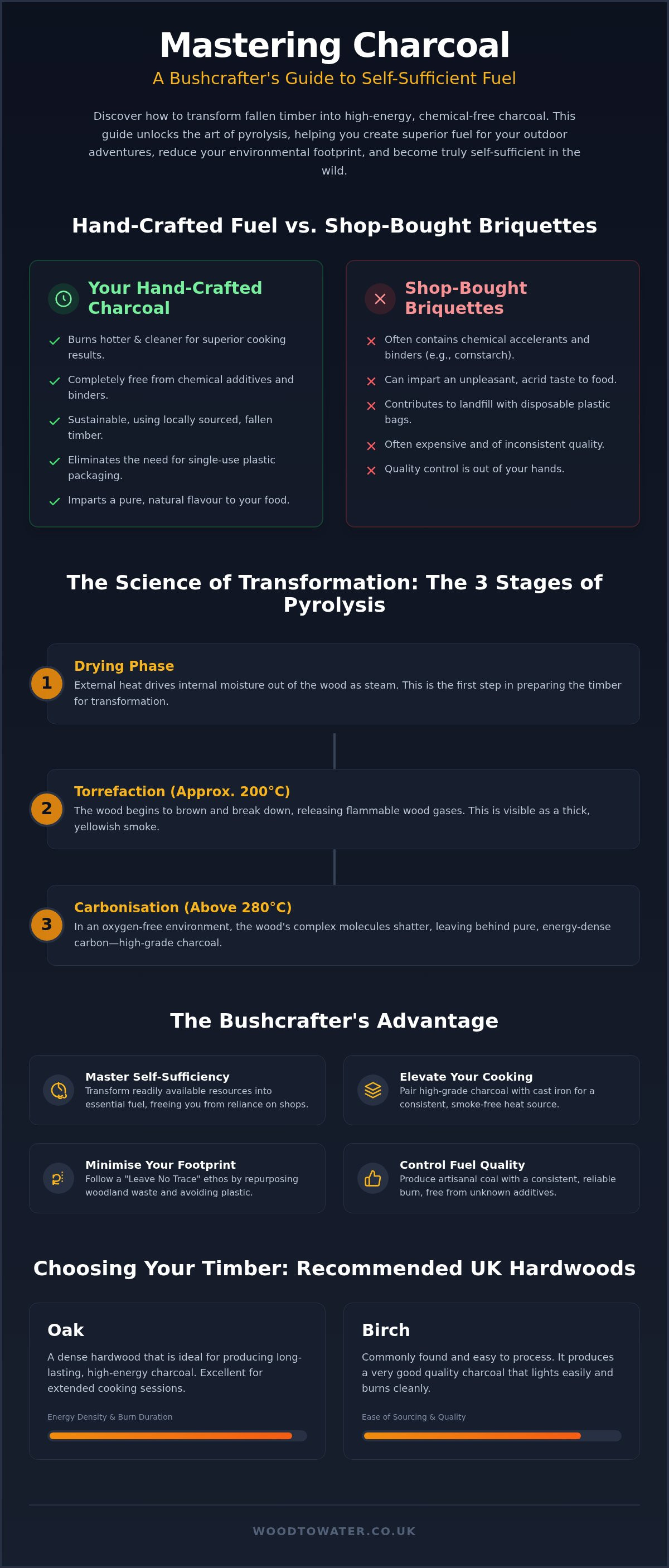
Making charcoal isn't simply about setting wood on fire. It is a process of controlled thermal decomposition. When you use the Petromax Charcoal Maker, you are initiating pyrolysis; the chemical breakdown of organic material in a high-heat environment where oxygen is strictly excluded. Without this anaerobic setting, wood simply combusts, leaving you with nothing but a pile of grey ash. By sealing the wood inside a robust vessel, you force it to undergo a transformation that preserves its energy-dense carbon structure.
This transformation occurs in three distinct stages. First is the drying phase, where external heat drives off internal moisture as steam. Once the wood reaches approximately 200°C, it enters torrefaction. During this stage, the wood begins to brown and lose its cellular integrity, releasing volatile gases. Finally, as temperatures climb above 280°C, carbonisation takes over. This is the critical moment where the wood's complex molecules shatter, leaving behind the pure carbon we recognise as high-grade charcoal.
The Role of Heat and Oxygen
The airtight design of the vessel is what makes this science work in the field. As the wood inside heats up, it releases a thick, yellowish smoke. This isn't actually smoke in the traditional sense; it's a flammable mixture of wood gases, including carbon monoxide and methane. Because the Petromax design prevents oxygen from entering, these gases can't ignite inside the maker. Instead, they are forced out, often providing additional fuel for the fire surrounding the canister. You'll know the process is nearing completion when the heavy, white vapours transition into a thin, bluish haze or disappear entirely, signalling that the volatile materials have been spent.
Chemical-Free Fuel Benefits
Producing your own fuel offers a level of purity that commercial products simply can't match. Most shop-bought briquettes are held together with cornstarch binders or contain chemical accelerants to make lighting easier. These additives often impart an unpleasant, acrid taste to your food. When you use the pure carbon produced by your own hands, you ensure a clean, odourless burn that lets the natural flavours of your ingredients shine. It's the ultimate way to level up your cast iron cookware sessions, providing a consistent heat source that is entirely free from artificial toxins. By controlling the input wood, you control the output quality, resulting in a superior outdoor cooking experience every time.
Home-Made vs. Shop-Bought: A Practical Comparison
Choosing between a bag of supermarket briquettes and making your own fuel comes down to a choice between convenience and quality. While grabbing a pre-packed bag is easy, it often leaves you at the mercy of poor-grade timber and mystery additives. For those who prefer to source professionally seasoned logs from a specialist supplier, click here to explore the premium firewood options from Santa Barbara Firewood. When you use the Petromax Charcoal Maker, you're effectively turning free woodland waste into a premium resource. It's a shift from being a consumer to a producer, ensuring you always have a steady supply of high-energy fuel even in the most remote backcountry locations. You'll never have to worry about a shop being closed or a heavy bag splitting in your pack again.
Quality control is perhaps the greatest advantage of the DIY approach. Shop-bought lumpwood is frequently a mix of softwoods and scraps that spark excessively or burn out in minutes. By selecting your own "dead and down" timber, you can tailor the burn to your specific needs. Oak and Beech provide the sustained, intense heat required for slow-roasting, whilst lighter woods like Alder are perfect for a quick sear. This level of precision is simply impossible with generic, mass-produced alternatives that prioritise volume over performance.
Environmental responsibility is at the core of the modern bushcraft kit. Commercial charcoal carries a heavy footprint, involving industrial processing, plastic packaging, and long-distance transport. Producing your fuel on-site eliminates these factors entirely. It also aligns perfectly with "Leave No Trace" principles. Instead of building large, scorching campfires that leave lasting scars on the ground, you can use small, efficient batches of charcoal in a portable stove. This method requires far less raw wood, meaning you won't need to strip the local area of its fallen branches to stay warm and well-fed. It's a more respectful way to interact with the landscape. To further your journey into self-reliant living, you might want to discover Homesteading to Riches, which offers a wealth of community-led advice for sustainable enthusiasts.
Performance on the Grill
Freshly made lumpwood charcoal is remarkably different from the dusty bags found in shops. Because it hasn't been crushed in transport or sat in a damp warehouse, it remains highly porous and incredibly easy to light. You'll find that home-made charcoal reaches cooking temperature much faster, often with just a single spark and some dry tinder. The heat intensity is also superior. Pure carbon burns hotter and cleaner than briquettes, which are often weighed down by non-combustible binders. If you're using Bushcraft Essentials stoves, this high-grade fuel ensures maximum efficiency with minimal smoke, making your outdoor kitchen both more professional and more pleasant to use.
Masterclass: Using Your Petromax Maker in the UK
Success in British woodlands depends on your choice of timber. Our damp climate means moisture management is your biggest hurdle when producing fuel. Using the Petromax Charcoal Maker effectively requires a bit of local knowledge and a steady hand with the fire. It's a rewarding process that turns a standard camping trip into a lesson in self-sufficiency.
UK Wood Selection Guide
Not all timber is created equal. For the best results in our environment, focus on these three stalwarts of the landscape:
- Oak: Known as the king of hardwoods, oak produces incredibly dense charcoal. It provides a long-lasting, intense heat that is perfect for slow-cooking a hearty stew.
- Birch: This is a fantastic wood for beginners. It chars quickly and the resulting coal is very easy to light, making it ideal for shorter camping trips.
- Ash: Often called the perfect all-rounder, ash has a naturally low moisture content. It produces a reliable, consistent charcoal that suits almost any bushcraft task.
Step-by-Step Production
For the best results, process your timber into uniform pieces approximately the size of a finger or small kindling sticks. Consistency is vital; if your wood pieces vary too much in size, the smaller ones will over-char before the larger ones have even finished drying.
When loading the canister, leave a small amount of breathing room at the top rather than cramming it to the brim. Overpacking can lead to uneven carbonisation, leaving you with raw wood in the centre of the batch. Once sealed, place the maker in the heart of a well-established fire. You want the flames to lick around the sides of the vessel to ensure an even internal temperature throughout the pyrolysis process.
Managing the external fire is a balancing act. You don't need a raging inferno; a steady, consistent heat is far more effective. Watch for the gas escaping the lid. When the heavy yellow smoke turns to a thin blue shimmer, you've hit the "sweet spot". At this point, carefully remove the maker and let it cool completely before opening. Opening it too early introduces oxygen, which will cause your fresh charcoal to ignite and turn to ash instantly. You can find the Petromax Charcoal Maker amongst our curated fire-making selection to start your own sustainable fuel cycle.
Completing Your Bushcraft Kitchen
Owning a Petromax Charcoal Maker is only the first step in building a truly self-sufficient outdoor kitchen. It’s about creating a cohesive system where every piece of gear works in harmony to produce the best possible results. For the serious enthusiast, this kit represents a long-term investment in skill and sustainability. Once you’ve mastered the art of carbonisation, you’ll find that your entire cooking routine becomes more efficient, cleaner, and significantly more rewarding.
High-grade, home-made charcoal is the perfect partner for cast iron cookware. The intense, even heat provided by pure carbon is ideal for maintaining the seasoning on your Dutch ovens and skillets. It allows for precision searing that gas stoves struggle to replicate in the wild. To make the most of this fuel, we recommend using your charcoal in Bushcraft Essentials stoves. These folding hobo stoves are engineered for maximum airflow, ensuring your hand-crafted coal burns with incredible efficiency and almost zero smoke.
Preparation is equally vital. Whilst the maker handles the chemical transformation, you’ll need a reliable bushcraft knife to process your timber into those uniform finger-sized pieces we discussed. A sharp, robust blade makes the task of batoning down hardwoods much safer and less fatiguing, ensuring your Petromax Charcoal Maker is always loaded with the optimal feedstock for a successful burn.
The Full Fire System
Integrating charcoal production into your camp routine is simple once you find your rhythm. Start your burn early in the evening whilst you’re relaxing by the main fire; by the time you’re ready to cook, your fresh fuel will be cooling and ready for harvest. In our damp British climate, storing your finished coal is the biggest challenge. Always keep your harvested charcoal in a dry, airtight bag or tin to prevent it from absorbing atmospheric moisture. Safety is paramount; always remember that the steel vessel remains hot for a long time and the gases released during the process are highly flammable. Handle the unit with heat-resistant gloves and ensure you’re working in a well-ventilated outdoor space.
Why Order from Wood To Water Outdoors?
We don’t just sell gear; we live the lifestyle. Our inventory is carefully curated and expert-vetted to ensure every item, from the Petromax range to our TOAKS titanium kit, meets the demands of the UK wilderness. We’re here to support the bushcraft community with practical advice and reliable customer service. Explore the Petromax range at Wood To Water Outdoors today and take the next step in your journey toward total outdoor self-sufficiency.
Take Control of Your Campfire Fuel
Mastering the Petromax Charcoal Maker represents a significant step toward total outdoor self-sufficiency. By harnessing the power of pyrolysis, you've moved beyond relying on supermarket briquettes and embraced a more sustainable, artisanal approach to fire-making. This skill doesn't just improve your cooking; it deepens your connection to the British landscape by allowing you to process local timber into high-grade fuel. You now have the knowledge to maintain a clean-burning, smoke-free kitchen whilst minimising your environmental footprint in the backcountry.
At Wood To Water Outdoors, we pride ourselves on being a trusted partner for your adventures. Our expert-vetted bushcraft gear is highly rated by the UK outdoor community, ensuring that every tool we stock meets our rigorous standards for durability and utility. With reliable UK-wide delivery, we make it easy to source the essential kit you need for your next trip. Upgrade your bushcraft kit with the Petromax Charcoal Maker today and experience the satisfaction of producing your own premium fuel. We'll see you out there.
Frequently Asked Questions
How long does it take to make a batch of charcoal?
A typical batch in the Petromax Charcoal Maker takes between 90 minutes and three hours to complete. This duration depends heavily on the moisture content of your timber and the intensity of your external fire. You'll spend the first hour driving off moisture and the remaining time facilitating the carbonisation. Always allow for an additional hour of cooling time before opening the lid to ensure the process has fully finished and the charcoal doesn't ignite.
Can I use softwoods like Pine or Spruce in the Charcoal Maker?
You can certainly use softwoods like Pine or Spruce, but they aren't the best choice for high-quality cooking fuel. Softwoods contain high levels of resin, which can leave a bitter soot on your food and cause the charcoal to spark excessively. Whilst they char quickly, the resulting coal is less dense and burns through much faster than hardwoods. For a steady, reliable heat source, we always recommend sticking to UK hardwoods like Oak or Ash.
Is the Petromax Charcoal Maker too heavy for backpacking?
Whether it's too heavy depends on your trek, but at approximately 1.1kg, it is generally better suited for base camps or shorter expeditions. Whilst it might be a stretch for ultralight hikers, the weight is a trade-off for the extreme durability of the stainless steel construction. If you're staying in one spot for a few days, the ability to produce your own fuel actually saves you from carrying heavy bags of commercial coal on the way in.
Do I need a large fire to use the Charcoal Maker?
You don't need a massive bonfire; you simply need a consistent heat source that can surround the vessel. A medium-sized campfire or even a large wood-burning stove is usually sufficient to trigger the pyrolysis process. The key is ensuring the flames reach the sides of the canister to maintain an even internal temperature. If your fire is too small, the wood in the centre of the maker might not reach the 280°C required for full carbonisation.
How many times can I reuse the Petromax Charcoal Maker?
The Petromax Charcoal Maker is designed for long-term, repeated use thanks to its robust stainless steel build. If you maintain it properly and avoid dropping it whilst it's red-hot, it should last for years of regular bushcrafting. The metal will naturally discolour over time due to the extreme heat, but this is purely aesthetic and doesn't affect the unit's performance. It's a "buy once, use forever" piece of kit that rewards proper care and maintenance.
Can I use the charcoal maker in my garden fire pit?
Absolutely, using it in a garden fire pit is an excellent way to practice your skills before heading into the wild. It allows you to experiment with different wood types in a controlled environment. Just ensure you follow local smoke control regulations, as the initial drying phase produces a fair amount of steam and wood gas. It's a brilliant way to turn garden prunings from fruit trees or hedges into premium barbecue fuel for your next cookout.
What happens if I open the lid too early?
If you open the lid before the unit has completely cooled, the superheated carbon will react with the sudden influx of oxygen and burst into flames. This will instantly turn your hard-earned charcoal into a pile of useless white ash. Patience is the most important part of the process. Always wait until the canister is cool enough to touch with your bare hands before peeking inside; otherwise, you risk ruining the entire batch in seconds.
Is the charcoal maker dishwasher safe for cleaning?
Whilst stainless steel is technically dishwasher safe, we don't recommend putting your charcoal maker in one. The unit will be covered in soot, creosote, and carbon deposits that could easily clog your dishwasher's filters or stain other dishes. The best way to maintain the maker is to simply wipe away loose debris with a stiff brush or a damp cloth. A bit of carbon build-up on the inside actually helps to protect the metal during future burns.