

The Essential Guide to Choosing a Bushcraft Knife in the UK (2026)
A bushcraft knife isn't a weapon; it's the most versatile tool in your pack, provided you understand the legal weight it carries in the UK. With 34.3 million people now participating in outdoor recreation across the country, more of us are heading into the wild to hone our woodcraft skills. You've likely felt that pang of uncertainty when browsing fixed blades. It's natural to worry about staying on the right side of the law or fear a blade snapping during heavy use whilst you're miles from the nearest road.
It's a common frustration, but choosing the right gear shouldn't feel like a gamble. We're here to help you master the technical nuances of blade geometry, steel types, and UK legalities to find your perfect bushcraft companion. You'll learn exactly how to choose a "buy-it-for-life" tool and maintain a razor-sharp edge with total confidence. We'll break down the difference between carbon and stainless steel whilst ensuring you stay compliant with current regulations; giving you the peace of mind to focus on your campfire instead of your kit list.
Key Takeaways
- Navigate UK knife laws with confidence by understanding the "good reason" clause required for carrying a fixed blade in public.
- Discover why a full tang construction is non-negotiable for a reliable bushcraft knife and how it prevents tool failure during heavy use.
- Compare the pros and cons of carbon versus stainless steel to find the best match for the damp British climate.
- Learn how to identify the right blade grind for your specific tasks, whether you're batoning logs or carving fine feather sticks.
- Master essential field maintenance tips to keep your edge razor-sharp and ensure your tool remains safe to handle.
Understanding the Bushcraft Knife: Purpose and UK Legalities
A bushcraft knife is more than just a piece of sharp steel; it's your primary partner for wilderness survival. Unlike a kitchen blade or a tactical tool, this equipment is designed for the specific physical demands of the woods. Whether you're processing firewood or crafting a trap, your blade needs to handle stress that would snap a standard pocket knife in seconds. It's a tool built for utility, durability, and safety in environments where your kit simply cannot fail.
What Makes a Knife a "Bushcraft" Tool?
Real bushcraft involves more than just simple cutting. It requires a tool capable of "batoning" (using a wooden club to drive the knife through a log) and "feather sticking" to create fine tinder. To understand what is bushcraft in a modern context, you have to view the knife as a lever, a plane, and a chisel all in one. It's about working with nature, not just against it.
Folding knives, even those with sturdy locks, have a pivot point. This is a natural weak spot. Under the heavy pressure of woodcraft, a pivot can fail, leading to serious injury. A fixed-blade bushcraft knife offers the structural integrity you need for peace of mind. It represents a psychological shift; you aren't carrying a weapon, you're carrying a curated survival tool that's as essential as your matches or your shelter.
Navigating UK Knife Law for Outdoorsmen
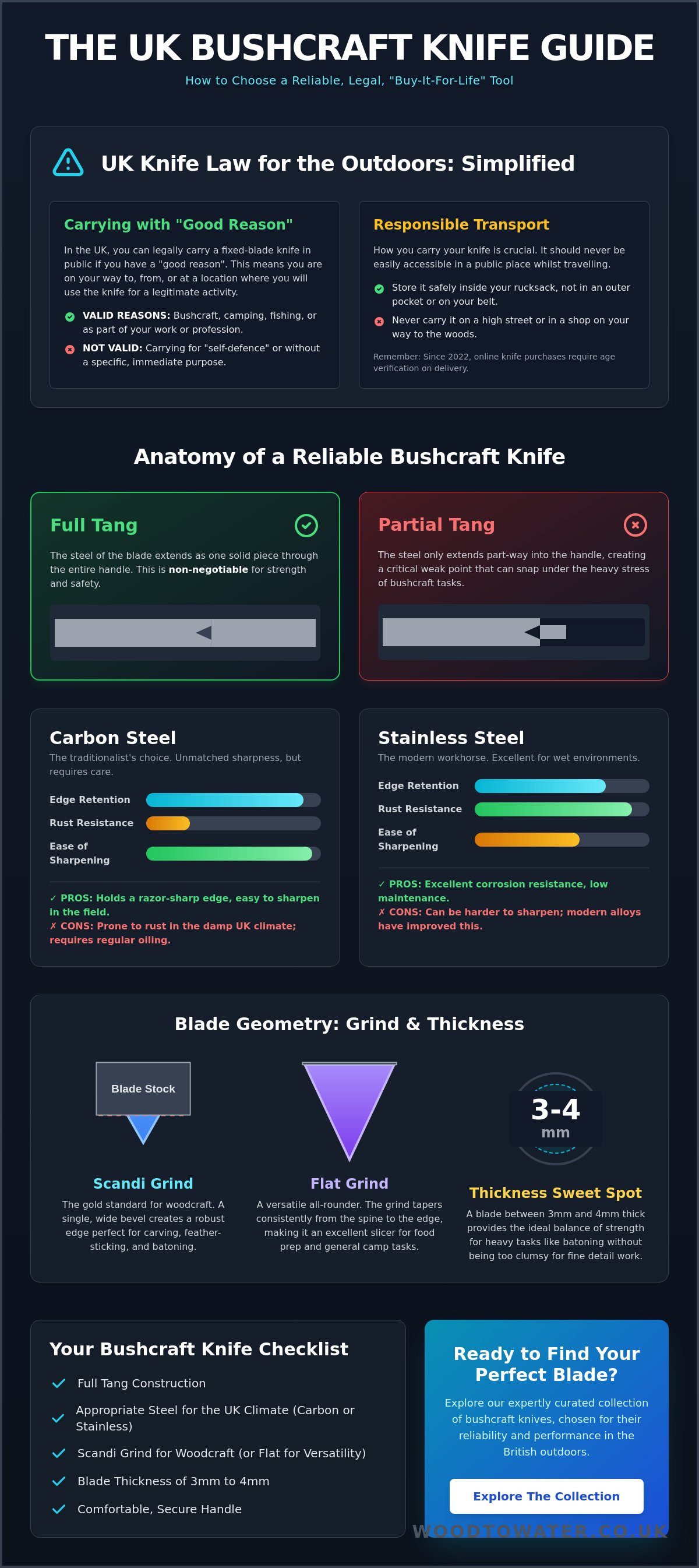
UK knife laws are strict, but they aren't designed to stop you from enjoying the outdoors. Most people are familiar with the "Every Day Carry" (EDC) rule: a non-locking folder with a cutting edge under 3 inches. However, a standard bushcraft knife is almost always a fixed blade, which falls into a different category. You can't just have one in your pocket whilst walking down a high street.
You can legally carry a fixed blade in a public place if you have a "good reason." Heading to a specific campsite to practice woodcraft is a valid reason, whilst carrying it in a supermarket on the way there is not. Always keep your knife stored securely at the bottom of your rucksack whilst travelling to ensure you're acting with "lawful authority." If you aren't currently using it or standing on the land where you intend to use it, it should be out of sight and reach.
In the eyes of the law, a "good reason" is a specific, justifiable purpose for possessing a knife in a public place, such as using it for a legitimate outdoor hobby like camping or fishing. Additionally, remember that since April 2022, any online knife purchase requires age verification upon delivery, so ensure you have ID ready when your new tool arrives.
Anatomy of a Reliable Blade: Steel, Tang, and Grinds
A high-quality bushcraft knife isn't just about the edge; it's about the construction. The most critical feature you should look for is a "full tang." This means the steel of the blade extends in one solid piece through the entire length and width of the handle. It's non-negotiable for safety. If you're batoning through a piece of seasoned oak, a partial tang can snap inside the handle, potentially causing a nasty injury. A full tang tool is a "buy-it-for-life" investment that won't let you down when you're miles from the nearest road.
Steel Types: Carbon vs Stainless in the UK
The British climate is notoriously damp, which makes your choice of steel vital. Carbon steel, such as O1 tool steel, is a favourite amongst traditionalists because it holds a fantastic edge and is easy to sharpen in the field. However, it will rust quickly in a damp woodland. You'll need to develop a "patina" or keep it lightly oiled to protect the surface. On the other hand, stainless steels like Sandvik 14C28N offer excellent rust resistance. This is a huge advantage if you're out in the rain for days. Whilst stainless steel was once harder to sharpen, modern alloys have narrowed that gap significantly. Before you buy, check the latest UK knife law to ensure you're purchasing from a reputable source that follows age verification rules.
Blade Geometry and the Scandi Grind
The "Scandi Grind" is the gold standard for woodcraft. It features a single wide bevel that runs to the edge, acting like a tiny chisel. This geometry allows the blade to bite deeply into wood for carving or creating feather sticks. For a more versatile camp tool, you might consider a Flat Grind or Sabre Grind, which are better at slicing through food or cordage. Aim for a blade thickness between 3mm and 4mm. This is the "sweet spot" that provides enough strength for heavy work without becoming too bulky for fine detail. When you're ready to upgrade your kit, you can view our curated selection of outdoor tools to see these features in action.
Finally, don't overlook the handle material. Your choice often comes down to personal preference versus practical durability in the field:
- Traditional Wood: Curly birch or oak looks beautiful and feels warm in the hand.
- Micarta: A laminate of fabric and resin that provides incredible grip even when soaked.
- G10: A glass-based epoxy resin that is virtually indestructible and won't rot or swell.
Synthetic materials like Micarta and G10 are often better suited to the unpredictable British weather. They don't shrink or rot, ensuring your tool remains reliable year after year. Choose a handle that feels comfortable in various grips, as you'll be using it for everything from heavy chopping to delicate carving tasks.
Choosing Your Primary Blade: A Comparison of Bushcraft Styles
Finding the right bushcraft knife isn't just about the steel; it's about how the tool fits your specific style of woodcraft. Some enthusiasts prefer a heavy blade that can replace a small hatchet, whilst others prioritise fine carving and detail work. Your choice will dictate how you interact with the woodland environment. If you're planning a multi-day trip involving heavy shelter building, your needs will differ wildly from someone focused on green woodworking and spoon carving. It's about matching the tool to the task at hand.
The Heavy-Duty Workhorse
If your priority is processing firewood and building structures, you need a "Workhorse." These blades typically feature a thickness of 4mm or more. A drop point profile is ideal here because it places the tip in a strong, controllable position for prying or drilling. Look for a robust pommel that allows for light hammering tasks. This style is perfect for splitting logs through batoning, a technique that requires absolute structural integrity. However, be aware that a thicker blade can be a hindrance when you're trying to slice thinly or perform delicate tasks. It's a trade-off between raw power and surgical precision.
The Precision Woodcraft Knife
For those who love the "craft" in bushcraft, a thinner blade is often superior. A "Carver" usually has a blade stock between 2.5mm and 3mm. This thinner profile, combined with an acute Scandi grind, allows the steel to glide through wood with minimal resistance. It's the perfect tool for making intricate trap triggers or shaving fine tinder. When performing these repetitive tasks, "comfort in the hand" matters far more than total blade length. A well-contoured handle prevents "hot spots", those painful friction points that can end a carving session early. You want a tool that feels like an extension of your arm, not a heavy weight in your palm.
Don't overlook the importance of a secondary tool like a neck knife. These small, lightweight blades are incredibly handy for minor tasks, such as cutting cordage for your DD Frontline Hammock or opening a pack of 5 Minutes to Delhi Ready Meals. They save you from constantly unsheathing your primary blade for every small job. They are the ultimate backup for the modern outdoorsman.
Finally, consider how you'll carry your tool in the unpredictable British weather. A traditional leather sheath is beautiful and moulds to your knife over time, but it requires regular treatment to prevent it from becoming a soggy mess in the rain. Kydex, a modern thermoplastic, is entirely waterproof and offers a "click-fit" retention that is incredibly secure. If you're wearing Highlander Outdoor Clothing and trekking through a downpour, the peace of mind offered by a weather-resistant Kydex sheath is hard to beat. It ensures your bushcraft knife stays exactly where it should be, regardless of the terrain.
Field Maintenance: Keeping Your Edge Sharp Whilst Outdoors
A dull bushcraft knife isn't just frustrating; it's a liability in the woods. When a blade loses its "bite," you're forced to apply more pressure to complete a cut. This extra force increases the risk of the blade slipping, which is how most outdoor injuries occur. A sharp knife is predictable; a dull one is dangerous. Maintaining your edge in the field is a fundamental skill that separates the novice from the seasoned outdoorsman.
You don't need a heavy bench stone to keep your edge keen. Portable solutions are perfect for "touching up" a blade by the campfire. These compact tools allow you to address minor rolls or dull spots before they become major problems. If you've been batoning through grit-covered logs, a quick session with a diamond and ceramic stone will restore that vital edge in minutes. Follow these steps to touch up your edge after a day of woodcraft:
- Clean any sap or debris from the blade using a damp cloth or a bit of water.
- Use the diamond side of a portable stone for any visible nicks or rolls.
- Switch to a fine ceramic side to hone the edge back to a sharp point.
- Finish with several passes on a leather strop to achieve a razor-like finish.
The Art of the Field Strop
Stropping is the secret to a "scary sharp" edge. By pulling the blade across a piece of leather, you realign the microscopic "teeth" of the steel without actually removing any material. This simple act extends the time between major sharpenings, keeping your tool in peak condition for longer. If you don't have a dedicated field strop, your leather belt can work in a pinch. Just ensure it's pulled taut and always move the blade away from the edge to avoid cutting the leather.
Cleaning and Oiling in the Rain
UK woodlands are rarely dry, and humidity is the enemy of high-carbon steel. Never sheath a wet blade, especially if you're using a traditional leather sheath. Leather holds moisture against the steel, creating a perfect environment for rust to bloom overnight. Always dry your blade thoroughly after use. If you're processing food, a food-safe oil like Camellia oil is essential. For general protection, a light coat of mineral oil will suffice. If your leather sheath becomes waterlogged, let it air dry slowly. Never put it near a direct heat source like a fire, as this will cause the leather to shrink and crack.
Keeping your kit in top shape is part of the lifestyle. You can browse our full range of field sharpeners and maintenance gear to find the right kit for your next expedition.
Expertly Curated: The Wood To Water Bushcraft Knife Collection
At Wood To Water Outdoors, we aren't just retailers; we're active participants in the outdoor lifestyle. Our team spends their weekends in the same British woodlands where you'll be testing your skills. This hands-on experience is exactly why our selection of tools is so tightly curated. We only stock a bushcraft knife if it's something we would trust in our own kit bags. Every item in our inventory has been vetted for reliability; ensuring you get a tool that performs as expected when you're out in the field.
Why Buy From a UK Specialist?
Choosing a UK-based specialist means you're dealing with people who understand the specific challenges of our environment. From the humidity of a Scottish glen to the dense hardwoods of southern England, we know what gear works. You'll benefit from fast UK shipping and local customer support from fellow enthusiasts who speak your language. With participation in outdoor recreation reaching 34.3 million people in the UK as of 2026, the demand for quality kit has never been higher. We ensure every product meets UK legal expectations and quality standards, so you can buy with total confidence.
Beyond the Blade: Completing Your Kit
A great blade is the heart of your kit, but it works best when paired with the right companion gear. There's a natural synergy between a high-quality bushcraft knife and a reliable firesteel for starting your morning campfire. We organise our inventory to provide a complete solution for your expeditions. Whether you need the ultra-lightweight durability of TOAKS Titanium Cookware or the dependable shelter of a DD Frontline Hammock, we've got you covered. You can explore our full range of bushcraft knives here to start building your "buy-it-for-life" setup.
If you're still feeling unsure about which blade geometry or steel type is right for your specific needs, please contact our expert team. We're always happy to provide personalised advice to help you find your perfect companion. We value your success and comfort in the outdoors above all else. Drop us a message or give us a call; we're here to help you get the most out of your time in the wild. Our goal is to ensure every outdoor activity is a worthwhile pursuit for you, regardless of your experience level.
Ready Your Kit for the Next Adventure
Choosing the right tool is about more than just aesthetics; it's about having the confidence to handle any woodcraft task whilst staying safely within UK legal guidelines. You now understand the vital importance of a full tang for safety and how the Scandi grind excels at processing native timber. By mastering field maintenance and selecting the right steel for our damp climate, you've ensured your gear will remain a reliable companion for years to come. Owning a high-quality, fixed-blade tool is the foundation of every successful trip, whether you're carving a simple spoon or building a complex shelter.
Our team of passionate enthusiasts has expertly vetted every item in our shop to ensure it meets the highest standards of durability and utility. We provide dedicated UK-based customer support to help you make the right choice for your specific needs; ensuring you find a tool that fits your hand perfectly. Find your next reliable bushcraft knife at Wood To Water and head into the woods with total peace of mind. Your next great outdoor experience starts with the right gear. We'll see you out there!
Frequently Asked Questions
Is a bushcraft knife legal to carry in the UK?
You can legally carry a fixed-blade tool in a public place if you have a "good reason" for doing so. Legitimate reasons include using the tool for woodcraft, camping, or fishing. It's illegal to carry one without justification, so always keep your blade stored securely at the bottom of your rucksack whilst travelling to your destination.
What is the best steel for a bushcraft knife in the UK climate?
Stainless steel, such as Sandvik 14C28N, is often the most practical choice for the damp British climate. It offers excellent rust resistance during wet expeditions. Whilst carbon steel provides superb edge retention and is easy to sharpen by a campfire, it requires constant oiling to prevent corrosion in our high-humidity woodlands.
Do I need a full tang knife for bushcraft?
A full tang construction is non-negotiable for any serious woodcraft tool. This design means the steel runs the entire length and width of the handle, providing maximum structural integrity. It prevents the blade from snapping during high-stress tasks like splitting logs, making it a "buy-it-for-life" feature that ensures your safety in the woods.
What is the difference between a Scandi grind and a flat grind?
A Scandi grind features a single wide bevel that acts like a chisel, making it the gold standard for biting into wood and carving. A flat grind tapers all the way from the spine to the edge. This makes the blade a more versatile slicer for general camp tasks, such as food preparation or cutting cordage.
How long should a bushcraft knife blade be?
Most outdoorsmen find that a blade length of 4 inches (approximately 10cm) is the "sweet spot" for versatility. This size provides enough surface area for splitting small logs whilst remaining nimble enough for intricate carving. Blades much longer than 5 inches often become too cumbersome for the fine detail work required in traditional woodcraft.
Can I use a folding knife for bushcraft?
You can use a folder for light tasks like cutting string, but it's not recommended for primary use. The folding mechanism is an inherent weak point that can fail under the pressure of heavy wood processing. A fixed-blade bushcraft knife is far safer and more reliable for demanding activities like building shelters or batoning wood.
How do I stop my carbon steel knife from rusting?
Keep your blade dry and apply a light coat of oil after every trip. Food-safe mineral oil or Camellia oil are excellent choices for protecting the steel. You can also develop a forced "patina" using vinegar, which creates a protective oxidised layer that helps the metal resist the humid British air.
What is batoning and why does my knife need to handle it?
Batoning is the technique of hitting the spine of your knife with a wooden club to drive it through a log. It's a vital skill for reaching the dry wood found in the centre of wet timber. Your bushcraft knife needs a robust, full tang to withstand these repeated impacts without the handle failing or the steel snapping.