

How Sleeping Mat R-Ratings Ensure a Warmer Night's Sleep
You can spend a fortune on the loftiest down sleeping bag available, but if your mat isn't up to the task, the cold ground will steal your body heat before midnight. It's a common frustration for UK wild campers who find themselves shivering despite their gear; often, the confusion starts when trying to figure out exactly whats is r ratings on camping mats and why they seem to change between every brand you look at. We understand the annoyance of waking up cold or, conversely, lugging a heavy, over-insulated mat through the hills during a mild British summer.
This guide will help you master the science of R-ratings to ensure a warm, safe night’s sleep in the UK outdoors, regardless of the season. We'll break down the official ASTM F3340-18 standard so you can compare gear with confidence. You'll learn exactly which rating you need for spring, summer, and winter; we'll also show you how to save money by stacking your existing gear to create a versatile, modular sleep system that works for any adventure.
Key Takeaways
- Discover exactly whats is r ratings on camping mats and why resisting ground-conducted heat loss is the secret to a comfortable night's sleep.
- Navigate the UK seasons with confidence by matching your mat's R-value to the specific temperature ranges found in the British hills.
- Master the art of "mat stacking" to increase your thermal protection effortlessly without buying a dedicated winter mat for every trip.
- See how your choice of sleeping bag and even your sleeping position work alongside your mat to create a complete, reliable sleep system.
- Optimise your pack by choosing the right shape and thickness to balance essential warmth with the durability needed for rugged wild camping.
Understanding R-Value: Why Your Camping Mat is More Than Just a Cushion
Many hikers focus entirely on their sleeping bag's temperature rating, yet they still wake up shivering at 3 am. It's a classic mistake. Your sleeping pad isn't just a bit of foam to soften the rocks; it's the only thing standing between you and the literal freezing earth. When you're trying to figure out exactly whats is r ratings on camping mats, think of it as a measurement of thermal resistance. The higher the number, the better the material resists the flow of heat from your warm body into the cold ground. If you're pitching up in 1-man tents on damp British soil, this resistance is your best friend.
We often confuse "comfort" with "warmth". A thick, bouncy mat might feel like a cloud in the shop, but if it has no internal insulation, it won't keep you warm in a frost. Comfort is about padding; warmth is about thermal resistance. In 2026, the industry uses a specific language to describe this, known as the ASTM F3340-18 standard. This ensures that a rating of 3.0 from one brand means the same level of protection as a 3.0 from another. Understanding whats is r ratings on camping mats is the first step toward building a reliable sleep system that actually works in the wild.
The Science of Conduction: How the Ground Steals Your Heat
Your body loses heat in several ways, but conduction is the primary culprit when you're lying down. Heat naturally moves from a warmer object to a cooler one through direct contact. Because the solid earth is far denser than the air inside your tent, it's significantly more efficient at sucking the warmth right out of you. Air is a poor conductor, which is why we use it for insulation, but the ground is a heat sink that never gets full. Conduction is the process of your body heat being drained into the cold ground through direct physical contact.
The ASTM F3340-18 Standard: Why It Matters in 2026
Before 2020, manufacturers used their own internal tests to decide R-values, which made comparing gear nearly impossible. It was the "wild west" of outdoor marketing. The introduction of the ASTM F3340-18 standard changed everything by creating a universal, independent testing protocol. Now, whether you're looking at ultralight mats or heavy-duty winter pads, the numbers are finally reliable. You can easily spot this on modern packaging by looking for the ASTM logo or a specific mention of the standard. This transparency builds trust and ensures you don't accidentally take a summer mat onto a snowy ridge in the Lake District. Reliable gear starts with standardised data.
The R-Value Scale: Matching Your Rating to UK Seasons and Conditions
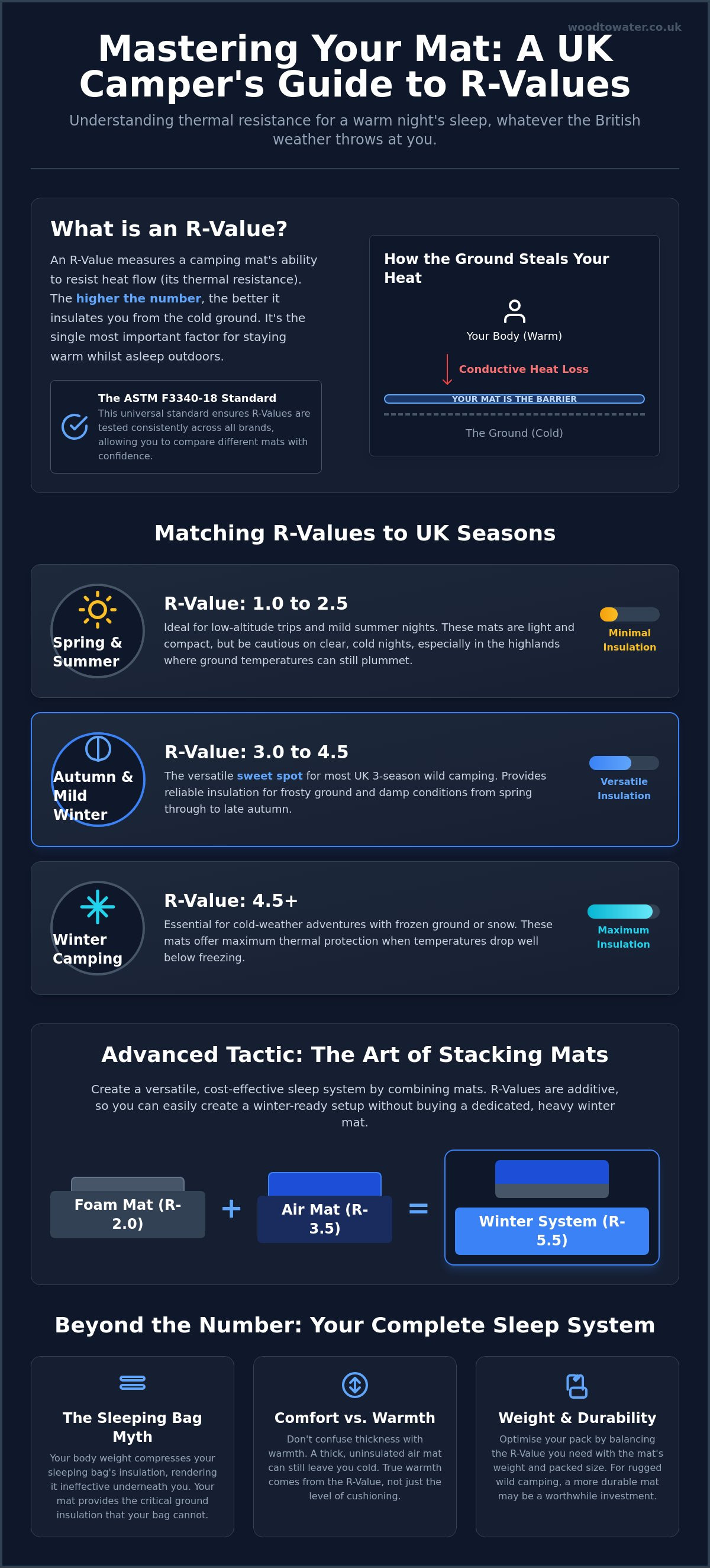
The R-value scale is a linear measurement. A mat with an R-value of 4.0 provides exactly twice the thermal resistance of a mat rated at 2.0. When you are browsing gear and wondering whats is r ratings on camping mats, it helps to think of the scale as a progression from basic padding to extreme survival equipment. In the UK, we rarely need the R7.0+ ratings designed for polar expeditions, but getting stuck with an R1.5 mat in the middle of a damp Pennine autumn is a recipe for a miserable night. Understanding whats is r ratings on camping mats is vital for avoiding the weight-to-warmth trap. Ultralight hikers often sacrifice insulation to save a few grams, only to find they burn more calories shivering than they saved by carrying a lighter pack.
Spring and Summer (R-Value 1.0 to 2.5)
During a genuine heatwave in the South of England, a simple R1.0 mat is often enough. These are typically uninsulated air mats that pack down to the size of a small water bottle. They are brilliant for summer festivals or low-altitude valley camping where the ground remains relatively warm. Be careful, though. A clear night in the Scottish Highlands can see ground temperatures plummet even in July. For those more exposed trips, we recommend at least R2.0 to ensure you aren't woken by the creeping chill of the earth.
Autumn and Mild Winter (R-Value 3.0 to 4.5)
For most year-round UK wild campers, this range is the absolute sweet spot. This is where you will find reliable self-inflating mats that use a clever mix of foam and air. These provide excellent stability and enough insulation for a frosty October night in the Peak District. Brands like 3FULGear offer fantastic options for 3-season setups that balance durability with weight. It is important to remember how your sleep system influences thermal performance as a whole; if your mat is too thin, even the most expensive down sleeping bag will fail to keep you warm.
Extreme Cold and Snow (R-Value 5.0+)
When you are heading for winter summits in Snowdonia or the Cairngorms, you need to step up to R5.0 or higher. At this level, mats often feature internal reflective Mylar layers to bounce your body heat back towards you. Sleeping on frozen ground or snow requires serious thermal resistance. Anything less than R5.0 in these conditions risks your safety, not just your comfort. If you are planning a trip into the hills this weekend, take a look at our curated range of 2-man tents to find the perfect shelter for your new sleep system.
Beyond the Number: How Your Sleep System Influences Thermal Performance
A high-spec mat is an investment in your safety, but it doesn't work in isolation. When you're trying to figure out exactly whats is r ratings on camping mats, remember that your own body is the most variable part of the equation. Your physical size and metabolism play a huge role in how warm you'll feel. Smaller individuals or those with lower metabolic rates often find they are "cold sleepers" who require a higher R-value than the average person to stay comfortable. If you've ever woken up shivering while your companion slept soundly on the same gear, your personal "sleep temperature" is likely the culprit. Choosing a mat with a slightly higher rating than the seasonal minimum is a smart way to compensate for this.
The UK environment adds another layer of complexity. Damp peat and waterlogged soil are notorious heat sinks. Water conducts heat away from the body much faster than dry air; therefore, a campsite in a boggy valley will feel significantly colder than a dry, grassy ridge at the same temperature. Whilst tent floors and footprints offer a small amount of extra protection, their R-value is negligible. They primarily serve to keep your gear clean and dry, which is essential because a damp mat or sleeping bag will lose its ability to insulate almost immediately. Understanding whats is r ratings on camping mats within this damp context helps you prepare for the reality of the British hills.
The Sleeping Bag Connection
There is a common misconception that a thick sleeping bag can make up for a poor mat. In reality, the down or synthetic fill underneath you is compressed by your body weight, which squeezes out the air pockets that provide warmth. This creates "dead spots" where only the mat is providing insulation. A high-R mat is essential because it supports the sleeping bag by preventing heat from escaping through these compressed areas. For those pursuing an ultralight setup with TOAKS Titanium Cookware and minimal packs, balancing the weight of a warmer mat against a lighter sleeping bag is a classic strategy. You can find more technical details on how these ratings are determined by checking the ASTM F3340-18 R-Value Standard, which provides the foundation for modern gear testing.
Hammock Camping and R-Values
If you prefer sleeping amongst the trees in a DD Frontline Hammock, the rules change slightly. Because you are suspended, you are dealing with convection (moving air) rather than conduction (solid ground). A mat placed inside a hammock can still provide vital insulation, but it often feels different because it has to wrap around your body. Many enthusiasts choose integrated insulation from Onewind Outdoors, such as underquilts, which hang below the hammock to prevent the air from stealing your heat. However, a reliable inflatable mat remains a versatile backup for those times you're forced to "go to ground" when no suitable trees are available.
Advanced Insulation Tactics: Stacking Mats and Practical Trail Tips
If you find yourself heading out in conditions colder than your current gear allows, don't rush to buy a whole new setup. One of the most effective ways to stay warm is through "stacking". The math here is beautifully simple because R-values are additive. If you have a lightweight summer mat with an R-value of 2.0 and you place it on top of a closed-cell foam mat with an R-value of 1.5, you have created a combined system of R3.5. When people ask whats is r ratings on camping mats, they often overlook this modular potential. It's the secret to a comfortable night without carrying a heavy, dedicated winter pad for every single trip.
Most experts recommend placing the closed-cell foam (CCF) mat on the bottom. This acts as a protective barrier against sharp rocks or thorns, whilst the inflatable mat on top provides the comfort and captures your body heat. However, if your inflatable mat is completely uninsulated, putting the CCF on top can sometimes feel warmer against your skin. For extra warmth at the foot of your bed, try sliding your empty rucksack or spare warm clothing under your mat. It's a classic trail hack that prevents heat loss through your heels and calves. You can find everything you need to build a complete sleep system in our curated collection.
The CCF Strategy for UK Bushcraft
In the rugged environments of the UK, a CCF mat is the ultimate insurance policy. They are virtually indestructible; you can sit on them by the fire, use them as a kneeling pad whilst processing wood, or even use them as a splint in an emergency. They don't pop, and they don't absorb water. If you are pairing this with rugged gear from Bushcraft Essentials, you have a setup that can handle the grit and grime of a British winter. Using a CCF mat as a base layer also protects your more expensive inflatable mat from the hidden flints and thorns common in UK woodlands.
Maintenance: Keeping Your R-Value Intact
To keep your mat performing at its rated level, you must manage moisture. Blowing into an air mat with your mouth introduces warm, damp air. Over time, this moisture can condense into water droplets or even grow mould, both of which degrade the internal insulation and lower the effective R-value. Using a pump sack or a dedicated electronic pump from Flextail Gear prevents this issue entirely. When you get home, store your mat unrolled with the valve open. This preserves the loft of any internal foam or synthetic fibres, ensuring that next time you head out, your mat is ready to resist the cold as efficiently as the day you bought it.
Finding the Right Balance: Weight, Comfort, and Warmth for Your Next Trek
For the average UK hiker, aiming for an R-value between 3.0 and 4.0 is the most sensible choice. This range covers you for almost everything from the first buds of spring through to the crisp mornings of late autumn. It is the "Goldilocks" zone where you aren't lugging unnecessary weight in August, but you won't be left shivering during a surprise frost in May. When you finally grasp whats is r ratings on camping mats, you realise that this specific range provides the most versatility for our unpredictable British climate. It allows you to move fast without sacrificing the recovery that only a warm night's sleep can provide.
Choosing between a mummy-shaped and a rectangular mat is often a battle between weight and comfort. Mummy shapes shave off grams by tapering at the feet, which is brilliant for backpackers but can be frustrating for active sleepers who find their legs sliding onto the cold tent floor. Rectangular mats offer more room to sprawl but naturally take up more space in your pack. It is also vital to remember that thickness doesn't always equal warmth. A 10cm air mat with no internal insulation might only have an R-value of 1.5; conversely, a thinner 5cm mat packed with reflective technology could reach R5.0. Always prioritise the rating over the physical depth of the pad before buying your next mat from Wood To Water Outdoors.
Weight vs. Warmth: The Backpacker’s Dilemma
For those obsessed with their base weight, the "half-mat" trick is a classic strategy. You carry a torso-length mat to protect your vital organs and use your empty rucksack or spare clothing to insulate your legs. This significantly reduces bulk whilst keeping your core warm. However, for most of us, the extra few hundred grams for a full-length, high-R mat is a price worth paying for a restorative night's sleep. To balance bulk and thermal efficiency, you must prioritise the insulation of your core whilst ensuring your chosen mat fits comfortably within your shelter. A warm core is the secret to a successful multi-day trek.
Your Next Adventure Starts Here
Before you head out on your next expedition, take a moment to verify your current gear against the ASTM standard. If your mat is an older model with no clear rating, it might be time for an upgrade to ensure your safety in the hills. A solid sleep system is the foundation of any successful trip. Once you've sorted your insulation, make sure the rest of your kit is up to the task. Whether you are looking for ultralight 1-man tents for solo missions or more spacious 2-man tents for you and a companion, we have personally vetted every piece of gear to ensure it stands up to the rigours of the British weather. Don't forget to browse our Camping Gas Stoves to complete your setup. There is nothing quite like a hot brew and a warm bed after a long day on the trail.
Master Your Sleep System for Every UK Season
Understanding exactly whats is r ratings on camping mats is the difference between a restless, shivering night and waking up refreshed for the trail. Your mat is the foundation of a modular system; using the stacking method with a closed-cell foam pad can save you both money and pack weight whilst keeping you warm in the hills. By matching the ASTM standard to the specific demands of the British weather, you can pitch up with total confidence regardless of the forecast.
We've hand-selected every item in our inventory to ensure it meets the rugged standards required for wild camping in the UK. Our team provides expert UK bushcraft advice to help you build a kit that is both reliable and efficient. Explore our curated range of high-performance sleeping mats and camping gear today to find the perfect fit for your next trek. Plus, you can take advantage of free UK delivery on orders over £70. Don't let the cold ground steal your heat; get out there and enjoy the spectacular British landscape in comfort.
Frequently Asked Questions
What R-value do I need for camping in the UK?
For the majority of UK trips between spring and autumn, an R-value of 3 to 4 is the ideal choice. If you are only camping in the lowlands during a peak summer heatwave, a rating of 1 to 2 will suffice. However, for winter expeditions or sleeping on frozen ground in the Highlands, you should look for a mat with a rating of 5 or higher to stay safe.
Is a higher R-value always better for camping?
A higher R-value provides more warmth, but it isn't always the best choice for every hiker. Mats with high ratings often weigh more and take up more space in your rucksack. If you are camping in mild conditions, a winter-grade mat might feel unnecessarily bulky and could even make you feel uncomfortably warm. It's best to match the rating to the expected ground temperature.
Can I use a summer mat in winter by stacking it?
You can definitely use a summer mat in winter by stacking it with another pad. Because R-values are additive, placing a summer air mat with a rating of 2.0 on top of a closed-cell foam mat rated at 1.5 gives you a combined R-value of 3.5. This modular approach is a brilliant way to stay warm without needing to buy a separate, expensive winter mat.
Do R-values apply to hammocks as well as tents?
R-values apply to the mat itself, but they behave differently when you are suspended in a hammock. Whilst a mat provides vital insulation against the air moving beneath you, it can be difficult to keep in place. Many hammock campers prefer underquilts, but a mat remains a reliable option if you need a versatile setup that works both in the trees and on the ground.
Does the thickness of a sleeping mat affect its R-value?
Thickness is not a reliable indicator of warmth because the internal materials are what actually resist heat flow. When people ask whats is r ratings on camping mats, they often assume a bouncier mat is warmer, but a thin pad with reflective layers can easily outperform a thick, uninsulated air mattress. Always prioritise the tested ASTM rating over the physical depth of the mat.
What is the difference between ASTM and the old R-value ratings?
The ASTM F3340-18 standard introduced a universal testing method that ensures all brands measure warmth in the exact same way. Before this standard arrived in 2020, manufacturers used their own internal tests, which meant you couldn't accurately compare a mat from one brand to another. Now, an R3.0 rating means the same level of thermal resistance regardless of who made the gear.
How do I know if my sleeping mat has an ASTM rating?
You can usually find the ASTM F3340-18 logo or a specific mention of the standard on the product packaging or the manufacturer's website. If you are looking at older gear and wondering whats is r ratings on camping mats you already own, it's likely they were tested using older, less consistent methods. Most reputable brands have used the standardised ASTM rating for all products released since 2020.
Can I wash my sleeping mat without damaging the R-value?
You can wash the exterior of your mat with a damp cloth and mild soap without affecting its R-value. It's vital that you never machine wash or submerge an inflatable mat, as water getting inside the valves can damage the internal insulation and cause mould. Always ensure the mat is completely dry before you roll it up for storage to preserve its thermal integrity.
