

Essential Wild Camping Equipment: A Professional UK Guide
What if the heaviest part of your next wild camping trip isn't the rucksack on your back, but the nagging worry that you've packed the wrong gear for a sudden downpour or a freezing night on a remote moor? It's a common anxiety for anyone heading off-grid. We've all experienced that restless night shivering in a damp bag or the physical toll of an overstuffed pack on a long ascent. We believe that picking the right wild camping equipment shouldn't feel like a gamble against the British weather.
You're likely looking for a way to balance durability with a low trail weight whilst staying on the right side of local land laws. This guide is designed to help you master the art of off-grid adventure with an expert-curated selection of the most reliable gear for our unique wilderness. We'll provide a definitive kit checklist and break down the pros and cons of different sleep systems. We also clarify the latest regulations; from designated zones to permit requirements. You'll discover exactly how to build a versatile kit that keeps you warm, dry, and ready for anything!
Key Takeaways
- Balance weight and reliability by prioritising the "Big Three" to ensure you're prepared for unpredictable British conditions.
- Choose the right shelter for your environment by comparing the specific benefits of hammocks, tents, and bivvies.
- Optimise your pack with high-performance wild camping equipment that focuses on speed and efficiency for trail cooking.
- Protect your comfort and safety with essential accessories like reliable backup lighting and high-quality gaiters to stay dry.
- Plan a responsible expedition by mastering packing strategies and "Leave No Trace" ethics to protect the wilderness.
Understanding the Wild Camping Kit Philosophy: Weight vs Reliability
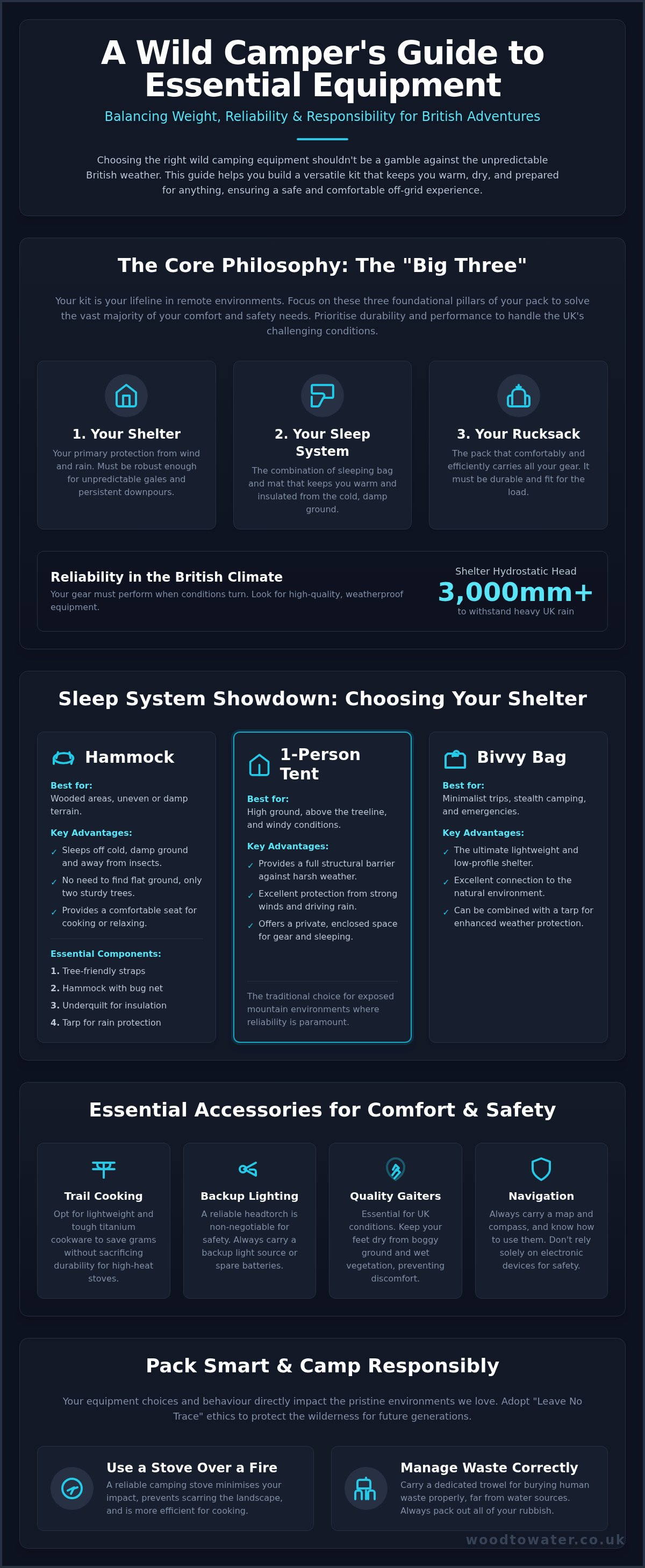
Wild camping equipment isn't just standard holiday gear; it's a curated collection of tools designed for total self-sufficiency in remote environments. When you're miles from the nearest road, your kit becomes your lifeline. We focus on the "Big Three" as the foundation of every pack: your shelter, your sleep system, and the rucksack that carries it all. Get these right, and you've solved the vast majority of your comfort and safety needs. It's about building a modular system that adapts to your environment rather than just carrying a collection of random items.
In the UK, we often prioritise durability over raw weight-saving. A featherlight tent is useless if it collapses in a gale or leaks during a persistent Scottish drizzle. Your gear must also reflect Leave No Trace (LNT) principles. Choosing a reliable stove over building a fire, or using a dedicated trowel to manage waste, ensures we leave the fells exactly as we found them. This philosophy treats the wilderness with respect whilst ensuring your own safety and comfort remain uncompromised.
The Ultralight Debate: When to Save Grams
Saving weight is addictive, but it's about being smart, not just minimal. Beginners often overpack heavy cotton clothing or massive "just in case" tools that never leave the bag. Instead, focus on where weight reduction actually improves your experience without sacrificing function. Switching to TOAKS Titanium Cookware is a classic move; it's incredibly light but tough enough to handle high-heat stoves. The goal is a balance between comfort and carrying capacity. You want a pack that feels agile on steep ascents but still contains the essentials for a warm, restful night.
Reliability in the British Climate
Our weather is famously unpredictable, which puts unique demands on wild camping equipment. High-quality shelters need a solid hydrostatic head rating; usually 3,000mm or higher to withstand heavy UK rain. It's not just about staying dry from the outside, though. You need "active" gear that manages moisture whilst you move, preventing condensation from building up inside your layers. Reliability is the quiet confidence that your equipment will perform exactly as expected when the mist rolls in and the temperature drops on a remote fell. Don't settle for gear that only works in the sunshine; choose kit that thrives when the conditions turn sour.
The Sleep System: Choosing Between Hammocks, Tents, and Bivvies
Your choice of shelter defines your entire experience in the wilderness. British terrain is diverse; you might find yourself amongst dense ancient woodlands one night and on a windswept, rocky ridge the next. Each environment demands a different approach to your wild camping equipment. Tents offer a traditional sanctuary against the wind, whilst bivvies provide the ultimate low-profile "stealth" experience. However, for many UK enthusiasts, the versatility of camping tarps combined with a hammock or bivvy is the gold standard for weight-saving and connection to nature.
Before you commit to a system, consider the temperature. UK nights are notoriously damp, which can make a 5°C night feel much colder than the numbers suggest. Always match your sleeping bag's "comfort" rating, not its "extreme" rating, to the expected lows of the fells. A modular approach allows you to swap components based on the season, ensuring you aren't carrying unnecessary bulk during a rare summer heatwave or shivering through a frost in late October.
The Hammock Advantage for Bushcraft
In wooded areas, the DD Frontline Hammock is a genuine game-changer. It solves the eternal problem of finding flat, dry ground in a British forest. By sleeping off the ground, you avoid damp soil and crawling insects; you also gain a comfortable seat for evening cooking. Systems from Onewind Outdoors are particularly popular for their modularity, allowing you to add or remove layers as needed. A complete setup typically includes:
- Tree-friendly suspension straps
- A breathable hammock with an integrated bug net
- An underquilt to prevent heat loss from below
- A lightweight tarp for rain protection
Tents and Bivvies for High Ground
When you move above the tree line, trees disappear and the wind picks up. This is where 1-man tents shine. They provide a structural barrier against the elements and a mental "safe space" when the weather turns. If you prefer to keep your footprint as small as possible, a bivvy bag is the lightest option available. Bivvies allow you to tuck into small depressions in the land that would be far too tight for a tent. This stealthy approach is perfect for quick overnight stays where you want to remain unnoticed and leave no trace behind. If you're planning a solo expedition, you might want to explore our curated hammock and shelter range to find your perfect fit.
Trail Cooking and Hydration: Efficiency in the Field
After a long day navigating the fells, your stove becomes the most vital piece of wild camping equipment in your pack. It's the difference between a morale-boosting hot meal and a cold, miserable night! In the UK, we generally choose between three stove types: gas canisters, multi-fuel systems, or wood-burning stoves. Gas is the most popular for its simplicity and instant heat. Multi-fuel stoves are rugged workhorses for winter expeditions, whilst wood-burning options like the BE bushbox appeal to those who enjoy the ritual of gathering fuel from their surroundings.
Efficiency is the goal here. You want gear that works quickly so you can focus on recovery and rest. This is especially true in the British climate, where a sudden drop in temperature makes a hot drink a safety priority rather than just a luxury. By choosing modular, high-performance components, you can significantly reduce your pack weight without compromising your ability to cook a satisfying meal in the middle of nowhere.
Speed vs Versatility: Jetboil and Beyond
If you want coffee or a hot meal in under three minutes, Jetboil is the undisputed king. Their integrated heat exchangers trap energy that traditional pans lose to the wind. The Jetboil Trailcook 1.2L is particularly effective for fast-packing; it's a self-contained system that stores its own fuel and burner. For hikers looking for great value, Fire-Maple Gear provides excellent performance in a more traditional format. To keep efficiency high in breezy weather, always look for stoves with integrated wind blocks or carry a separate folding shield to protect your flame.
Hydration and Nutrition Strategies
Nutrition is about recovery. You need a high calorie-to-weight ratio to fuel the next day's ascent. We've found that 5 Minutes to Delhi Ready Meals are perfect for this; they're packed with flavour and energy but take up minimal space. Pair these with TOAKS Titanium pots for the ultimate lightweight kitchen. Titanium is the minimalist's dream because it's virtually indestructible and weighs next to nothing! Regarding hydration, don't break your back carrying five litres of water. Use a reliable filter to tap into the many streams and tarns found across our national parks. Just ensure you filter everything to avoid unwanted stomach issues far from home.
Essential Accessories: Navigation, Lighting, and Safety
What's in the pockets of your rucksack is often just as critical as the shelter on your back. Small oversights in your wild camping equipment can quickly escalate into safety issues if the mist descends or your electronics fail. Whilst a map and compass are your primary tools, modern accessories provide the redundancy needed for a stress-free night. A secondary camping torch is non-negotiable; don't rely solely on a single headlamp that might break or run out of juice when you're scouting for a pitch in the dark.
Comfort in the British wilderness usually starts with your feet. Wet socks lead to blisters and cold, so using Origin Outdoors Drytogo Gaiters is a smart way to bridge the gap between your boots and trousers when trekking through peat bogs. Beyond clothing, your camping accessories should include a bespoke Repair and First Aid kit. This isn't just about plasters; it's about having the ten-mil tape to fix a torn tarp or a spare washer for your stove. Preparation is the hallmark of a professional camper.
Power Management on Long Treks
Modern wild campers rely on GPS and headlamps, making power management a core skill. The Petzl Core 2 Rechargeable battery has changed the game by offering a high-capacity, USB-rechargeable solution that fits standard headlamps. This move towards USB-standard gear means you only need one power bank to keep everything running. To preserve life in cold weather, keep your batteries and phone tucked into an internal jacket pocket. Cold temperatures drain lithium cells rapidly; your body heat is the best way to keep them at peak performance.
Essential Small Kit Items
Organisation is key to efficiency. Use small dry bags to colour-code your kit, so you aren't rummaging for a lighter in a downpour. For mat inflation and area lighting, Flextail Gear offers ultralight, multi-use pumps that save your breath at high altitudes. Don't forget a reliable fire starter from the Bushcraft Essentials range. Even if you plan to use a gas stove, a backup spark is a vital safety layer. Refining your wild camping equipment is a continuous process of trial and error; you can find our curated list of camping accessories to help you prepare for your next big trip.
Organising Your Pack for a Sustainable Expedition
The final stage of your preparation involves turning a pile of wild camping equipment into a balanced, functional rucksack. Packing is an art form that directly impacts your physical comfort on the trail. A poorly balanced bag pulls at your shoulders and throws you off-balance during tricky stream crossings or steep scrambles. By following a logical system, you ensure that the heaviest items sit close to your centre of gravity, making the miles feel much shorter.
Sustainability is just as important as stability. The "Leave No Trace" ethos is the foundation of the UK wild camping community. It's about more than just picking up litter; it's about choosing a campsite that minimises environmental impact. Look for durable surfaces like rock, gravel, or dry grass. Avoid camping on fragile vegetation or too close to water sources. Your goal is to leave the fells exactly as you found them, ensuring these wild spaces remain open and beautiful for everyone.
The Art of Efficient Packing
Success starts at the bottom of your bag. Place your lightest, bulkiest items there, such as your sleeping bag and spare clothing. Your heaviest gear, including your stove, fuel, and water, should be placed in the centre of the pack, as close to your back as possible. Medium-weight items like your shelter can go towards the front. Try to keep the interior of your pack organised so you don't have to strap everything to the outside; external attachments snag on branches and can destabilise your load. Once you're finished, perform the "shake test" by lifting the bag and giving it a firm jiggle; a properly packed bag should be silent and feel like a single, solid unit rather than a collection of shifting parts.
Respecting the Wild: The UK Code
Legal realities vary across the UK, so always do your homework before setting off. In Scotland, the Land Reform Act 2003 and the Scottish Outdoor Access Code provide a statutory right to camp responsibly on most unenclosed land. In England and Wales, you generally need landowner permission, though specific designated zones in Dartmoor offer a rare legal exception. To keep your impact low, consider using a Kelly Kettle for boiling water. It's an incredibly efficient tool that contains its heat, protecting the ground from scorch marks. Before you head out, run through this final checklist of frequently forgotten essentials:
- A lightweight trowel and waste bags for responsible sanitation
- Spare batteries or a power bank for your navigation tools
- A small whistle for emergency signalling
- A waterproof bag for carrying out all your rubbish
Ready to kit out? Explore our full Wild Camping Collection for expert-approved gear designed for the British wilderness.
Gear Up for Your Next Off-Grid Adventure
Mastering the British wilderness starts with a shift in mindset. It's about moving from "just surviving" to truly thriving in remote environments. We've explored how a modular sleep system and efficient cooking tools can transform your experience across our national parks and uplands. By choosing reliable wild camping equipment and perfecting your pack organisation, you gain the freedom to explore safely and sustainably. Remember that respecting the land through "Leave No Trace" principles ensures these beautiful spaces remain open for the next generation of adventurers.
At Wood To Water Outdoors, we don't just sell gear; we use it. Our inventory is carefully vetted for the unique challenges of the UK climate. Whether you're planning a solo bivvy night or a multi-day hammock expedition, we provide expert-vetted gear for UK conditions and friendly, enthusiast-led customer support. Plus, you can enjoy free UK delivery on qualifying orders to help you get trail-ready faster. Explore our curated Wild Camping Equipment at Wood To Water Outdoors and start planning your next escape. The wilderness is calling; make sure you're ready to answer with confidence!
Frequently Asked Questions
Is wild camping legal in the UK?
Legality depends on your specific location. In Scotland, the Land Reform Act 2003 grants a statutory right to camp on most unenclosed land if you follow the Scottish Outdoor Access Code. In England and Wales, you generally need landowner permission. However, the Dartmoor exception allows backpack camping in designated zones under Byelaw 16. Loch Lomond requires a £4.50 permit between March and September. Always check local maps to avoid civil trespass and potential fines.
What is the most essential piece of wild camping equipment?
Your shelter system is arguably the most essential piece of wild camping equipment because it provides your primary defence against the elements. Whether you choose a tent, a bivvy, or a hammock, it must be reliable enough to handle sudden UK weather shifts. We recommend focusing on gear with a high hydrostatic head rating or a modular setup that includes a quality tarp. This foundation ensures you stay dry and safe throughout your expedition.
How much should a wild camping pack weigh?
A well-organised wild camping pack should ideally weigh between 10kg and 15kg for a multi-day trip. Beginners often overpack, but you can significantly reduce this by choosing ultralight materials. Using TOAKS Titanium Cookware and a minimalist sleep system helps keep the weight manageable on long ascents. Aim for a total weight that doesn't exceed 20% of your body mass to ensure you remain agile and comfortable whilst navigating difficult terrain.
Can I go wild camping in a hammock in the UK?
Yes, hammock camping is a fantastic option in the UK, particularly in the many wooded areas of our national parks. Using a DD Frontline Hammock allows you to sleep off the damp ground and stay away from crawling insects. It's often easier to find two suitable trees than a perfectly flat, dry patch of ground for a tent. Just remember to use tree-friendly straps and a quality tarp to stay protected from the rain.
What do I do about going to the toilet whilst wild camping?
Responsible waste management is a core part of the "Leave No Trace" ethos. You should carry a lightweight trowel to dig a hole roughly 15cm to 20cm deep, ensuring you are at least 30 metres away from any water sources or paths. Always pack out your toilet paper and sanitary products in a sealed bag. This behaviour protects the local environment and ensures the wilderness stays clean and healthy for other campers and wildlife.
How do I keep my gear dry in the British rain?
Keeping gear dry requires a multi-layered approach. Use a waterproof rucksack liner combined with individual dry bags for your sleeping bag and electronics. For your person, Origin Outdoors 'Drytogo' Gaiters are excellent for preventing water from seeping into your boots when walking through wet grass or peat bogs. Always store your damp outer layers in a separate compartment or external mesh pocket to prevent moisture from transferring to your dry kit inside.
Is it safe to wild camp alone in the UK?
Wild camping alone in the UK is generally safe if you are well-prepared and share your plans with someone back home. Ensure you carry a reliable light source, such as a headlamp with a Petzl Core 2 battery, and a basic first aid kit. Solo camping offers a unique sense of peace, but it requires more careful navigation and risk assessment. Always check the weather forecast and know your physical limits before heading into remote areas.
What is the best stove for wild camping?
The "best" stove depends on your priorities, but the Jetboil Flash is the industry standard for speed and fuel efficiency. It can boil water in under 100 seconds, which is vital for morale in cold conditions. If you prefer a more traditional bushcraft experience, the BE bushbox is a brilliant wood-burning alternative that uses natural fuel found on the trail. Both options are highly reliable and designed to perform in the challenging British environment.
