

Choosing the Best Camping Torch: A Professional Guide
You're halfway through pitching your tent in the drizzle when your beam suddenly flickers and dies, leaving you fumbling in the pitch black. It's a frustrating scenario we've all faced; relying on a camping torch that just can't handle the damp or the biting cold of a British night. Whether it's a battery failing unexpectedly or a beam that's too dim to light the path, unreliable gear is more than a nuisance; it's a safety risk that can ruin a perfectly good expedition.
We've vetted the latest kit to help you avoid these pitfalls and find gear you can actually trust. This guide reveals how to select a reliable camping torch that balances high-performance brightness with long-lasting battery life and rugged durability. You'll learn why modern hybrid models and IPX8 waterproof ratings are game-changers for the unpredictable outdoors. We'll explore everything from compact 1,100-lumen headlamps to powerful 4,600-lumen handhelds, ensuring you have a lightweight kit that won't clutter your rucksack but will keep you safe in an emergency.
Key Takeaways
- Understand why a dedicated light source is a non-negotiable safety tool rather than relying on a smartphone flash.
- Learn to decode technical specs like lumens and IP ratings to ensure your gear survives the wet British weather.
- Discover how to build a reliable power strategy for your camping torch using rechargeable batteries or versatile hybrid systems.
- Identify whether a headlamp, handheld torch, or lantern is the most practical choice for your specific outdoor needs.
- Gain the confidence to choose gear that has been professionally vetted for real-world reliability and durability.
Why Your Camping Torch is a Critical Safety Tool
Nightfall in the British wilderness is a total experience. Unlike the soft orange glow of a city, the darkness found in our national parks and wild spaces is thick and uncompromising. A reliable camping torch isn't just a convenience for finding your tent zip; it's a fundamental safety tool that dictates how you interact with your environment. While the history of the flashlight shows we've moved far beyond primitive oil lamps, many campers still make the mistake of relying on their smartphone when the sun goes down.
A phone flash is designed for close-up photos, not navigating a rocky descent. It produces a flat wash of light that kills depth perception, making a two-foot drop look like level ground. In contrast, a dedicated camping torch provides a focused beam that creates shadows, allowing you to judge terrain accurately. If things go wrong, a professional torch often includes a dedicated SOS mode. This high-intensity strobe is visible for miles, providing a lifeline when your voice won't carry over the wind.
Lighting for Comfort vs. Survival
There is a significant difference between lighting for a relaxed evening and lighting for a crisis. Ambient light is perfect for inside the tent, but it won't help you find a lost trail in the woods. High-intensity beams are essential for trail finding; they cut through the dark to highlight distant markers or hazards. We view quality lighting as a core part of your bushcraft essentials, as vital as your sleeping bag or shelter. A reliable beam reduces the stress that comes with a late-night camp setup, keeping you calm and focused on the task at hand.
The British Environment Factor
The UK presents unique challenges, particularly the rapid onset of long winter nights. During the colder months, you could find yourself in total darkness as early as 4:00 pm. Mist and heavy rain are common, and they act like a wall against poor-quality lights. Low-lumen beams often reflect off water droplets, creating a "white-out" effect that further obscures your vision. You need a torch with enough throw to punch through the murk. Remember, a water-resistant rating might survive a light drizzle, but a typical British autumn demands something truly waterproof. If your gear fails after a heavy downpour, you aren't just inconvenienced; you're stranded.
Understanding the Technical Specs: Lumens, Beams, and IP Ratings
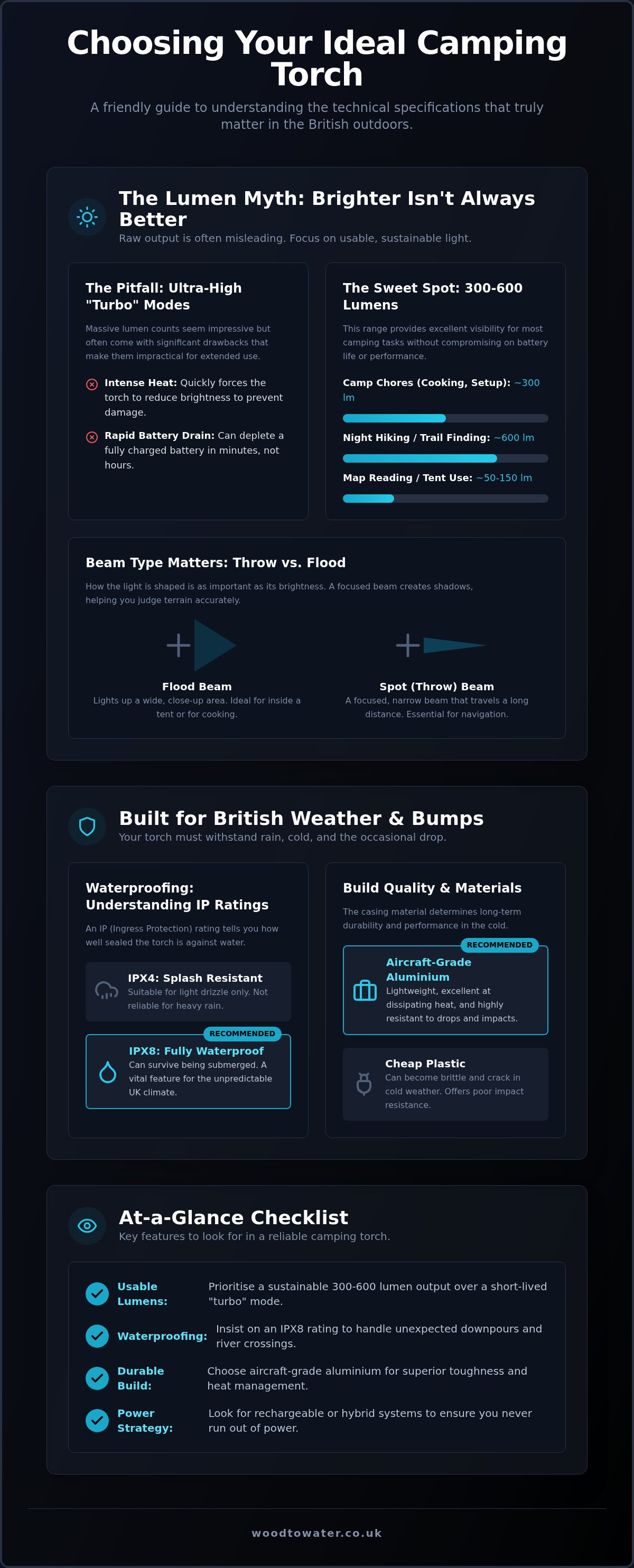
Many brands shout about massive lumen counts to grab your attention. It's easy to be swayed by a camping torch claiming 10,000 lumens for the price of a pub lunch; however, these figures are often misleading or entirely fabricated. Real-world performance is about how that light is managed, not just the raw output. Understanding the Technical Specs is the first step toward building a kit that won't fail when you're miles from the nearest road.
The build quality of your gear matters just as much as the bulb inside. Cheap plastic housings often become brittle and crack in the cold, or shatter if dropped on a rock. We always recommend aircraft-grade aluminium for a professional-grade camping torch. It's lightweight, dissipates heat efficiently, and offers the structural integrity needed for years of hard use. Look for an IK rating too; this measures impact resistance, ensuring the lens won't give up the ghost after a minor tumble.
The Lumen Myth: Why Brighter Isn't Always Better
High-output modes generate intense heat. They often force the torch to throttle down its brightness after just a few minutes to protect the internal circuits. For most tasks, such as cooking on your stove or reading a map, 300 to 600 lumens is the genuine sweet spot. This range provides ample visibility without nuking your battery life in a single evening. Throw distance is equally vital; a 500-lumen spot beam might reach much further into the distance than a 2,000-lumen floodlight that just washes out your immediate surroundings.
Weatherproofing for the UK Climate
The British weather doesn't care about your weekend plans. IP ratings tell you exactly how much moisture your gear can handle. An IPX4 rating protects against splashes, which is fine for a light drizzle. For serious trekking across our wetter national parks, we suggest looking for IPX8. This rating means the torch can survive being submerged in water; a vital feature if you drop it in a stream or get caught in an intense autumn downpour. Don't forget that cold temperatures can sap battery voltage; choosing gear with high-quality seals and insulated compartments helps maintain performance when the frost hits.
If you're looking for high-performance lighting that fits in the palm of your hand, check out our range of Flextail gear for innovative, compact solutions that don't compromise on durability.
Rechargeable vs. Battery Powered: Developing a Power Strategy
Deciding how to fuel your camping torch is a decision that impacts both your wallet and the planet. Disposable alkaline batteries are quickly becoming a relic of the past for serious outdoor enthusiasts. They are expensive to replace over time and often leak, which can corrode the internal terminals and ruin your expensive gear. Rechargeable systems offer a much cleaner, more efficient solution; you can top them up using the same power bank you use for your phone or GPS device. For extended trips, integrating a small solar panel into your setup allows you to harvest energy during the day, ensuring you never start a night on a low charge.
A smart power strategy always includes redundancy. No matter how reliable your primary light is, you should always carry a compact backup source in your rucksack. This isn't just about the battery dying; it's about mechanical failure or accidentally losing your main light in deep heather. Having a small, lightweight secondary torch tucked into your rucksack lid provides the confidence that a single gear failure won't leave you stranded in the dark. We view this dual-light approach as an essential safety protocol for any wild camp or night hike.
The Petzl Core 2 Advantage
One of the most significant innovations for modern campers is the Petzl Core 2 Rechargeable battery. Unlike standard alkaline batteries that slowly dim as they lose voltage, the Core 2 provides consistent brightness throughout its entire burn time. It's easily charged via a standard USB port, making it a simple addition to your camping checklist. This hybrid ecosystem is brilliant because it allows you to swap between the rechargeable pack and standard AAA batteries, offering total flexibility when you're away from a power socket for several days.
Cold Weather Performance
Winter in the UK can be particularly brutal on electronic components. Lithium-ion batteries generally perform much better than alkaline in near-freezing conditions, but they still lose efficiency when the mercury drops. To keep your camping torch running at its best, try keeping spare batteries in an internal jacket pocket where your body heat can keep them at an optimal temperature. Cold-soaked batteries can often show a "low" signal even when they have plenty of energy left. A hybrid power source is the safest choice for multi-day treks because it allows you to utilise rechargeable power for daily use whilst keeping a set of lithium disposables as a cold-proof emergency reserve.
Handheld Torches vs. Headlamps vs. Lanterns: Which Do You Need?
Choosing the right form factor is just as critical as the technical specs we discussed earlier. You wouldn't use a screwdriver to hammer a nail; the same logic applies to your camping torch setup. Most seasoned campers eventually build a "lighting ecosystem" that uses different tools for different jobs. Balancing weight and utility is the key here. You want a kit that provides total coverage without making your rucksack feel like it's full of lead.
Lanterns shouldn't be overlooked for the social side of camping. While a headlamp is personal, a lantern provides 360-degree area light that transforms a dark camp into a welcoming space. They are perfect for hanging from a ridge pole or placing on a flat rock while you organise your gear. Combining these three sources ensures you have the right light for every scenario, from high-intensity navigation to a relaxed evening under the stars.
The Case for the Headlamp
A headlamp is arguably the most versatile piece of kit you'll own. It's the reason every hiking checklist should start with a headlamp as the primary light source. When you're managing a Jetboil stove in the dark or tensioning camping tarps against a gale, you need both hands free. Most modern headlamps include a red light mode; this is a lifesaver for preserving your natural night vision and avoiding the cloud of midges that an intense white beam tends to attract.
When to Carry a Handheld Torch
Handhelds still hold the crown for raw power and beam distance. If you're navigating off-trail or searching for dry firewood in a dense thicket, the superior "throw" of a handheld camping torch is unmatched. They feel robust and are often easier to aim precisely than a headlamp. A handheld is also perfect for those final gear checks before you turn in. For instance, it's the best tool to check your DD Frontline Hammock suspension at night, ensuring your knots are secure and your tree huggers haven't slipped an inch.
Ready to light up your next adventure? Browse our professionally curated selection of reliable lighting and bushcraft gear to find the perfect match for your kit bag.
Curating Your Kit with Wood To Water Outdoors
At Wood To Water Outdoors, we don't believe in carrying gear "just in case" if it isn't up to the job. Every camping torch in our inventory has been hand-selected because it meets a strict standard of real-world reliability. We've spent years in the field, so we know that a piece of equipment failing at 2 am isn't just a nuisance; it's a genuine problem. By choosing a specialist retailer, you're tapping into that experience. We've already done the hard work of filtering out the hyperbole to leave you with a curated selection of bushcraft essentials that work as hard as you do.
Lighting shouldn't be an afterthought in your pack. It's a tool that integrates with your entire setup, from how you organise your shelter to how you prepare your evening meal. We prioritise gear that offers versatility without adding unnecessary bulk. Whether you're a seasoned bushcrafter or a casual weekend hiker, the right light provides the confidence to push your boundaries and stay out longer, knowing you can navigate safely back to camp. Our philosophy is simple: we provide the reliable kit, so you can focus on the adventure.
Lighting and the Modern Camp
Modern lighting is becoming more integrated and efficient. Take Flextail gear, for example. They've pioneered multi-functional tools that serve as both high-quality lanterns and air pumps for your sleeping mat. This kind of efficiency is perfect for ultralight outdoor gear enthusiasts who want to shave every possible gram from their rucksack. By selecting brands that prioritise durability and smart design, you can build a cohesive gear system that won't let you down when the weather turns.
Final Checklist for Your Next Purchase
Before you commit to a new camping torch, run through this quick professional checklist to ensure it fits your specific needs:
- Check the IP rating: Ensure it's at least IPX4 for rain resistance, but look for IPX8 for total peace of mind.
- Consider the battery type: Decide if a rechargeable ecosystem fits your travel style or if you need the flexibility of standard batteries.
- Match the lumens to the task: Remember that 300 to 600 lumens is the sweet spot for most camping activities.
- Don't forget the backup: Always carry a secondary light source and a portable power bank for longer expeditions.
Lighting is the bridge between a stressful night and a successful expedition. It's about more than just seeing; it's about the confidence to explore further. Explore our full range of professional camping torches and lighting at Wood To Water Outdoors to find your next essential piece of gear.
Light Your Path with Confidence
Selecting the right gear is about more than just finding the highest lumen count; it's about genuine reliability when the British weather turns. We've explored how understanding IP ratings and beam patterns keeps you safe on the trail, whilst a smart power strategy ensures you're never left in the dark. Whether you prefer a hands-free headlamp for campsite tasks or a powerful handheld camping torch for long-distance navigation, the right choice builds confidence for every expedition. Every piece of kit should earn its place in your rucksack by being both durable and functional.
We are passionate about high-quality bushcraft gear and have personally vetted our entire range for the unpredictable UK climate. If you're ready to upgrade your lighting, shop our curated collection of professional camping torches today. We offer free UK returns on eligible orders, so you can find the perfect fit for your kit with total peace of mind. Investing in quality lighting is an investment in your safety and comfort in the wild. We can't wait to see where your next adventure takes you!
Frequently Asked Questions
What is the best lumen count for a camping torch?
For most general camping tasks like cooking or navigating a clear trail, 300 to 600 lumens is the ideal range. It provides enough light without draining your battery too quickly. If you're involved in search and rescue or need to identify distant objects, high-performance handheld models can reach outputs between 2,500 and 4,600 lumens. Always remember that extremely high brightness generates significant heat and can cause the device to throttle its output.
Are rechargeable camping torches better than battery-powered ones?
Rechargeable torches are generally better for regular use because they are more cost-effective and environmentally friendly over time. However, battery-powered options remain a reliable choice for emergency kits or remote areas where you can't access a power source. We recommend a hybrid approach. Using a system like the Petzl Core 2 battery allows you to enjoy rechargeable convenience whilst keeping standard AAA batteries as a backup for long expeditions.
What does an IPX rating mean for a torch?
An IPX rating classifies the degree of protection a device has against water and dust. For a camping torch used in the UK, look for at least IPX4, which protects against splashes and light rain. If you're heading into more extreme conditions or crossing water, an IPX8 rating is superior. This indicates the device can survive continuous immersion in water, ensuring it won't fail if dropped into a stream or soaked in a heavy downpour.
Why do I need a red light mode on my headlamp?
Red light mode is essential for two main reasons. First, it helps preserve your natural night vision, making it easier to see your surroundings when you turn the light off. This is perfect for stargazing or checking a map without blinding yourself. Second, red light is much less attractive to insects like midges and moths. Using this mode during a humid British evening helps keep the clouds of bugs away from your face whilst you work.
How long should a camping torch battery last?
Battery life varies significantly based on the brightness setting you choose. A high-quality torch should offer several nights of use on a medium setting. Some models feature a "moonlight" mode that can last up to 120 hours on a single charge. Always check the runtime for the specific lumen level you'll use most often. We suggest carrying a power bank to top up your gear during multi-day treks if you're using high-output modes frequently.
Can I use my smartphone as a camping torch?
Whilst a smartphone flash works in a pinch at home, relying on it in the wild is a dangerous mistake. Phones produce a very wide, flat beam that lacks depth perception and throw distance. Most importantly, using your phone as a camping torch drains the battery you might need for emergency calls or GPS navigation. A dedicated torch is far more durable, waterproof, and designed to handle the rigours of the outdoor environment safely.
What is the difference between a spot beam and a flood beam?
A spot beam is highly focused and designed to reach long distances, making it perfect for navigating trails or searching for landmarks. A flood beam provides a wide wash of light that illuminates your immediate surroundings, which is ideal for cooking, reading, or setting up your tent. Many modern torches allow you to toggle between both or use a mixed beam, providing the versatility needed for different tasks throughout the night.
How do I maintain my torch to ensure it lasts for years?
Proper maintenance ensures your gear lasts for years. Regularly wipe down the lens and body with a damp cloth to remove grit and salt. If your torch uses replaceable batteries, remove them during long periods of storage to prevent leaks and corrosion. Check the O-rings and seals occasionally; applying a tiny amount of silicone grease helps maintain their water resistance. Always ensure the charging port is clear of debris before plugging it in.
