

Best Outdoor Dry Bags: Keep Your Gear Dry and Protected
There is nothing quite like the sinking feeling of reaching the end of a rain-soaked trek in the Highlands only to discover your down sleeping bag is a sodden, useless mess. It's the kind of mistake you only make once; after that, you realise that reliable outdoor dry bags are the most important bit of kit in your rucksack. We've all been there, staring at a jumble of damp clothes and wondering if that "waterproof" rucksack cover was ever going to hold up against a proper British downpour.
We believe that a perfectly organised, waterproof packing system is the secret to a successful trip. This guide will help you master the art of gear protection so you never have to worry about wet electronics or ruined insulation again. We'll walk you through choosing the right materials, understanding whether a 5L, 10L, or 20L bag fits your specific needs, and how to pack your gear for total confidence on the trail. From protecting your titanium cookware to keeping your hammock underquilt bone-dry, we've vetted the best solutions for the unpredictable UK climate.
Key Takeaways
- Learn why the unpredictable British climate makes a reliable roll-top seal a non-negotiable part of your wild camping kit list.
- Understand the difference between IPX4 and IPX7 ratings so you can choose the right level of protection for your electronics and down insulation.
- Find the perfect fit for your gear by learning how to size outdoor dry bags for everything from compact first aid kits to bulky sleeping bags.
- Discover professional packing secrets like the "burping" technique and colour-coding to create a perfectly organised and balanced rucksack.
- Get expert advice on selecting materials, whether you need ultralight protection for a DD Frontline Hammock or rugged durability for your titanium cookware.
Why Outdoor Dry Bags are Essential for British Wild Camping
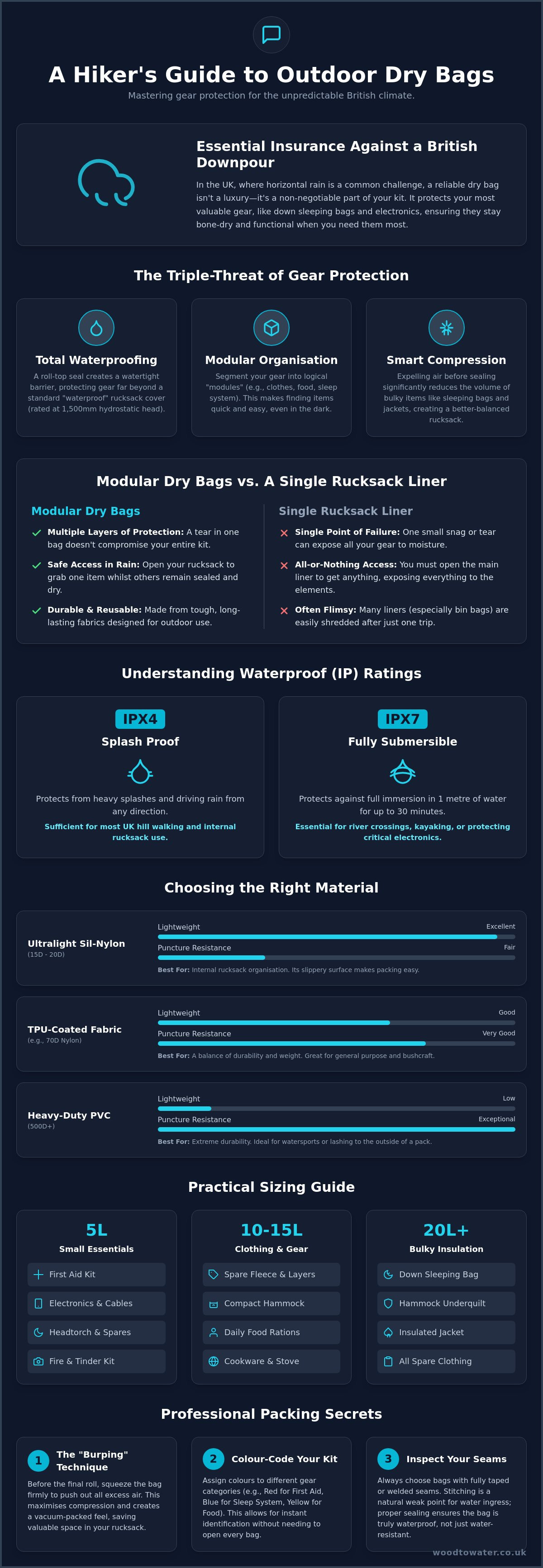
A dry bag is essentially a flexible, waterproof container that uses a roll-top closure to create a watertight seal. Whilst many people associate them with kayaking or canoeing, they've become the fundamental organising principle for any serious hill walker or wild camper. In the UK, where horizontal rain is a frequent companion, outdoor dry bags aren't just a luxury; they're a non-negotiable insurance policy against a miserable night in the wilderness. British standards consider a fabric "waterproof" with a hydrostatic head of 1,500mm, but a quality dry bag offers far more protection than a simple rain jacket ever could.
Beyond the obvious benefit of keeping moisture out, these bags are master organisers. They allow you to segment your gear into logical "modules," which makes finding your headtorch or spare socks in the dark a breeze. Because they are airtight, they also act as compression sacks. By squashing out excess air before sealing the roll-top, you can significantly reduce the volume of bulky items like spare fleeces or down jackets. This creates a slimmer pack profile and a better-balanced rucksack, which your back will certainly thank you for after ten miles on the trail. Most importantly, they protect your most expensive investments. High-quality down sleeping bags lose almost all their warmth when wet, and electronics can fail instantly in a damp environment. A dedicated dry bag ensures these essentials stay bone-dry regardless of the conditions outside. Similarly, if you are looking to protect and upgrade your high-performance racket sports kit, click here to explore the yoSports range.
Dry Bags vs. Rucksack Liners
Many hikers start out using a single large rucksack liner, but this creates a "single point of failure" risk. If that one bag gets a snag or a small tear, your entire kit is suddenly vulnerable. Modular outdoor dry bags offer far better protection during kit transitions. When you need to open your pack in a downpour to grab a map or a snack, only the top of the rucksack is exposed whilst your sleeping bag and dry clothes remain safely sealed in their own containers. They're also vastly more durable than the classic plastic bin liner, which usually ends up as shredded waste after just one or two trips.
The Role of Dry Bags in Bushcraft and Tactical Setups
For bushcraft enthusiasts, keeping tinder and fire starters dry is a matter of survival. Stashing your bushcraft essentials in a small, dedicated dry bag ensures you can always get a fire going when you stop for the night. If you're sleeping in a camping hammock, dry bags are vital for keeping your gear off the damp ground. Brands like Onewind Outdoors provide specialised gear that integrates perfectly with hammock systems. In a pinch, a half-inflated dry bag makes a decent makeshift pillow; in a real emergency, they can even be used to carry water back to your camp.
Understanding Materials and Waterproof Ratings
Selecting the right material for your outdoor dry bags depends entirely on where they will spend most of their time. If you are organising gear inside a rucksack, weight is your main enemy. If you are lashing kit to the outside of a pack or a kayak, durability takes the lead. Most bags are rated using the Ingress Protection (IP) system. For hikers, an IPX4 rating is usually sufficient; it handles heavy splashes and rain from any angle. If you anticipate river crossings or total immersion, look for IPX7. This rating ensures your gear stays dry even if submerged in a metre of water for up to thirty minutes.
The fabric itself is only half the story. You must check that the bag has fully taped or welded seams. Without these, water will eventually wick through the stitching, regardless of how waterproof the material claims to be. In a forest-based bushcraft setting, you'll face a constant trade-off between weight and puncture resistance. A feather-light bag might save your knees on a long ascent, but it won't survive a stray spark or a sharp thorn as well as a heavier alternative. It's often worth carrying a slightly heavier bag for your most critical items, like your fire-lighting kit or down insulation.
Lightweight vs. Heavy-Duty Dry Sacks
Ultralight sil-nylon, typically in the 15D to 20D range, is the gold standard for internal rucksack organisation. It's slippery, which makes it easy to slide into tight gaps. For more rugged use, 500D PVC is incredibly tough; it's the stuff of truck tarpaulins and is perfect for external attachment. If you want the best of both worlds, TPU-coated fabrics offer excellent puncture resistance whilst remaining supple and easier to fold than heavy PVC. You can find these durable options amongst our curated bushcraft essentials.
Closure Systems and Features
A roll-top closure is only effective if used correctly. You need at least three tight folds to create a reliable seal; don't be tempted to over-stuff the bag and settle for a single turn. D-rings are a vital feature for securing your bags to the outside of your pack or inside a hammock setup. Using Expert packing techniques will help you decide which gear needs the most accessible placement. Clear viewing windows or a colour-coded system can also save you from rummaging through every bag just to find a spare pair of socks in the fading light.
Sizing Your Dry Bags: A Practical Guide for Every Kit List
Choosing the right size for your outdoor dry bags is just as vital as selecting the right material. A common mistake is buying a bag that is exactly the same volume as your gear, forgetting the "roll-top tax." To achieve a truly watertight seal, you need enough fabric at the top to fold the opening over at least three times. If you over-fill a bag, you'll likely end up with a leaky seal and a bulky, awkward shape that won't sit right in your rucksack. When you get the sizing right, you can use the bag to compress bulky items, squashing out excess air to save precious space in your pack. Before you buy, it is helpful to look at Understanding Materials and Waterproof Ratings to see how different constructions might affect the internal capacity and flexibility of the bag.
Small Bags (1L to 5L): The Electronics and First Aid Centre
Small dry bags are the unsung heroes of a well-organised rucksack. A 1L or 2L bag is the perfect home for your high-value electronics. It's the ideal size for protecting your mobile phone, power banks, and Petzl Core 2 batteries from the damp. Moving up to the 3L to 5L range, you'll find the perfect fit for your fire-lighting kits and medical supplies. We also recommend using a 5L bag to house your TOAKS Titanium Cookware. Not only does this keep moisture away from your stove, but it also prevents any soot or grease from the pot's exterior from marking your spare clothing or sleeping bag. These smaller bags are also brilliant for keeping tent pegs and repair kits separate from the main body of your tent.
Medium to Large Bags (8L to 20L+): Clothing and Sleep Systems
The 8L to 13L range is the "sweet spot" for most wild campers. This size is usually perfect for a standard down sleeping bag or a complete change of dry clothes, including a spare fleece and trousers. If you are carrying larger items like 2-man tents or bulky winter insulation, you'll need to step up to a 20L+ bag. One of our favourite pro-tips is using a large dry bag as a dedicated "wet bag." After a rainy night, you don't want your sodden tarp or flysheet touching your dry gear. Stuffing the wet items into a 20L bag keeps the moisture contained until you can hang them out to dry back at home. For most beginners, we suggest starting with a multi-pack of different sizes; it's the most cost-effective way to build a versatile outdoor dry bags system that adapts to any adventure.
Expert Packing Techniques for a Better Balanced Rucksack
Mastering your pack layout is about more than just fitting everything in; it's about accessibility and stability on the move. We always talk about the "Holy Trinity" of camp comfort: dry socks, dry base layers, and a bone-dry sleeping bag. If these three stay protected, you can recover from almost any weather. Using outdoor dry bags allows you to treat your rucksack like a chest of drawers rather than a bottomless pit. By packing bags vertically rather than stacking them horizontally, you can use side-access zips to grab exactly what you need without exploding your entire kit across a wet trail.
One of the most useful tricks we've picked up over the years is the "Burping" technique. Before you finish the final roll of your dry bag, kneel on it or press it against your chest to force out the excess air. This creates a vacuum-like seal that slims down the profile of bulky items. To take your organisation to the next level, try colour-coding your system. We recommend using red bags for emergency gear and first aid, blue for your sleep system, and green for tools or bushcraft essentials. This visual shorthand saves precious time when you're tired, cold, or racing against a setting sun.
Modular Packing for Hammock Campers
For those of us who prefer life between the trees, outdoor dry bags are essential for managing a modular setup. When using a DD Frontline Hammock, you should always keep it in a separate bag from your tarp. If you've had a wet night, stuffing a sodden tarp in with your hammock is a recipe for a damp bed the next evening. High-loft insulation like underquilts should live in high-compression dry sacks at the bottom of your pack. Once you're at camp, you can even hang smaller dry bags from your hammock's ridge line to keep your torch and phone within arm's reach whilst keeping them off the damp ground.
Maintaining and Caring for Your Dry Bags
A little bit of maintenance goes a long way in ensuring your gear lasts for years. Always shake out any grit, sand, or pine needles after a trip; these small particles act like sandpaper against the waterproof coating. When you get home, store your bags unrolled and open in a cool, dry place. This prevents the internal coatings from becoming tacky or developing mould. For those with extensive kit collections, having a dedicated space like bespoke garden rooms Kent provides the perfect environment for drying and organising gear. If you do suffer a small puncture from a stray thorn, don't bin the bag. A patch of Tenacious Tape on both sides of the tear is a reliable field repair that will keep you waterproof until you get back to civilisation.
Ready to build a more organised kit? Browse our curated range of bushcraft essentials and find the perfect dry bag for your next trip.
Choosing the Right Dry Bag for Your Adventure
Selecting the perfect outdoor dry bags for your kit list is the final step in securing your comfort in the wild. Whilst we've covered the technical side of materials and sizing, the actual choice often comes down to the specific demands of your activity. For those who prefer sleeping amongst the trees, we highly recommend Onewind Outdoors for their specialised hammock protection. Their gear is designed with the modularity needed for forest environments; it ensures your insulation and hammock stay protected even when your tarp is dripping with morning dew.
If you often find yourself setting up camp in fading light, look for bags with transparent panels. These allow for instant kit identification without having to unroll every seal in your rucksack. For maximum space-saving, consider bags with integrated purge valves. These one-way valves allow you to squeeze out every last bit of trapped air after the bag is sealed, providing a tighter, more stable pack than manual "burping" alone. Before you commit to a purchase, run through this final checklist to ensure your gear is up to the task:
- Seam Integrity: Are the seams fully taped or RF-welded to prevent wicking?
- Roll-Top Length: Is there enough spare fabric to achieve at least three full folds?
- Attachment Points: Does the bag have a D-ring or buckle loop for securing it to your pack or ridge line?
- Weight vs Durability: Is the denier rating appropriate for where the bag will be stored?
Our Curated Selection for UK Hikers
The British woodland and mountain environments are notoriously unforgiving on gear. Sharp gorse, abrasive grit, and constant dampness will quickly find the weaknesses in sub-standard equipment. We focus on a curated selection of outdoor dry bags that strike a precise balance between being lightweight enough for long ascents and rugged enough for the reality of wild camping. Unlike big-box retailers that stock generic options, we vet every brand for its reliability in genuine UK conditions. Buying from a UK-based specialist like Wood To Water Outdoors means you get expert support from people who actually use this gear in the same rain-soaked valleys you do.
Ready to Weather the Storm?
There is a unique confidence that comes from knowing your down sleeping bag and spare layers are safe, regardless of how hard the heavens open. Upgrading your packing system is one of the most effective ways to improve your experience on the trail. If you're ready to master your organisation, explore the full range of protection at Wood To Water Outdoors. If you're unsure which combination of sizes or materials best fits your specific rucksack, don't hesitate to contact our team for bespoke kit-list advice. We're always happy to help a fellow enthusiast get it right the first time.
Take Command of the Conditions
You now have the expertise to transform your rucksack from a cluttered risk into a perfectly organised, waterproof system. By mastering the "roll-top tax" and matching the right denier to your environment, you've taken the most important step in protecting your high-end down insulation and electronics. Our family of tactical and outdoor specialists at Wood To Water Outdoors has personally vetted every item in our inventory to ensure it stands up to the unpredictable British climate. We value reliability above all else; that's why we only stock gear we'd trust on our own wild camping trips.
Protect your gear today and browse our curated range of outdoor dry bags. We offer free UK delivery on orders over £80 and provide expert gear reviews from active outdoor enthusiasts who know exactly what it's like to be caught in a Peak District downpour. Don't let the weather dictate your adventure. With the right protection from Wood To Water Outdoors in place, you can head into the hills with total confidence. See you out there.
Frequently Asked Questions
Are outdoor dry bags fully submersible?
Most outdoor dry bags with a roll-top closure are designed for heavy rain and splashes rather than prolonged submersion. Whilst they can handle a brief dip in a river, they aren't meant to be held underwater. If you anticipate swimming with your gear or frequent river crossings, you'll need a bag rated IPX7 or higher. These are specifically tested to survive immersion in one metre of water for up to thirty minutes.
How many dry bags do I need for a 3-day hiking trip?
For a standard three-day trek, we recommend a modular set of four bags. You'll want a large bag for your sleeping bag, a medium one for a full change of clothes, and a small one for electronics and first aid. A fourth bag is useful for keeping your wet tarp or tent separate from your dry kit. This system ensures that even if you open your rucksack in a downpour, your critical gear stays protected.
Can I use a dry bag to compress my sleeping bag?
Yes, dry bags are excellent for compressing bulky items. By using the "burping" technique or choosing a bag with an integrated purge valve, you can force out excess air to save space. Just be careful not to over-compress high-loft down for long periods. Doing so can eventually damage the delicate plumes that provide your warmth at night, so only compress them whilst you are actually on the move.
What is the difference between a dry bag and a dry sack?
The terms are often used interchangeably, but there is usually a difference in durability. A dry bag typically refers to a heavy-duty, abrasion-resistant container made from PVC or thick TPU, designed for external use or rugged environments. A dry sack is generally a lightweight, sil-nylon version meant to live inside your rucksack. For most hikers, a mix of both provides the best balance of weight and reliability.
How do I know if my dry bag is still waterproof?
You can check your bag's integrity using the "balloon test" at home. Simply fill the bag with air, roll the top down tightly at least three times, and submerge it in a bath or sink. If you see any bubbles escaping from the seams or the fabric, the bag has a puncture. Small holes can usually be fixed with a patch of Tenacious Tape on both sides to restore the seal.
Are dry bags worth the extra weight for ultralight hiking?
Absolutely. Whilst ultralight hiking is about saving grams, carrying sodden gear is much heavier than a few 20D sil-nylon outdoor dry bags. A wet down jacket can triple in weight and lose all its insulating properties, which becomes a safety risk in the UK mountains. Lightweight dry sacks provide essential insurance for a negligible weight penalty, ensuring your sleep system stays dry regardless of the weather.
What size dry bag fits a standard 1.2L Jetboil?
A 5L dry bag is the perfect fit for a JetBoil Trailcook 1.2L or a Jetboil Flash. This size allows enough room for the stove unit and a gas canister whilst still leaving plenty of fabric for a secure three-roll seal. Using a dedicated bag for your stove also prevents soot or food residue from marking the rest of your clothing or your sleeping bag inside the rucksack.
Can I wash my dry bags in a washing machine?
We strongly advise against putting dry bags in a washing machine. The mechanical agitation and harsh detergents can delaminate the waterproof coating and ruin the seam tape. Instead, simply wipe the bag down with a damp cloth and some mild, non-detergent soap if it's particularly muddy. Always hang your bags to air-dry completely, unrolled and out of direct sunlight, before storing them away for your next adventure.