

Best Camping Kettles: Top Rated Lightweight Gear for the UK
Is your camping kettle actually a vital piece of kit, or is it just dead weight in your rucksack? Many trekkers assume a standard cooking pot is enough, yet they often find themselves huddled in the wind, watching a slow boil drain their fuel reserves. You've likely been there; shivering on a damp morning while your gear struggles to produce a simple cup of tea. It's a common frustration amongst those who explore the UK's more rugged landscapes.
We're here to help you solve that problem. In this guide, you'll discover how to choose the perfect lightweight, durable, and fuel-efficient kettle for your next British outdoor adventure. We'll look at the expert-vetted options that survive years of hard use, from the rapid boil times of the Jetboil Flash to the ultralight TOAKS titanium range. Whether you need a fuel-free Kelly Kettle for bushcraft or a compact system for wild camping water sterilisation, we've curated the best gear to keep your pack light and your drinks hot. Let's find the right match for your stove and your style of travel.
Key Takeaways
- Learn why a dedicated camping kettle provides superior fuel efficiency and safer precision pouring than a standard cooking pot.
- Compare essential materials; choose hard-anodised aluminium for balanced performance or titanium for the ultimate lightweight rucksack.
- Match your gear to your specific outdoor activity, from rapid integrated systems for hikers to rugged stainless steel for basecamping.
- Understand how to maintain fast boiling times in windy conditions by selecting designs that prioritise thermal efficiency.
- Discover why curated brands like Kelly Kettle and Jetboil are the preferred choice for reliable performance in the British wild.
Why a Dedicated Camping Kettle is Essential for UK Expeditions
Whilst you might think a standard cooking pot is versatile enough for a quick trip, a dedicated camping kettle is a game-changer for efficiency. It isn't just about the tea; it's about managing your resources in the unpredictable British weather. Boiling water in an open-top pot is remarkably inefficient when you're out on the trail. Heat escapes rapidly from the wide surface area, forcing your stove to work harder and consume more gas than necessary. A kettle is designed to concentrate thermal energy, using a narrow spout and a tight-fitting lid to trap steam and accelerate the process.
Precision pouring is another major advantage that is often overlooked. When you're rehydrating a meal in a flimsy pouch or filling a narrow flask, a controlled pour is essential to avoid dangerous spills. Dealing with boiling water in a cramped tent porch or on uneven ground requires gear that prioritises safety. A kettle allows for a steady stream, which is far safer than tipping a wide, heavy pot. Furthermore, using a separate vessel protects your primary cookware. Cooking pots often end up with food residue or soot from open fires; boiling your water in a dedicated kettle keeps your drinking water clear and prevents your main pot from developing stubborn tea stains.
Fuel Efficiency and Heat Retention
On multi-day treks through the UK wilderness, every gram of gas matters. Modern designs often incorporate heat exchangers at the base to reduce fuel consumption. Systems like the Jetboil range are built specifically for this rapid heating. By shielding the flame from the wind and trapping heat against the vessel, these systems ensure you spend less time waiting and more time exploring. Even a simple lid and spout design can significantly lower the energy required for a rolling boil compared to a standard mess tin.
Hygiene and Water Safety
Wild camping in the hills requires a reliable way to treat water. To ensure safety, you need a consistent rolling boil to neutralise pathogens effectively. A kettle makes this process straightforward and repeatable. It also ensures better trail hygiene; you don't want the remnants of last night's pasta contaminating your morning coffee. For those who prefer traditional methods, the Kelly Kettle offers a fantastic fuel-free solution. It uses natural debris to boil water quickly, making it an essential tool for off-grid survival and bushcraft enthusiasts who want to avoid carrying heavy gas canisters. This separation of cooking and boiling gear is a hallmark of a well-organised pack.
Comparing Materials: Aluminium, Stainless Steel, and Titanium
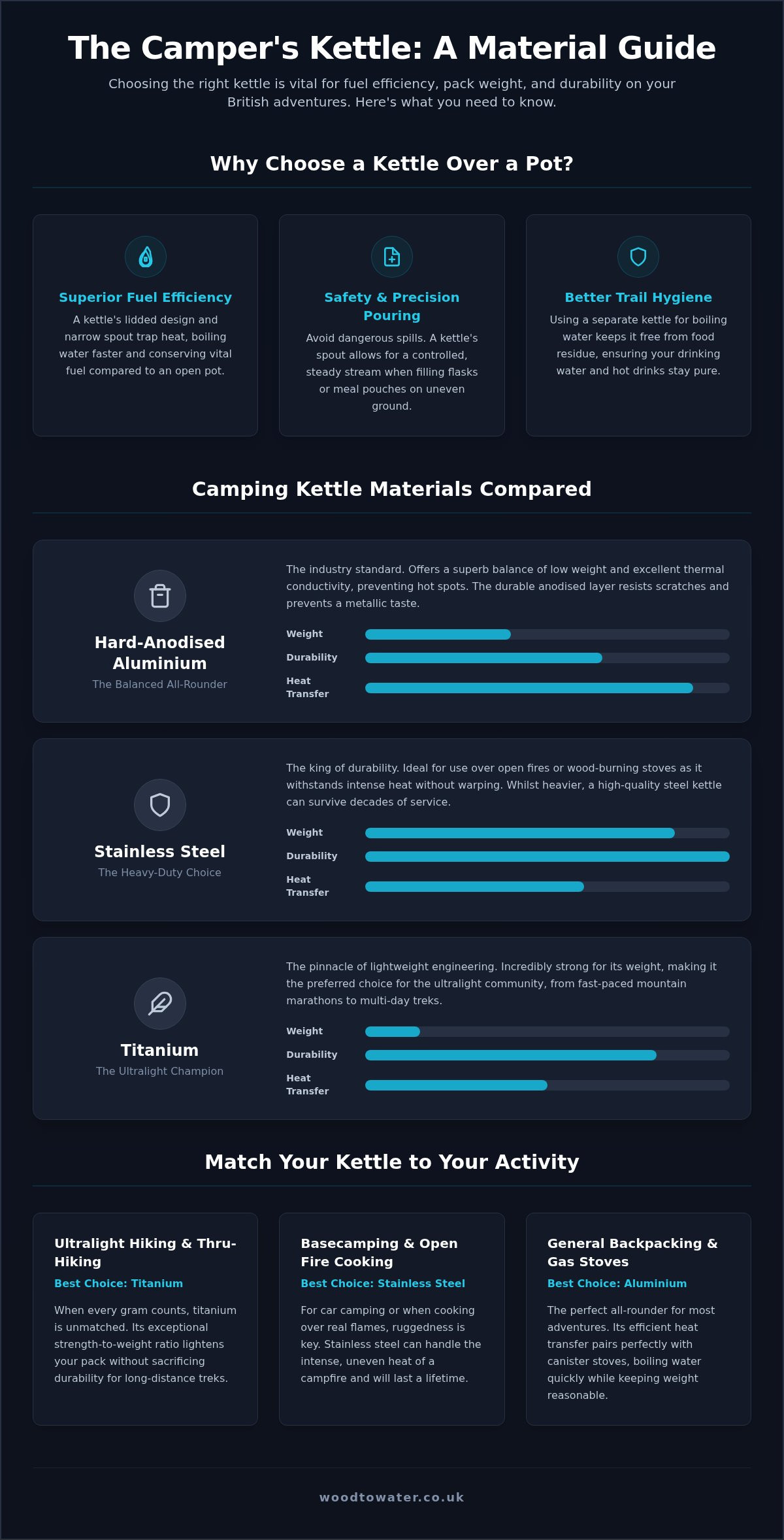
Selecting the right material for your camping kettle is one of the most important decisions you'll make when building your trail kitchen. It isn't just about weight; it's about how the metal reacts to heat, wind, and the rough treatment of life in a rucksack. Each material serves a specific purpose in the British wild, and understanding these differences will help you avoid gear failure when you're miles from the nearest road.
The trade-offs are straightforward. Some materials heat up instantly but struggle to distribute that heat evenly, whilst others are virtually indestructible but add significant bulk to your pack. Your choice should reflect your preferred style of adventure, whether that's a fast-paced mountain marathon or a slow-burning weekend of bushcraft. By matching the metal to your stove type, you can maximise fuel efficiency and ensure your gear lasts for years of rugged use.
Hard-Anodised Aluminium Performance
Hard-anodised aluminium is the industry standard for a reason. It offers a superb balance of weight and thermal conductivity. Unlike raw aluminium, the hard-anodised version features a durable oxide layer that prevents a metallic taste and resists the scratches that come from being packed alongside other metal gear. It's the favourite choice for general backpackers using gas stoves. Because it spreads heat evenly across the base, it prevents the hot spots that can lead to scorched metal or inefficient boiling.
Durability of Stainless Steel and Titanium
Stainless steel is the undisputed king of durability. If your adventures involve cooking over an open fire or using a wood-burning stove, stainless steel is your best bet. It can withstand intense heat without warping or degrading. Whilst it's heavier than other options, its longevity is unmatched; a high-quality steel kettle can easily survive decades of service. It's the heavy-duty choice for those who value reliability over minimalism.
Titanium represents the pinnacle of engineering for the ultralight community. It's incredibly strong, allowing manufacturers to make the walls of the kettle much thinner without sacrificing structural integrity. This results in a featherweight piece of kit that feels solid. However, titanium doesn't conduct heat as efficiently as aluminium. It's designed for speed and minimalism, making it perfect for those counting every gram on a long-distance trek. You can explore our full range of camping gas stoves to find the perfect partner for your chosen kettle material.
Selecting the Right Kettle for Your Outdoor Activity
Picking the right camping kettle depends entirely on the rhythm of your trip. A solo hiker on a high-altitude ridge has very different needs compared to a group gathered in a forest clearing for a weekend of bushcraft. You need to balance the physical size of the gear with the actual volume of water you'll need for meals and brews. If you choose a model that's too small, you'll waste fuel on multiple boils. Choose one that's too large, and you're carrying unnecessary bulk across the hills.
Design details like handle stability and spout shape also play a massive role in your daily comfort. A kettle that nests perfectly inside your cookset saves precious rucksack space, whilst a sturdy, locking handle ensures safety when you're pouring in a gusty wind. Don't let the desire for minimalism tempt you into a design that's frustrating to use with cold or gloved hands. It's about finding that sweet spot between functional capacity and packable dimensions.
Bushcraft and Traditional Camping
If you're heading into the woods, fuel versatility is your best friend. Chimney-style kettles are iconic amongst the bushcraft community for a reason; they turn a handful of dry twigs or pinecones into boiling water in minutes. For those setting up a more permanent basecamp, the weight penalty of heavier materials is often offset by their incredible heat retention. You might even consider pairing your setup with rugged cast iron cookware for a truly traditional and indestructible outdoor kitchen experience.
Ultralight and Fast-Paced Hiking
For the fast and light crowd, every gram and centimetre of space is precious. This is where nesting capability becomes essential. Your kettle shouldn't just sit in your bag; it should house your stove, a small gas canister, or even your brew kit. A volume between 600ml and 900ml is usually the perfect choice for a solo trekker. It provides enough for a large coffee and a dehydrated meal without being overly bulky. Before you head out, check our Ultimate Hiking Gear Checklist for UK Trails in 2026 to see how a compact kettle fits into a streamlined kit.
Group expeditions change the requirements again. When you're catering for three or four people, a 1.2L or 1.6L model saves you from boiling multiple rounds and keeps the group morale high. Larger kettles often feature wider bases, which can also help with stability on smaller canister stoves. Always prioritise a model with a clean pour to avoid wasting water or causing spills in a crowded camp area.
Fuel Efficiency and Boiling Times in the British Wild
Wind is the silent thief of fuel in the British hills. A steady breeze can easily double your boiling time; it strips heat from the sides of your kettle before it ever reaches the water. Most manufacturers provide lab-tested boil times, but these are often recorded in perfectly still, room-temperature conditions. In the real world, you're dealing with damp air and gusty winds that make these numbers feel like a myth. On a typical UK wild camp, you're likely to use significantly more fuel than expected if you don't account for your environment.
To combat these conditions, you need to think about heat transfer. A standard kettle sitting on a basic burner is vulnerable to every gust. Integrated systems solve this by creating a physical barrier between the flame and the air, ensuring that every bit of energy is directed into your water. This isn't just about convenience; on a multi-day trek, it's the difference between a light pack and one weighed down by extra gas canisters.
Integrated Systems and Heat Exchangers
If speed is your priority, integrated systems are the gold standard. They use specialised heat exchangers, like FluxRing technology, to create a massive increase in surface area. This allows the vessel to capture heat that would otherwise be lost to the wind. These systems can often achieve a boil in under two minutes, saving you a significant amount of gas on longer trips. You can explore our full selection of Jetboil camping cooking gear to find a setup that prioritises this high-speed efficiency. These units are specifically vetted for British conditions where waiting ten minutes for a brew can lead to a frustrating drop in core temperature.
Optimising Your Camp Kitchen
Beyond your choice of hardware, how you set up your kitchen determines your fuel consumption. A lid is the most important feature any kettle can have. It traps steam and pressure, forcing the temperature up much faster. If you're using camping gas stoves, always look for a sheltered spot. A simple rock or a slight hollow in the ground can act as a natural windbreak. In cold weather, gas pressure drops; keeping your canister off the frozen ground or inside your jacket before use can make a massive difference. This ensures you maintain a consistent flame even as the temperature dips.
Managing your fuel levels effectively means you can stay out longer without a heavy pack. If you want to cut your boil times in half and stop wasting gas, upgrade to an integrated Jetboil system today.
The Wood To Water Selection: From Jetboil to Kelly Kettle
At Wood To Water Outdoors, we don't believe in stocking gear just for the sake of it. Every camping kettle in our collection has been hand-selected because it solves a specific problem for the British explorer. Our team personally tests these items in the rain, wind, and mud to ensure they meet our high standards for durability and functional design. Whether you're a minimalist hiker or a dedicated bushcraft enthusiast, our selection represents the best engineering from around the globe; specifically tailored for our unique environment. We take pride in being an official UK retailer for brands that share our passion for the outdoors.
Choosing the right gear is about more than just looking at a spec sheet. It's about knowing that your equipment will perform when the weather turns and you're miles from the nearest road. We've vetted our inventory to include everything from high-speed integrated systems to traditional wood-fired vessels. This curated approach ensures that regardless of your experience level, you can head out with confidence in your kit. Our goal is to provide the essentials that make every outdoor activity a worthwhile and comfortable pursuit.
The Iconic Kelly Kettle System
The Kelly Kettle collection remains a firm favourite amongst those who prefer to live off the land. Its genius lies in the chimney design. It creates a natural updraft that allows you to boil water using nothing but dry grass, twigs, or pinecones. This makes it the ultimate fuel-free solution for off-grid adventures. Because the fire is contained within the base, it's incredibly efficient even in damp or windy conditions. It is a rugged, dependable piece of kit that has become a staple for UK bushcraft, proving that traditional methods often hold their own against modern technology.
Modern Technical Kettles
For hikers who prioritise speed and pack volume, we've curated innovative solutions like Fire-Maple gear. These kettles often feature advanced heat exchangers that significantly reduce boil times. If you're moving fast, you need kit that keeps up with your pace. Similarly, our TOAKS titanium cookware offers the ultralight community a way to shave grams without losing out on structural integrity. To complete your setup, integrating your kettle with a high-quality stove from Bushcraft Essentials ensures a stable and efficient outdoor kitchen.
To keep your gear in top condition, always dry your kettle thoroughly before packing it away to prevent mineral buildup. If you're using wood fuel, a quick wipe to remove soot will keep the inside of your rucksack clean. High-quality gear is an investment. With a little care, these kettles will survive years of rugged use across the British hills.
Ready Your Pack for the British Trail
Choosing the right gear is about more than just numbers on a page. We've seen how matching your material choice to your specific environment ensures you won't be left waiting in the wind. Whether you prioritise the featherweight strength of titanium for a mountain trek or the rugged versatility of a wood-fired chimney, your kettle is the heart of your trail kitchen. It's the difference between a cold, damp morning and a warm, efficient start to your day.
At Wood To Water Outdoors, we're proud to be an authorised retailer for world-class brands like Jetboil and Kelly Kettle. Our seasoned UK outdoorsmen personally vet every item in our inventory to ensure it survives the realities of our environment. When you shop with us, you benefit from expert advice and free UK delivery on qualifying orders. It's time to stop worrying about your gear and start focusing on the journey ahead. Explore our full range of expert-vetted camping kettles and prepare for your next great escape. We'll see you out there!
Frequently Asked Questions
Can I use a camping kettle on a domestic kitchen hob?
Most camping kettles work on domestic gas hobs, but they aren't always compatible with induction or electric plates. Because they are often made from non-ferrous materials like aluminium or titanium, they won't trigger an induction sensor. The small base can also be unstable on large kitchen rings. It's best to keep your outdoor gear for the trail to avoid melting heat-resistant handles designed for lower-intensity camping stoves.
How do I remove soot and carbon build-up from my kettle?
You can remove stubborn soot and carbon by applying a paste of bicarbonate of soda and water. Let it sit for several minutes before gently scrubbing with a soft sponge. For heavy build-up after using a wood-fired stove, a specialised degreaser can help. Avoid using steel wool on hard-anodised aluminium surfaces, as this will strip the protective layer and damage the metal's integrity over time.
Is an aluminium kettle safe for boiling drinking water?
Modern hard-anodised aluminium is perfectly safe for boiling drinking water. The anodisation process creates a hard, non-reactive layer that prevents the metal from leaching into your brew. This material is a staple in the outdoor industry because it offers excellent heat distribution without the metallic taste associated with cheaper, raw aluminium pots. Just ensure you don't use metal utensils that could scratch through the protective surface during cleaning.
What is the best kettle size for a solo hiker?
The best camping kettle size for a solo hiker typically falls between 600ml and 900ml. This volume provides enough water for a standard 400ml dehydrated meal and a generous cup of coffee in a single boil. Choosing a model within this range ensures you aren't carrying unnecessary weight or bulk. Many hikers prefer a 750ml titanium model, as it balances capacity with the ability to nest a small gas canister inside.
Can I use a Kelly Kettle on a gas stove?
You can use a Kelly Kettle on a gas stove, but it isn't the most efficient method. These chimney-style kettles are designed to draw heat from a small fire in their base plate. When placed on a gas burner, the hollow centre allows much of the heat to escape straight through the top. If you must use gas, keep the flame low to prevent damaging the internal seals or melting the handle.
Why does my kettle whistle, and do I need that feature?
A kettle whistles to alert you that the water has reached a rolling boil. This is a useful feature for saving fuel, as it prevents you from leaving the stove running longer than necessary. In the wild, where wind can mask the sound of bubbling water, a clear whistle helps you react quickly. However, many ultralight models omit this to save weight, requiring you to monitor the steam manually.
How do I prevent my titanium kettle from warping?
To prevent your titanium kettle from warping, never heat it whilst it's completely empty. Titanium is incredibly strong but thin, making it susceptible to heat damage if there is no liquid to absorb the thermal energy. You should also avoid plunging a hot kettle into freezing stream water. This extreme thermal shock can cause the metal to contract too quickly, leading to permanent distortion of the base or the lid fit.
What is the most fuel-efficient way to boil water outdoors?
The most fuel-efficient way to boil water is to use a camping kettle with a tight-fitting lid and a dedicated windbreak. By shielding your stove from the breeze, you ensure the flame stays concentrated on the base. Using an integrated system like the Jetboil Flash further improves efficiency by trapping heat that would otherwise escape. Always use the minimum amount of water needed to reduce the energy required for the boil.
