

TOAKS Long Handle Spoon for Dehydrated Meals: Is It the Right Choice?
What good is a lightweight spoon if it can’t reach the last mouthful in your meal pouch? The TOAKS long handle spoon for dehydrated meals is designed for that awkward moment, when a short utensil leaves food at the bottom and your fingers get in the way. Its extra reach can make eating straight from a pouch more comfortable, although the longer handle may take up more room in your kit.
If you’re choosing between a spoon, a spork or a longer-handled design, think about how you eat on the trail, not just which option is lightest. This guide compares reach, bowl finish, titanium construction and packability, with practical checks to help you match an utensil to your meal pouches and cookware. You’ll also see when a standard-length spoon may be the more convenient choice.
Key Takeaways
- The TOAKS long handle spoon for dehydrated meals may suit you if you regularly eat spoonable meals straight from deep pouches or cookware.
- Consider the bowl’s finish and shape for comfort and cleaning. Don’t assume every version feels the same.
- A spoon, standard utensil and spork suit different eating habits. Match your choice to the meals you carry and how you prefer to eat them.
- Compare the specifications for the version you’re considering, then check that its length fits your containers and packed kit.
- If you usually transfer meals to shallow tableware, a standard-length utensil may be more practical.
Why choose a long-handle spoon for dehydrated meals?
The last mouthful is often the awkward one: it has settled at the bottom of a deep meal pouch, just beyond a short spoon. Reaching in with your fingers can leave them sticky. A long handle is designed to make that reach easier. A long-handle camping spoon is an eating utensil with an extended handle intended to reach further into taller food pouches, pots and other containers.
Extra reach is useful when it matches the way you prepare and eat meals. Pouches vary in depth and shape, so a spoon that works well for eating from a meal bag may feel too long with a shallow bowl. Judge the TOAKS long handle spoon for dehydrated meals against the containers you actually use and the rest of your cook kit, not handle length alone.
When does extra reach make mealtimes easier?
If you add hot water to a meal pouch and eat from it directly, a longer handle can help you stir and scoop from lower down without putting your fingers inside the opening. It can be especially useful as the pouch empties and food settles at the bottom. Dehydrated food is rehydrated before eating; the Dehydrated food overview explains the process and its uses.
Serving the meal in a bowl changes the job. You can bring the food closer and use a conventional spoon, so extended reach matters less. Look at the actual pouch or pot you carry: some containers are taller or narrower than others, and meal packaging does not have a standard depth.
Who is most likely to appreciate this spoon style?
Backpackers who regularly prepare spoonable meals in tall pouches are the clearest fit. The extra reach can help when stirring and eating, without leaning as far over the opening or reaching inside to gather the last bites. Matching a small piece of kit to your routine can make mealtimes more straightforward.
If you usually serve meals into shallow dishes, a shorter utensil may feel more natural. Think about where your meal ends up: do you eat from the pouch, a cooking pot or separate tableware? If you’re building a coordinated setup, the TOAKS Titanium Cookware guide offers broader context for choosing cookware alongside your utensil.
Picture your last few trail meals. If you often scrape food from the bottom of a tall container, extra reach has a clear purpose. If you routinely transfer meals to a shallow plate, it may be less useful. That simple distinction helps put handle length in context before you compare other details.
What the TOAKS long-handle spoon’s design and specifications tell you
Specifications are most useful when you connect them to how you eat. Handle length affects reach and stowage; bowl shape affects how a spoonful sits and fits your mouth; material and finish describe the utensil’s construction and surface. None of these details alone tells you whether it will feel comfortable in your hand or suit the way you eat.
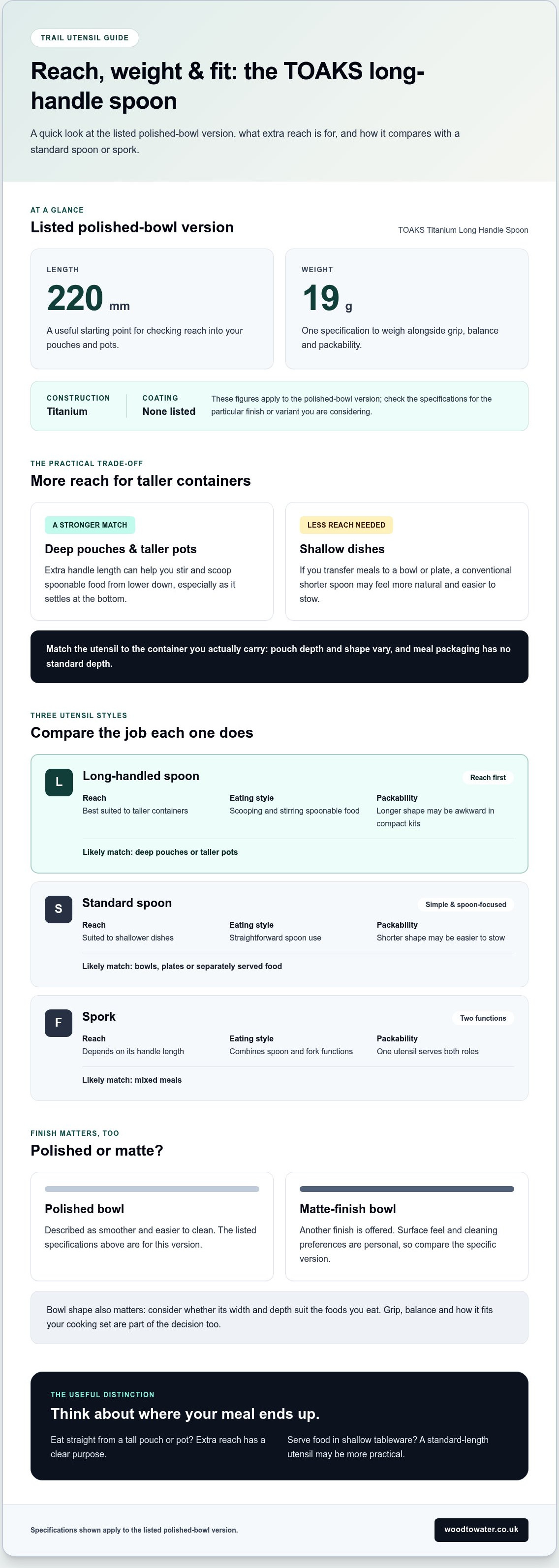
Product information lists the TOAKS Titanium Long Handle Spoon with Polished Bowl as 220 mm long and 19 g, made from titanium with no coating. Those figures apply to that polished-bowl version, so don’t assume they describe every finish or variant.
The listed length gives you a starting point for comparing the spoon’s reach with the pouches and pots you carry. It also helps you judge how it might fit alongside compact cookware or inside a small pouch. Weight is only one part of the decision. Grip, balance and how the spoon fits your cooking set matter too.
Polished or brushed bowl: what should you consider?
TOAKS offers a polished-bowl version and a matte-finish bowl version. The polished surface is described as smoother and easier to clean, but comfort and cleaning are partly subjective. A reviewer’s impression of mouthfeel or how easily residue comes away may not match yours. Bowl shape matters too, so consider whether its width and depth suit the foods you eat.
If you often eat sticky or thick meals, ease of wiping or rinsing the bowl may matter more than its shine. If mouthfeel is a priority, pay attention to the surface finish. Treat these as preferences to weigh, rather than assuming one option will feel better for everyone.
How titanium and handle length affect trail use
The listed titanium construction and weight help you compare the spoon with other kit, but they don’t settle the choice. Balance reach, grip and packability. A long handle can be useful with taller cookware, yet less convenient to stow if your cook kit is tightly packed. To plan a complete cooking setup, explore the range of Jetboil camping cooking systems alongside your other equipment.
Choose the TOAKS long handle spoon for dehydrated meals by the version and specifications that suit your priorities. A polished finish may appeal if you prefer a smoother surface; another bowl finish may suit your feel and cleaning preferences. Compare the details for the specific version with your cookware and packed kit.
Long-handle spoon vs standard spoon vs spork: which suits your meals?
The right utensil depends on the food you eat and the container you use. A long-handled spoon prioritises reach, a standard spoon suits ordinary bowls, and a spork combines spoon and fork functions. Compare how each will work at mealtime and how easily it fits into your kit.
| Utensil | Reach | Eating style | Packability | Likely match |
|---|---|---|---|---|
| Long-handled spoon | Best suited to taller containers | For scooping and stirring spoonable food | Longer shape may be awkward in compact kits | Deep pouches or taller pots |
| Standard spoon | Suited to shallower dishes | Simple, spoon-focused eating | Shorter shape may be easier to stow | Bowls, plates or food served separately |
| Spork | Depends on its handle length | Combines spoon and fork functions | One utensil serves both roles | Mixed meals and varied bites |
When does a long-handled spoon beat a standard spoon?
Choose extra reach if you regularly eat straight from a deep meal pouch or taller cooking pot. A standard spoon may be a better fit if meals go into a shallow bowl, or if you prefer a shorter utensil that packs neatly with your other kit. Neither design suits every container, so consider the depth and shape of the pouch or pot you actually use.
When might a spork be the more versatile choice?
A spork combines a spoon bowl with fork prongs, giving you two ways to handle a meal with one utensil. That can suit mixed food with larger pieces as well as softer portions. For meals that are mostly spoonable, the prongs may add little value, and a plain spoon bowl may feel more natural for scooping. Your menu is a useful guide.
Think about a typical meal, not an unusual one. If you usually eat a soft rehydrated dish from its pouch, the TOAKS long handle spoon for dehydrated meals may be a more direct match than a spork. If your meals include pieces you’d rather lift with fork prongs, the combined design could be more useful. For food served in a shallow dish, a standard spoon may keep things simple.
In short: choose a long-handled spoon for taller containers, a standard spoon for shallow tableware and compact packing, or a spork if you value having spoon and fork functions together. Check that the handle length suits your usual pouch or pot and the way you store your utensils. There’s no universal winner; match the design to your regular trail meals.
How to decide whether this spoon belongs in your trail kit
A utensil can look ideal on a product page and still feel awkward in your pack. Make your decision against your actual meals, cookware and packing habits. These four checks can help you work out whether the TOAKS long handle spoon for dehydrated meals fills a useful gap or adds length you don’t need.
- Identify your meal containers. Do you eat straight from a pouch, cook or eat from a pot, or transfer meals to separate tableware? Note the containers you use most, including their depth and opening. Pouch shapes vary, so don’t assume one handle length will work equally well with every meal.
- Choose your eating style. If you scoop meals directly from a deeper container, reach may be a priority. If you mostly eat from a shallow plate or bowl, a standard utensil may feel more natural. Consider whether you want a spoon for soft, spoonable meals or a spork for meals where fork prongs could be useful.
- Compare specifications. Look at the length and weight for the exact version you’re considering, then compare its length with the containers you carry. Figures won’t tell you how it feels in your hand, so consider whether the handle and bowl suit your grip and eating style.
- Assess how it packs. Picture where the handle will sit alongside your cooking kit. Will it fit with your other utensils, or catch on the edge of a packed pouch? Weigh the trade-off: a long utensil may combine reach and eating in one tool, while a shorter alternative may be easier to store.
Match utensil reach to your meals and cookware
Compare the spoon’s listed length with the containers you use most. Consider whether it needs to reach into a pouch and still feel comfortable with a pot or shallow plate. If meals usually go into separate tableware, browse camping plates that suit the way you serve food, then decide whether your spoon needs extra reach.
Check packability and the rest of your cooking kit
Consider how the handle sits in your pack, how it stores alongside other utensils and whether it feels comfortable to use for a full meal. A longer design may suit a pouch-focused routine; a shorter spoon may be simpler if space and easy stowage matter more. Make the choice based on your kit, not weight alone.
Make the call based on your routine: if you regularly eat from deeper containers and can pack the handle comfortably, the long-handled design has a clear purpose. If you usually serve meals into shallow tableware or prefer compact utensils, choose for that setup instead. Comparing your containers with your packed kit can help you avoid carrying a utensil you rarely use.
Is the TOAKS long-handle spoon the right buy for you?
The TOAKS long-handle spoon is most compelling if your usual trail meal is spoonable and you eat directly from a deeper pouch or pot. Its extended reach and spoon-shaped bowl suit that routine. If your meals go into shallow tableware, or a long utensil is awkward in your pack, those advantages may matter less. The right choice depends on how you cook, eat and carry your kit.
The strongest reasons to choose a long-handled spoon
Extra reach is useful if you often scrape the last portion from the bottom of a pouch. A spoon bowl also suits soft meals, without fork prongs that may have little use for that texture. Compare the specifications for the version you’re considering, then think about whether its length and weight work for your containers, grip and storage setup.
This style is worth considering if you want one utensil for stirring and eating from taller cookware, as well as reaching into meal packaging. It is less useful if you rarely use deep containers. The handle still needs to feel comfortable and practical to stow; reach alone doesn’t make a utensil right for every camp kitchen.
When a different utensil may suit you better
A standard spoon may be the more comfortable, compact option if you usually transfer meals to a shallow bowl or plate. If you eat a mix of soft food and pieces you’d rather lift with fork prongs, a spork combines both functions in one utensil. Match the design to the food and tableware you use most, and consider whether the longer handle is worth packing for the occasions when it helps.
Picture a typical meal on your next trip. If you’d eat it from a tall pouch and value reaching the bottom, a long-handled spoon may earn its place. If you’d serve it into a shallow dish or prioritise compact packing, a shorter spoon or spork could make more sense. Compare the spoon’s details with your usual setup, rather than choosing on weight or appearance alone.
Wood To Water Outdoors offers TOAKS Titanium Cookware alongside other outdoor cooking equipment, making it easier to plan how cookware fits into your trail kit. Explore outdoor cooking equipment to find pieces that suit the way you like to cook and eat outdoors.
Make your next trail meal work for you
Before your next trip, picture how you’ll eat a planned meal from its container. That simple check can show whether the TOAKS long handle spoon for dehydrated meals suits your routine or whether a shorter utensil would be easier to carry. Think of your cook kit as a whole: each item should work with the meals and cookware you choose.
You don’t need to perfect your setup all at once. Start with the way you like to cook and eat outdoors, then refine your kit as you learn what feels comfortable on the trail. A considered choice can make mealtimes simpler without adding gear you won’t use.
Wood To Water Outdoors specialises in camping, hiking and bushcraft equipment, including TOAKS Titanium Cookware. Explore outdoor cooking equipment and choose the pieces that suit your next adventure.
Frequently Asked Questions
Is a long-handled spoon better for dehydrated meals?
It can be more convenient if you often eat straight from a deep pouch, but it isn’t automatically the better choice for every meal. The TOAKS long handle spoon for dehydrated meals may help you reach food lower down. If you pour dinner into a shallow bowl, a shorter utensil could feel easier to handle. Think about the packaging of the meals you actually take on trips, not just a pouch you use occasionally.
Can I use the TOAKS long-handle spoon with ordinary camping pots?
Yes, a long-handled spoon can be used with camping pots if its length and bowl suit the pot. A narrow, deep pot and a broad, shallow one can feel quite different to eat from. Compare the spoon’s dimensions with your cookware and consider where you’ll hold it while eating. If you use several pots, judge it against the one you use most often.
How long is the TOAKS long-handle spoon?
Product information lists the polished-bowl version as 220 mm long. That figure applies to that version, so compare the details for the specific spoon you’re considering. To judge whether the length suits you, compare it with the deepest pouch or pot you use and consider where the handle will fit in your kit.
Is the TOAKS long-handle spoon polished or brushed?
There is a polished-bowl version and a matte-finish bowl version; descriptions of the handle finish may refer to a different part of the utensil. Distinguish the bowl surface from the handle when comparing details. Finish is also a matter of preference: a reviewer’s impression of how a surface feels or cleans doesn’t guarantee you’ll have the same experience.
Is a long-handled spoon more useful than a spork?
Neither is universally more useful. A spoon’s continuous bowl suits food you scoop, while a spork combines spoon and fork functions for meals with different textures. If you pack varied food, the combination may appeal. For a menu that’s mostly spoonable, you may prefer a spoon bowl without prongs. Also consider whether the longer handle fits your kit.
How do I clean a titanium camping spoon after a dehydrated meal?
Follow the care guidance supplied for the specific spoon and clean it soon after eating. A quick wipe can remove loose residue before it dries; if washing water is available, clean the bowl according to the product instructions. If washing is impractical on a trip, keep used cutlery separate from clean kit. Don’t assume every finish has identical care requirements.
Is a 19 g spoon light enough for backpacking?
Product information lists the polished-bowl version at 19 g. Whether that weight works for your backpacking kit depends on the trade-off you’re making. If extra reach solves a regular mealtime annoyance, it may matter more to you than a small difference between utensils. Consider comfort, handle length and where it packs alongside weight.