

Nalgene Water Bottles: A Guide to the Best Outdoor Choice
If your gear fails at two thousand feet, it isn't just an inconvenience; it's a disaster for your kit and your morale. We've all experienced that sinking feeling of discovering a damp sleeping bag or enduring the sharp, chemical taste of water from a cheap container. It's frustrating to spend time choosing the right rucksack only to have a flimsy bottle ruin your day. You deserve a hydration solution that's as tough as the fells you're climbing. That's exactly why Nalgene water bottles have remained the undisputed gold standard for hikers and bushcraft enthusiasts for over seventy years.
You're looking for gear that lasts a lifetime and won't crack in the cold. In this guide, we'll dive into the material science behind the latest Sustain range; these bottles use Tritan Renew to turn waste plastic into rugged, BPA-free containers. We'll also explore why these bottles are an essential part of a modular system. You'll discover how they integrate seamlessly with your TOAKS titanium cookware or JetBoil stoves to create a compact, reliable kit list. Let's look at why this simple piece of plastic is still the most important item in your pack.
Key Takeaways
- Learn how lab-grade engineering translates to a leak-proof seal that protects your kit from damp disasters on the trail.
- Explore the shift towards sustainability with the Sustain range, which utilises 50% recycled plastic whilst maintaining legendary durability.
- Weigh up the benefits of Wide Mouth versus Narrow Mouth designs to find your perfect balance of easy cleaning and spill-free drinking.
- Discover how to integrate Nalgene water bottles with your existing gear, including the essential "Golden Rule" for nesting with TOAKS titanium pots.
- Identify the ideal capacity for your next British adventure, from the 1L workhorse for wild camping to the compact 0.5L version for day trips.
The Nalgene Legacy: From Laboratory to the Great Outdoors
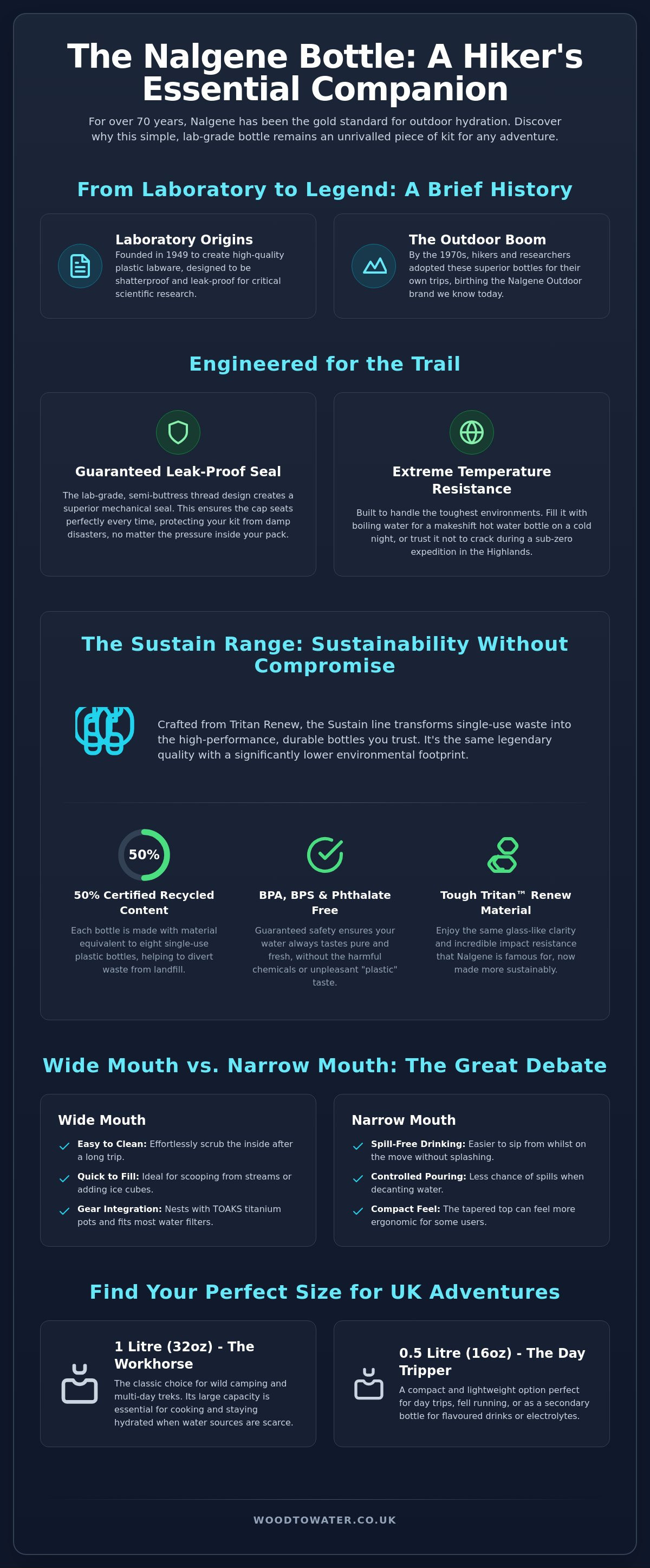
Nalgene didn't start its journey on a rugged mountain trail. In 1949, Emanuel Goldberg founded the company in Rochester, New York, to manufacture high-quality plastic labware. These containers were originally designed for scientists who needed vessels that wouldn't shatter or leak dangerous chemicals. By the 1970s, researchers realised these lightweight, indestructible bottles were far superior to the heavy glass or metallic containers available for hiking. They began taking their lab kit on weekend backpacking trips; this grassroots movement eventually led to the birth of Nalgene Outdoor. You can explore the full Nalgene brand history to see how a simple centrifuge bottle became a global icon.
The 32oz Wide Mouth bottle emerged as the definitive choice during the 1970s backpacking boom. Whilst most outdoor gear has become increasingly high-tech and over-engineered, Nalgene water bottles have remained remarkably consistent. This longevity isn't a result of stagnation. It's the product of a design so fundamentally sound that it hasn't required a major overhaul in over half a century. It's a rare example of getting it right the first time.
Why Lab-Grade Precision Matters
Engineering is what separates a genuine Nalgene from a supermarket imitation. The secret to a truly leak-proof bottle lies in the design of the threads. Nalgene utilises a semi-buttress thread design; this creates a mechanical advantage that ensures the cap seats perfectly every time. Unlike cheap alternatives that might strip under pressure, these threads are built to withstand significant force. The straight-shouldered design also provides a larger, flatter surface area for the seal to grip. This precision is a direct hangover from the brand's laboratory roots where a single leak could ruin years of research. If your bottle is buried at the bottom of a heavy rucksack, that lab-grade quality control is the only thing keeping your spare socks and down jacket dry.
The Evolution of an Outdoor Icon
Material choices have shifted even if the iconic silhouette hasn't. The brand moved from original polycarbonate to BPA-free Tritan years ago to ensure user safety. In August 2020, they took another leap forward with the Sustain line. These modern bottles are crafted from Tritan Renew, a material derived from 50% certified waste plastic. This initiative aims to reduce the environmental footprint whilst maintaining the legendary durability enthusiasts expect. It also ensures the bottles stay ahead of strict 2026 regulations regarding recycled content and PFAS-free materials. Beyond the material science, Nalgene water bottles have become a canvas for outdoor culture. A scratched, battered bottle covered in stickers from various expeditions is a badge of honour. It's more than just a container; it's a reliable companion that tells the story of your adventures whilst remaining a functional, essential tool for the trail.
Material Science: Understanding Tritan, HDPE, and Sustain
Choosing the right material for your hydration kit is about more than just aesthetics. It's a choice that impacts your pack weight, your health, and how your gear performs when the temperature drops. Nalgene water bottles are famous for their indestructible nature, but the science behind that durability has evolved significantly since the early labware days. Today, the choice usually boils down to two primary plastics: the crystal-clear Tritan or the lightweight, flexible HDPE. Both are designed to handle extreme environments, from being filled with boiling water for a makeshift bed-warmer to surviving a sub-zero night in the Highlands.
Tritan Renew: Sustainability without Compromise
In 2020, Nalgene revolutionised their lineup with the introduction of the Sustain range. These bottles are crafted from Tritan Renew; this innovative material uses molecular recycling to transform single-use plastic waste into high-performance, food-safe containers. Each 1L Sustain bottle is made from the equivalent of eight single-use plastic bottles that would otherwise end up in landfill. You get the same glass-like clarity and incredible impact resistance of classic Tritan, but with a much lower environmental footprint.
Safety is a non-negotiable factor for any outdoor enthusiast. Whilst many brands claim to be BPA-free, Nalgene goes further. Their modern materials are guaranteed to be free from BPS and phthalates as well. This ensures your water never has that unpleasant "plastic" taste, even after sitting in a hot tent all afternoon. For those who demand the same water quality at home as they do on the trail, PureH2O Ltd offers advanced purifiers to ensure your supply is pristine. These bottles are also completely dishwasher safe, which is essential for maintaining hygiene after a long trip where protein shakes or electrolyte powders might have been used.
HDPE vs. Tritan: Choosing Your Plastic
If you're counting every gram for a long-distance trek, the "Ultralite" HDPE (High-Density Polyethylene) version is often the preferred choice. It's significantly lighter than Tritan, helping you shave precious weight from your base load. Whilst Tritan is prized for its rigidity and clarity, HDPE is semi-opaque and has a slight "give" to it. This flexibility is a massive advantage in extreme cold. In sub-zero conditions, hard plastics can become brittle; however, an HDPE bottle is far more likely to survive a drop on frozen ground without cracking.
- Tritan (Sustain): Best for daily use, high impact resistance, and total clarity.
- HDPE (Ultralite): Best for weight-conscious hikers and winter expeditions where flexibility matters.
Both materials are engineered to withstand temperatures from -40°C to 100°C. This versatility makes them an essential part of any survival kit. If you're currently refining your pack for an upcoming expedition, you can find more expert-vetted gear in our bushcraft essentials collection. Whether you favour the lightweight HDPE or the eco-friendly Sustain range, you're investing in a container that's built to last a lifetime.
Wide Mouth vs. Narrow Mouth: The Great Hydration Debate
Once you've settled on the material, the next hurdle is deciding on the aperture. It’s a debate that has split the outdoor community for decades. The choice between a wide or narrow opening might seem like a minor detail, but it fundamentally changes how you use your kit on the trail. Whether you’re trying to hydrate whilst navigating a rocky path or attempting to fill up from a shallow stream, the diameter of that neck matters. Most Nalgene water bottles come in one of these two iconic configurations; each offers distinct advantages depending on your specific activity.
The Versatility of the 32oz Wide Mouth
The 63mm Wide Mouth is the undisputed industry standard for a reason. Its primary strength is compatibility. Because this opening size is so common, it fits almost every major water filtration system on the market, including those from Katadyn and Sawyer. You can screw your filter directly onto the bottle, ensuring every drop of treated water stays inside. This wide aperture also makes the bottle a multi-functional tool. In an emergency, it can serve as a makeshift dry bag for your phone, car keys, or a small first aid kit.
Cleaning is where the Wide Mouth truly shines. You don't need specialised brushes to keep it hygienic; a standard sponge can reach every corner to prevent any mould or bacteria buildup. If you enjoy adding ice cubes, electrolyte tablets, or even fruit infusions to your water, the Wide Mouth handles them without a struggle. For those who find the large opening a bit messy to drink from on the move, accessories like the "Easy Sipper" insert can be added. This simple plastic guard sits inside the neck to control the flow, giving you the best of both worlds.
The Precision of the Narrow Mouth
The Narrow Mouth version was designed for those who prefer a more controlled drinking experience. We’ve all experienced the "Nalgene splash" where a sudden bump on the trail results in half a litre of water down your front. The smaller opening eliminates this risk, making it the favourite choice for drinking whilst walking, driving, or even whilst tucked inside a sleeping bag. Winter climbers particularly value this design; it allows them to hydrate without removing bulky gloves or risking a spill that could freeze on their expensive technical layers.
The trade-off for this convenience is maintenance. You won't be able to fit standard ice cubes through the neck, and cleaning requires a dedicated bottle brush to reach the bottom. It’s also less compatible with direct-attach water filters, meaning you’ll often need an extra hose or adapter. However, if your priority is effortless, spill-free hydration during high-intensity activity, the Narrow Mouth is an elegant solution that keeps you dry and focused.
Field Performance: Integrating Your Nalgene with Other Gear
A well-organised rucksack is like a puzzle where every piece must justify its weight. Nalgene water bottles are the ultimate team players in this regard. They aren't just standalone containers; they are the modular anchor for your entire hydration and cooking setup. By understanding how these bottles interact with the rest of your kit, you can save space, reduce weight, and increase your comfort on the trail. Whether you are wild camping in the Lake District or trekking across the Highlands, these integration tricks are what separate the novices from the seasoned enthusiasts.
Nesting and Pack Organisation
Space is at a premium when you're packing for a multi-day expedition. The "Golden Rule" of the bushcraft community is that a 32oz Wide Mouth Nalgene fits perfectly inside a 750ml pot. This nesting technique is a masterclass in efficiency. For example, your bottle will slide effortlessly into TOAKS Titanium Cookware; this protects the thin titanium walls from being crushed whilst occupying zero extra volume in your bag. If your internal space is completely full, the heavy-duty lid loop allows you to secure the bottle to the outside of your pack with a carabiner. It’s a secure, rattle-free solution that keeps your water within reach at all times.
The Nalgene as a Multi-Tool
Precision is vital when you are preparing food in the field. Most dehydrated meals require a specific amount of water to rehydrate properly. The integrated millilitre and ounce scales on Nalgene water bottles take the guesswork out of the process. This is particularly useful when using high-efficiency Jetboil cooking systems where boiling exactly the right amount of water saves both time and fuel. Beyond measuring, the leak-proof seal makes the bottle an excellent shaker for mixing protein supplements or electrolyte powders without making a mess of your gear.
Don't overlook the bottle's utility once the sun goes down. In cold British winters, a Nalgene serves as a highly effective hot water bottle. Simply fill it with near-boiling water from your stove and tuck it into the foot of your sleeping bag. Thanks to the lab-grade thread design, you can sleep soundly without worrying about a leak ruining your down insulation. By morning, you’ll have a litre of un-frozen water ready for your breakfast brew. It’s a simple, field-tested hack that makes a massive difference to your overnight recovery.
Ready to build a more efficient hydration system? You can find all the components to organise your outdoor kit at Wood To Water, where we only stock gear that's been vetted for the toughest environments.
Choosing the Right Nalgene for Your UK Adventure
Selecting the perfect hydration partner depends entirely on the terrain you're tackling and the duration of your trip. Whilst the iconic silhouette remains consistent, the variety of sizes ensures there is a specific bottle for every niche of outdoor life. We've spent years testing these in the damp, unpredictable conditions of the British countryside; this experience has helped us curate a selection that meets the needs of everyone from casual walkers to dedicated survivalists. Nalgene water bottles aren't a one-size-fits-all solution, but there is definitely a Nalgene for every pack.
Matching Size to Activity
The 1L (32oz) Wide Mouth is the undisputed workhorse for the UK trail. It provides a substantial volume of water that aligns perfectly with the distance between reliable refilling points in places like the Peak District or the South Downs. If you're counting grams or have limited space in your side pockets, the 0.5L (16oz) version is a fantastic alternative. It’s particularly popular for kids or as a dedicated "dirty water" container for filtration; in coastal environments, it can even be used to store water produced by a portable hand powered desalination device.
When you're squeezed into 1-man tents, every centimetre of vestibule space counts. The 1L bottle is the sweet spot; it's tall enough to hold significant volume but slim enough to stay out of the way of your boots and stove. For those heading into water-scarce areas or managing a basecamp, the 1.5L (48oz) Silo offers high-volume storage without the need for multiple smaller containers. It’s a beast of a bottle that ensures you have plenty of water for a full evening of cooking and hydration.
The Wood To Water Recommendation
We project the personality of a knowledgeable mentor because we actually use this gear. For the modern, eco-conscious hiker, we almost always recommend the Sustain range. It offers the same legendary durability as the original plastic but with a 50% recycled content that aligns with our commitment to the environment. When you're pairing your bottle with camping hammocks for a lightweight, low-impact setup, the Sustain range is the natural choice.
Our curation also focuses on "stealth" colours. Whilst Nalgene is famous for its vibrant neons, we favour muted tones like Olive, Woodsman Brown, and Grey. These colours allow you to maintain a low profile in the woods, which is essential for traditional bushcraft. Before you hit the checkout, run through this final checklist to ensure you've picked the right tool for the job:
- Capacity: Do you need the 1L workhorse, the 0.5L compact, or the 1.5L Silo?
- Aperture: Wide Mouth for easy cleaning and filtering, or Narrow Mouth for spill-free drinking?
- Material: The eco-friendly Sustain Tritan or the lightweight, cold-weather flexible HDPE?
- Colour: High-visibility for easy spotting or muted tones for a stealthy camp?
Investing in a Nalgene is a commitment to gear that won't let you down. Whether you're brewing up on a windy ridge or tucked into your hammock for the night, you can trust that your water is secure. Explore our full range of Nalgene water bottles and find the essential anchor for your next British adventure.
Ready Your Pack for the Trail
You've seen why these containers have earned their legendary status amongst adventurers for over half a century. From the lab-grade precision of the leak-proof threads to the innovative use of recycled plastics in the Sustain range, Nalgene water bottles remain the ultimate choice for field-tested reliability. Whether you're nesting your bottle in a titanium pot to save space or using it as a hot water bottle on a freezing night, this is a piece of kit that justifies every gram of its weight.
Don't settle for flimsy containers that might fail when you're miles from the nearest road. We've expertly selected our inventory specifically for the demands of UK bushcraft and wild camping; every item has been vetted by enthusiasts who live and breathe the outdoors. You can browse our curated range of Nalgene Water Bottles at Wood To Water today and enjoy fast UK-wide shipping on gear that's built to last a lifetime. We've done the testing so you can head out with total confidence. Your next great British adventure is waiting; grab your kit and get out there.
Frequently Asked Questions
Are Nalgene bottles truly BPA and BPS free in 2026?
Yes, all modern Nalgene water bottles are completely free from BPA, BPS, and phthalates. The Sustain range uses Tritan Renew plastic, which has been rigorously tested by independent third-party labs to ensure it is safe for food contact. You can drink with total peace of mind; these materials won't leach harmful chemicals into your water even if the bottle is exposed to high temperatures.
Can I put boiling water in my Nalgene bottle?
You can safely put boiling water into your bottle as they're rated to withstand temperatures up to 100°C. This is a brilliant feature for bushcraft enthusiasts who need to prepare dehydrated meals or want a makeshift hot water bottle for their sleeping bag. The plastic won't warp or melt, provided you're using a genuine Tritan or HDPE container designed for outdoor use.
How do I get rid of the smell or taste in my water bottle?
A simple mixture of warm water and a teaspoon of baking soda is usually enough to neutralise any lingering odours. If you've been using strong electrolyte powders, a very dilute bleach solution can help; just make sure you rinse the bottle thoroughly afterwards. Because the material is non-porous, it doesn't naturally harbour bacteria, so a quick scrub often solves the problem.
Is it safe to freeze a Nalgene bottle for cold water on the trail?
It's perfectly safe to freeze your bottle, but you must only fill it about two-thirds full to allow for expansion. Water increases in volume as it turns to ice; an overfilled bottle will likely bulge or crack under the pressure. If you're heading into exceptionally cold environments, the HDPE versions are a better choice because the material stays flexible when frozen.
Which Nalgene bottle fits inside a 750ml camping pot?
The 32oz (1L) Wide Mouth bottle is the industry standard for nesting inside a 750ml titanium camping pot. This combination is a classic space-saving trick amongst hikers because it creates a compact, rattle-free kit. It ensures your cooking pot is protected from being crushed whilst taking up zero extra room in your rucksack during your trek.
Are Nalgene bottles dishwasher safe on the bottom rack?
Nalgene water bottles are dishwasher safe, though we recommend using the top rack to ensure the plastic stays clear for longer. The intense heat from the drying element on the bottom rack can occasionally cause the plastic to become cloudy over several years. Keeping it on the top shelf protects the scale markings and maintains that glass-like clarity you expect from Tritan.
What is the difference between Tritan and HDPE Nalgene bottles?
Tritan is a crystal-clear, rigid plastic that's incredibly tough, whilst HDPE is a semi-opaque, lightweight material that offers more flexibility. If you want a bottle that looks great and is nearly indestructible, Tritan is the way to go. However, if you're an ultralight hiker looking to save every possible gram, the HDPE "Ultralite" version is the superior choice for your pack.
Can I use a Nalgene bottle with a water filter system?
Yes, the Wide Mouth bottles are designed with a 63mm thread that's compatible with most major water filtration systems. You can screw filters from brands like Katadyn or Sawyer directly onto the bottle neck for a secure, leak-proof connection. This makes refilling from streams much easier as you don't have to worry about balancing hoses or spilling treated water on the ground.