

Essential Wild Camping Equipment: A Complete UK Kit List
Would you still head into the fells if you knew your pack would weigh more than your sense of adventure? It's the most common hurdle for any aspiring explorer: what equipment do i need for wild camping? Getting the balance wrong usually leads to a shivering night in a damp bog or a back-breaking trek with gear you never actually use. We've all been there; staring at a mountain of kit and wondering if we'll be warm enough or if our stove will actually light when the Scottish mist rolls in.
We know that understanding the legalities of pitching up in England versus the Highlands can feel just as daunting as the terrain itself. You deserve to feel prepared; that's why we've put together this guide to help you discover exactly what gear you need to stay safe, warm, and comfortable whilst exploring the British wilderness. We'll walk you through a definitive kit list that balances rugged durability with lightweight efficiency. From the versatile DD Frontline Hammock to ultralight TOAKS titanium cookware, you'll gain the confidence to head out and truly enjoy the wild!
Key Takeaways
- Understand the wild camping mindset and why every gram in your rucksack must earn its place through total self-sufficiency.
- Master the 'Big Three' essentials and finally answer the question 'what equipment do i need for wild camping?|' by balancing lightweight shelter with high-performance sleep systems.
- Discover why efficient cooking systems, such as a Jetboil for a quick brew in a gale, are essential for staying warm and fuelled.
- Learn the 'Leave No Trace' toolkit and navigation must-haves to stay safe and protect the British wilderness for future explorers.
- Pick up expert organisation tips, including the 'Dry Bag' system, to keep your kit bone-dry regardless of the unpredictable UK weather.
Understanding the Wild Camping Mindset: Why Your Gear Matters
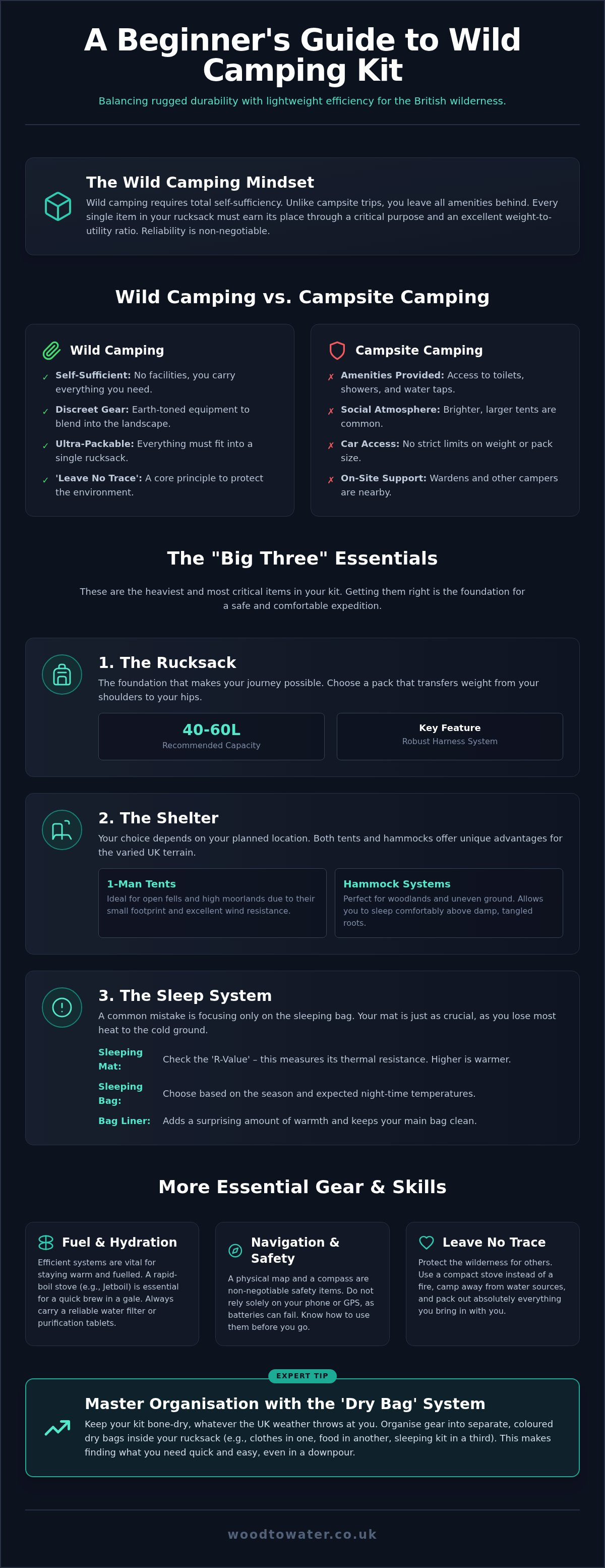
Wild camping isn't just a weekend away; it's a total shift in how you interact with the environment. When you pitch up in the middle of nowhere, you're leaving the safety net of taps, toilets, and wardens behind. This requires total self-sufficiency. Choosing what equipment do i need for wild camping?| is about building a personal life support system. Every single item in your rucksack must earn its place. If a piece of kit doesn't serve a critical purpose or has a poor weight-to-utility ratio, it's just dead weight slowing you down on the ascent.
I often see beginners tempted by budget "festival" gear. While a cheap tent might survive a sunny field, it will likely fail you in a Dartmoor gale. We focus on curated, technical gear because reliability is non-negotiable in remote areas. You don't need the most expensive carbon-fibre everything, but mid-range technical equipment offers the durability required for the harsh UK climate. Your gear should function as a "kit system"; your layers, shelter, and cooking setup must work in harmony to keep you dry and warm. You need to ask yourself: what equipment do i need for wild camping?| before you're halfway up a mountain in the rain.
Wild Camping vs. Campsite Camping
The biggest shock for newcomers is the lack of amenities. Without a communal kitchen or a block of showers, you must carry your own solutions for hydration and hygiene. Discreetness is also key. Whilst campsite tents are often bright and social, wild camping gear should be low-profile and earth-toned. You want to blend into the landscape, not stand out. This shift also impacts packability. You aren't just chucking things in a car boot; everything must fit comfortably into a 40-60L rucksack. Every gram counts when you're trekking miles to find the perfect spot.
The Legal Reality in the UK
Understanding where you can legally pitch is vital for any explorer. In Scotland, the Land Reform (Scotland) Act 2003 generally allows for wild camping on most unenclosed land. In England and Wales, the legalities are more restrictive; you usually need the landowner's permission, although some areas have specific bylaws. Regardless of where you are, your gear choice directly impacts your ability to follow the "Leave No Trace" mandate. Using a compact stove instead of a fire or choosing camping hammocks can significantly reduce your environmental footprint. Whilst legalities vary across the UK, the right equipment ensures you remain a respectful visitor to our wild spaces.
The "Big Three" Essentials: Shelter, Sleep Systems, and Rucksacks
When you start asking what equipment do i need for wild camping?|, the conversation always begins with the "Big Three." These are your shelter, your sleep system, and your rucksack. They are typically the heaviest and most expensive items in your kit, but they are also the most critical for your safety and comfort. Getting these right means the difference between a restorative night under the stars and a miserable, sleepless ordeal in the rain. Your goal is to find the "sweet spot" where durability meets a manageable pack weight.
A supportive rucksack is the foundation that makes your expedition possible. You need a pack with a robust harness system that transfers weight from your shoulders to your hips; this is essential when you're carrying a full load over uneven British terrain. Look for a capacity between 40 and 60 litres, which provides enough room for your gear without tempting you to overpack. Remember, every extra kilogram is a tax you pay on every ascent.
Tents and Hammocks: Picking Your Home for the Night
In the UK, your choice of shelter often depends on where you plan to pitch. For those heading to the open fells or high moorlands, 1-man tents are the gold standard. They offer a small footprint, making it easier to find a flat spot amongst the heather, and they provide excellent wind resistance. However, if you're exploring the dense woodlands of the South or the Scottish glens, level ground can be hard to find.
This is where the DD Frontline Hammock shines. It's a game-changer for stealth camping; it allows you to sleep comfortably above damp, uneven ground or tangled roots. To complete your setup, adding a camping tarp provides essential weather protection and a dry "porch" area to manage your gear. This versatility is why many seasoned UK wild campers are moving away from traditional tents in favour of hammock systems.
Staying Warm: Mats, Bags, and Liners
A common mistake is focusing solely on the sleeping bag and ignoring the mat. You lose heat to the cold ground much faster than to the air. Pay attention to the "R-Value" of your mat; this measures its thermal resistance. For UK wild camping, you'll want an R-value of at least 3 for three-season use. When choosing a bag, consider the dampness of our climate. While down is lighter, synthetic insulation often performs better when things get soggy. If you're looking to shave off even more weight from your total pack, check out our guide on Why TOAKS Titanium Cookware is the Choice for Ultralight Hikers in 2026 for expert weight-saving tips.
Ready to upgrade your sleep setup? Browse our curated selection of camping hammocks to find your perfect woodland retreat.
Fuel and Hydration: Choosing Efficient Cooking Systems
A hot meal is more than just calories; it's a massive morale booster when the temperature drops on a lonely ridge. When you're deciding what equipment do i need for wild camping?|, your cooking system is one of the most important choices you'll make. You need a setup that is reliable, easy to use with cold fingers, and efficient enough to work in the wind. The British weather is famously fickle, so your stove needs to be a workhorse, not a fair-weather friend.
Stove choice often comes down to your camping style. Gas canisters are the most popular for their "turn and click" simplicity. However, many seasoned explorers are looking toward bushcraft essentials like wood-burning hobo stoves. These allow you to utilise found fuel like twigs and pinecones, which is a fantastic way to save pack weight on longer trips. For pure speed, a Jetboil is arguably the fastest way to brew a coffee or rehydrate a meal in a gale. Its integrated heat exchanger protects the flame, ensuring you aren't wasting precious gas while waiting for a boil.
Cooking on the Trail
Reliability is everything when you're miles from the nearest pub. The Fire-Maple range offers fantastic, compact gas stoves that punch well above their weight. For the pots themselves, we always recommend titanium. TOAKS titanium cookware is the ultimate "buy once, cry once" investment for the weight-conscious hiker. It's incredibly light, doesn't impart a metallic taste, and is tough enough to survive being bashed around in a rucksack. To keep things simple after a long day of trekking, high-calorie trail food like 5 Minutes to Delhi ready meals provides a nutritious, tasty dinner with zero washing up required.
Hydration and Water Management
Finding water in the UK wilderness is usually easy, but making it safe to drink is the priority. You should always filter or boil water from streams and tarns to avoid nasty parasites. For those who prefer a traditional approach, the Kelly Kettle is a brilliant bit of kit for fuel-free boiling in the backcountry. It uses a chimney effect to boil water in minutes using just a handful of dry grass or sticks. Pair this with durable water containers that can handle rough handling. A reliable stove is a piece of safety equipment, not just a luxury; it provides the heat necessary to combat early-stage hypothermia if you get caught out in the wet. Knowing you can always produce a hot drink provides immense peace of mind whilst exploring the fells.
Navigation, Safety, and the "Leave No Trace" Toolkit
Safety in the British backcountry is often a matter of preparation rather than luck. When considering what equipment do i need for wild camping?|, you must look beyond your tent and stove. Navigation is your first line of defence. While GPS apps are fantastic, they are prone to battery failure in the cold; always carry a physical Ordnance Survey map and a compass you know how to use. For when the sun dips below the horizon, a reliable headlamp like the Petzl Core 2 is essential for hands-free tasks like pitching in the dark or finding your way to a midnight water source.
Your safety kit should also include a compact first aid pack. Focus on common trail ailments: blister plasters, antiseptic wipes, and a tick removal tool. Ticks are increasingly common in the UK fells, so checking yourself daily is vital. Finally, managing your own waste is the cornerstone of responsible camping. A lightweight trowel and "pack it out" bags ensure you leave the land exactly as you found it, preserving the wilderness for the next explorer. It is this attention to detail that separates a seasoned camper from a novice.
Footwear and Protection
The British landscape is famously wet. Even in summer, you'll likely encounter peat bogs and long, dew-soaked grass that can soak through even the best boots. This is why Origin Outdoors 'Drytogo' Gaiters are a staple for UK wild campers. They provide an extra barrier against moisture and mud, keeping your trousers and socks dry throughout the day. Pair these with a technical layering system to manage sweat and body temperature. And never underestimate the power of a fresh pair of spare socks; it's the simplest way to boost your morale after a long day on the trail.
The Ethics of Wild Camping
Wild camping is a privilege that relies on mutual respect between campers and landowners. Following "Leave No Trace" (LNT) isn't just a suggestion; it's an ethical mandate that ensures these spaces remain open to us all.
- Step 1: Arrive late and leave early. This reduces your visual impact on the landscape and keeps your camp discreet.
- Step 2: Use a stove from our camping gas stoves collection instead of an open fire. Fires scar the ground for years and are a major risk in dry moorland.
- Step 3: Perform a final sweep of your pitch. Check for micro-litter like elastic bands or food scraps before you depart.
Don't let wet feet ruin your expedition; grab a pair of high-quality gaiters from our bushcraft essentials range and stay dry on your next trek.
Expert Tips for Organising Your First Wild Camping Expedition
Packing for your first night under the stars shouldn't feel like a chore. Once you have sorted the basics of what equipment do i need for wild camping?|, the real challenge is organising it all so it works for you on the trail. A disorganised rucksack leads to frustration; it is never fun trying to find a headlamp in the fading light or a dry pair of socks after a heavy downpour. The secret lies in a modular system that protects your gear and balances the load effectively across your back.
Packing Like a Pro
How you pack is just as important as what you carry. Keep heavy items, like your cooking system and water, close to your spine and roughly in the middle of the bag. This prevents the pack from pulling you backwards on steep ascents and maintains your centre of gravity. Your rucksack lid should be reserved for quick-access items: snacks, your map, a compass, and your headlamp. If you are looking to reduce your pack volume and weight, explore our camping hammocks for a lighter alternative to traditional tents.
The "Dry Bag" system is non-negotiable for the UK climate. Don't rely on a rucksack cover alone; they often act like a sail in high winds and can blow away. Instead, use colour-coded dry bags inside your pack. Keep your sleep system in one, your spare clothes in another, and your electronics in a third. This ensures that even if you take a tumble in a stream or endure a day of relentless Scottish rain, your sleeping bag remains bone-dry for the night ahead. It is a simple step that guarantees comfort regardless of the conditions.
Final Checklist and Preparation
Before you head out, perform a full gear check at home. Test your stove to ensure it lights first time; check that you have every tent peg needed for a secure pitch in a gale. Monitoring the weather is equally vital. Use specialised mountain forecasts like MWIS (Mountain Weather Information Service) rather than standard apps. They provide specific data on wind speeds at height and cloud base levels, which are critical for staying safe on the fells. Understanding what equipment do i need for wild camping?| also means knowing when the conditions are too dangerous to go.
Building a definitive kit list takes time. You don't need the most expensive gear for your first outing; focus on the essentials first and upgrade as you learn your personal preferences. Start small, perhaps with a local overnighter, to build your confidence before tackling more remote peaks. Ready to start your journey? Gear up for your next adventure at Wood To Water Outdoors and discover the difference that quality, curated equipment makes to your experience.
Ready to Pitch Up in the Wild?
Wild camping is one of the most rewarding ways to experience the British landscape. By now, you should have a much clearer picture of what equipment do i need for wild camping?| to ensure your trip is a success. We've covered the importance of the "Big Three" essentials; choosing a shelter like the DD Frontline Hammock and a reliable sleep system is the foundation of your safety. Remember, staying warm and dry isn't just about comfort; it's about being prepared for the unpredictable UK weather with gear you can trust.
Always prioritise high-quality, curated items over budget alternatives that might fail when you need them most. Following "Leave No Trace" principles ensures these wild spaces remain pristine for everyone. Our expert-curated bushcraft selection is trusted by the British outdoor community and available for UK-wide delivery. Find your essential wild camping gear at Wood To Water Outdoors and start planning your next expedition. The fells are calling; it's time to head out and explore with confidence!
Frequently Asked Questions
Is wild camping legal in the UK?
Legality depends entirely on your location within the British Isles. In Scotland, the Land Reform Act 2003 generally allows for wild camping on most unenclosed land if you follow the Scottish Outdoor Access Code. In England and Wales, you technically need the landowner’s permission, although traditional acceptance exists in certain areas like parts of Dartmoor. Always research local bylaws and respect the land to ensure you remain a welcome visitor.
What is the best rucksack size for a one-night wild camp?
A 40 to 50-litre rucksack is usually the perfect size for a single night in the wild. This capacity provides enough space for your shelter, sleep system, and cooking gear without tempting you to overpack. If you are heading out in winter or carrying extra bushcraft tools, you might need to move up to a 60-litre pack to accommodate bulkier insulation and additional fuel supplies.
Do I really need a technical sleeping mat?
Yes, a technical mat is a vital piece of kit for preventing heat loss to the cold ground. Even the most expensive sleeping bag cannot protect you from the earth stripping away your body heat through conduction. For the damp and often chilly UK climate, look for a mat with an R-value of at least 3. This ensures you stay warm and comfortable throughout the night regardless of the surface temperature.
How much water should I carry for a wild camp?
You should carry at least two litres of water for your initial trek and evening meal, but plan to replenish from natural sources. Carrying all your water for a multi-day trip is incredibly heavy and inefficient. Use a reliable water filter or boil water from clear streams using a Kelly Kettle. Always check your map beforehand to ensure your chosen pitch is near a reliable water source.
Can I use a normal camping tent for wild camping?
You can use a standard tent, but a dedicated lightweight model is far better for the fells. When beginners ask what equipment do i need for wild camping?|, we usually advise against bulky "campsite" tents that are heavy and difficult to pack. A technical 1-man tent offers a smaller footprint and much better wind resistance. This is essential for staying safe when the weather turns on an exposed moorland or ridge.
What should I do if I am asked to move on whilst wild camping?
You must pack up and move on immediately and politely if requested by a landowner or warden. This is a fundamental part of the wild camping code and helps maintain good relationships between the outdoor community and locals. To minimise this risk, always pitch your camp late in the evening and ensure you are well away from any dwellings, roads, or enclosed livestock fields.
Are hammocks better than tents for UK wild camping?
Hammocks are often the superior choice in wooded areas where flat, dry ground is a rarity. Using a DD Frontline Hammock allows you to sleep comfortably above damp bogs, tangled roots, or sloping terrain. However, in the high, treeless fells of the Lake District or the Scottish Highlands, a lightweight tent remains more practical. Your choice should always depend on the specific terrain of your planned expedition.
How do I keep my gear dry in the British rain?
The most effective method is using a modular dry bag system inside your rucksack. When people ask what equipment do i need for wild camping?|, we always suggest colour-coded dry bags over simple rucksack covers. Covers can easily blow away or allow water to seep behind the harness. Keeping your sleeping bag and spare clothes in dedicated, waterproof dry bags ensures they stay bone-dry even during a relentless British downpour.