

Cook Sets: How to Choose the Right Camping Cookware
More cookware does not always make a better camp kitchen. The right cook sets give you the smallest complete kit for your group, stove and style of cooking, whether you’re packing light for a solo trip or sharing meals at a campsite. Carry too much and you’ll have pieces you never use; carry too little and you may struggle to make the meals you planned.
Choosing between low weight and a fuller kit comes down to how you cook and travel. Material, capacity and packability all affect how a set works, while coatings can influence cooking and cleaning. Start with the meals you actually plan to make, rather than choosing by the number of pieces in a set.
This guide compares titanium, aluminium, stainless steel and ceramic non-stick options, as well as compact pot-and-pan combinations and more complete sets. You’ll find practical points to consider for solo outings, two-person trips and group cooking, including how your stove and menu affect your choice. We’ll also look at examples such as TOAKS Titanium Cookware, so you can compare configurations with your needs in mind.
Key Takeaways
- Check what each set includes. Some focus on cookware, while others add pieces for cooking or eating.
- Choose pot capacity around the meals you plan to make, rather than treating volume as a fixed number of servings.
- Match packability and kit size to your trip, from lightweight travel to a more equipped campsite kitchen.
- Before buying, compare your menu, stove, available pack space and any extra utensils or eating gear you’ll need.
- Use cook sets as examples of different configurations, not as one-size-fits-all winners.
Cook sets explained: what should a camping set include?
A camping cook set is a group of pieces for preparing food outdoors. At its simplest, it may contain one or two pots. Other kits combine cookware with cups, pans or utensils, so the contents depend on the tasks the set is designed to handle. Some focus on cooking; others also help with serving and eating.
A solo walker who mainly boils water needs different pieces from a pair making meals in a campervan or a group cooking at a campsite. Before comparing cook sets, note who will eat, what you’ll cook and how you’ll carry the kit. Use those answers to decide which pieces will earn their place.
Cookware set, cook-and-eat kit or integrated cooking system?
Cookware-only sets provide vessels for preparing food, while cook-and-eat kits add pieces such as cups or utensils. An integrated stove-and-pot system combines the heat source and cooking vessel; cookware for a separate stove is a different arrangement. The SOTO Thermostack Cook Set Combo is a compact example, with a 750ml pot and two stacking cups. For broader context on the equipment and methods involved, see this overview of outdoor cooking equipment.
Buying separate pieces lets you choose each item for a particular task. A coordinated set can make it easier to store compatible pieces together and cover several cooking or eating jobs in one kit. Neither approach automatically saves money or space. That depends on the products and what you already own. If a cookware-only set leaves you short of plates, separate camping plates can complete your setup without adding unused extras.
When a cook set is more useful than separate pots
A set can be handy when you cook varied meals or regularly share food outdoors. Having suitable pieces together may make it easier to prepare and serve a meal without improvising with a single pot. For repeat campsite cooking, a coordinated kit can also simplify packing and setup. If the design allows, nesting or stacking pieces keeps them together and can help organise a pack.
A fuller kit is not automatically the better choice. Extra cups, pans or utensils take up space if they rarely leave the bag. Match each item to a real task:
- Who’s eating? Include enough cookware or eating pieces for the people sharing the meal.
- What’s on the menu? Simple hot drinks and meals may call for fewer pieces than varied cooking.
- How will you travel? Consider whether the kit needs to pack neatly for carrying or can travel with more room available.
This quick check helps you choose a kit for your actual routine, rather than one that only looks complete on paper. Start with the meals and the people, then decide which coordinated pieces will make camp cooking easier.
How to compare cook sets: capacity, materials and packability
Compare a set by what it lets you cook, how many people will share it and how it fits your load. A pot’s stated volume describes its capacity, not a guaranteed number of servings. Ingredients, portion sizes and whether you’re making one-pot food or separate dishes all affect the space you need. Use the table as a starting point, then compare the details with your meals.
| Example | Group and cooking task | Material and included pieces | Packability |
|---|---|---|---|
| SOTO Thermostack | Solo use; compact cooking and drinks | 750ml pot and two stacking cups | Stacking design |
| GSI Pinnacle Backpacker Cook and Eat | Two people; cooking and eating | Cook-and-eat set | Check product listing for dimensions and weight |
| GSI Glacier Stainless Camper | Group of four; campsite cooking | Stainless steel set with eating gear | Check product listing for dimensions and weight |
Choose capacity and pieces around your meals
The SOTO Thermostack’s 750ml pot gives solo travellers a clear capacity reference, while its two stacking cups provide an option for drinks. For two people, the GSI Pinnacle Backpacker Cook and Eat set is an example to compare; for campsite cooking for four, consider the GSI Glacier Stainless Camper. These configurations illustrate different needs, not fixed serving calculations. Think about whether you’ll boil water, simmer a shared meal or cook separate components, then decide what else the kit needs to do.
Compare materials and cooking surfaces
Material affects how cookware feels and performs, but there is no single best option for every trip. TOAKS titanium pot-and-pan options are made from pure, uncoated titanium, described as durable and corrosion resistant. The GSI Glacier Stainless Camper offers a stainless steel example with eating gear. For a coated surface, the Petromax Dimego set has ceramic non-stick coating. Compare these features with your priorities rather than assuming the material alone settles the decision. For more on titanium, see the related guide, Why TOAKS Titanium Cookware is the Choice for Ultralight Hikers in 2026.
Aluminium is another material used in cookware, while ceramic non-stick describes a surface treatment rather than a base material. Read each listing for the exact construction and included components. Weight, dimensions, nesting arrangement and stove compatibility vary by product, so don’t infer them from a material name or a similar-looking set. This matters if a pot needs to fit inside your pack or work with a stove you already own.
Once you’ve narrowed down group size, meals and material, compare the exact specifications and kit contents in the cook set collection. This final check helps you choose a setup that covers your cooking tasks without adding pieces you won’t use.
Which cook set suits backpacking, couples or campsite cooking?
The right setup depends on how far you’ll carry it and what you want to cook. A walker may value a compact kit with only the pieces needed for simple meals. At a festival, campervan or established campsite, extra cookware or eating gear can be useful if you have room to transport it. Consider the whole trip, not just the number of people: two diners sharing a one-pot meal need a different arrangement from two people preparing separate dishes.
| Trip profile | Useful set traits | Collection example |
|---|---|---|
| Backpacking solo | Compact pieces; cookware for planned meals | SOTO Thermostack or TOAKS titanium pot-and-pan combination |
| Two-person outing | Room for shared meals; consider whether eating gear is useful | TOAKS titanium cookware |
| Group campsite cooking | More cooking capacity and coordinated eating pieces | GSI Glacier Stainless Camper, described for four |
| Festival or campervan trip | Stacking pieces that suit varied cooking plans | Petromax Dimego Camping Cookware Set |
Lightweight and compact sets for travelling on foot
On a walking trip, each piece needs to justify the space it takes. The SOTO Thermostack combines a pot with stacking cups, while TOAKS titanium pot-and-pan cookware offers a different compact approach. Decide whether your meals mainly need a cooking vessel or whether a pan will be useful for the food you plan to prepare. Compare the exact product details and pack dimensions for the options you’re considering.
Cookware and stove systems are separate choices unless a product is designed to integrate them. Compatibility depends on the specific stove and cookware design, so check the product details rather than assuming every pot suits every burner. If you’re pairing cookware with a separate stove, browse the camping gas stove collection alongside your cookware options.
More capacity for shared meals and varied cooking
For campsite meals shared by a group, the GSI Glacier Stainless Camper is described as a cook-and-eat set for four. That configuration may suit a trip where coordinated eating gear is useful, rather than a menu built around a single shared pot. For greater flexibility, the modular SOTO Navigator Cook Set is an example of components intended for use separately or together. Consider whether you’ll use that flexibility across your planned meals.
The Petromax Dimego Camping Cookware Set is a stacking option described for camping, festivals, campervans and home use. It’s an example to compare for trips where cookware can travel with more available space. These cook sets aren’t universal winners. Choose by the distance you’ll carry them, the meals you’ll make and whether the pieces will see regular use.
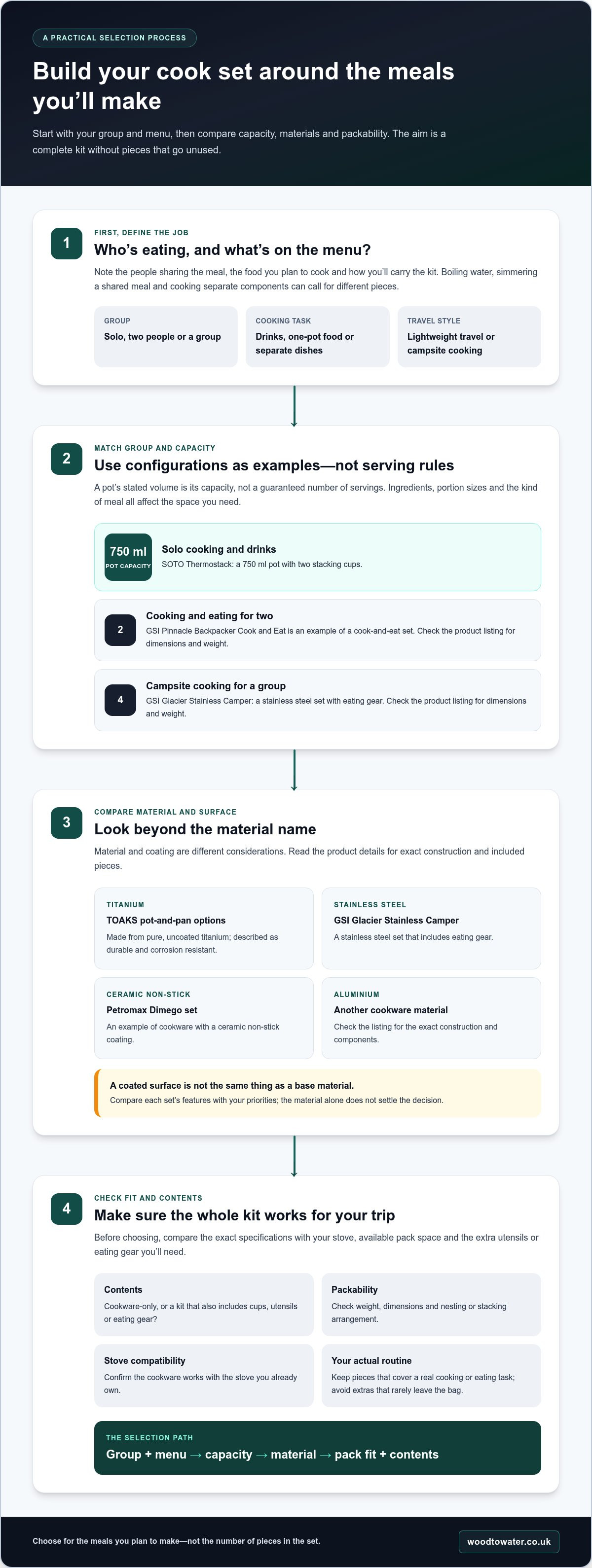
Common cook-set buying mistakes and how to avoid them
The biggest set isn’t automatically the most versatile. Extra pieces can be useful, but only if they suit the meals you make and the way you travel. A cookware set also doesn’t necessarily include a stove, burner or fuel. Read the product description carefully to see whether you’re choosing cookware for a separate stove or an integrated cooking system.
Before buying, run through this checklist:
- Who’s eating? Think about your usual number of diners, not just the largest group you might cook for occasionally.
- What’s on the menu? List the meals you actually prepare outdoors and the cookware they call for.
- Which stove will you use? Check the product’s stated compatibility with your specific heat source.
- Which material suits your use? Compare the cookware’s material and surface with your cooking habits.
- How will you carry it? Consider available pack space, including room for pieces that nest or stack.
- What else do you need? Account for utensils, cups or eating gear if they aren’t part of the set.
Avoid buying more cookware than your trips need
Start with your regular trips and familiar meals, rather than packing for every possible scenario. Pots, cups and utensils that stay unused add bulk without improving the cooking you do most often. If you usually travel solo, choose around that routine. For occasional group outings, bringing separate pieces may work better than carrying a larger kit on every trip.
That doesn’t mean you should always choose the smallest option. If you regularly cook varied meals for several people, extra cookware may earn its place. Ask whether each component solves a real need. Make a short menu, then check that the set can handle its tasks without leaving you short of essentials.
Check stove fit, included parts and care instructions
Look for a clear list of what the product includes and any stated compatibility information. Integrated stove systems differ from cookware designed for use with a separate burner. If you’re considering that format, the Ultimate Guide to Jetboil Systems for Fast Trail Cooking offers more context. For a separate heat source, the camping gas stove collection is useful when comparing stove options.
Surfaces can have different care requirements. Don’t assume non-stick, ceramic-coated and uncoated cookware all need the same handling. Follow the manufacturer’s instructions for both the cookware and its compatible heat source, including guidance on use and cleaning. A quick check before setting off can help you avoid relying on unsuitable cookware or missing a required component.
Use the checklist to narrow your options, then compare the cook sets and choose a kit for your trips. A well-matched set covers your planned meals without asking you to carry pieces you rarely use.
Cooksets to consider from Wood To Water Outdoors
Use the examples below to compare configurations, not to pick a universal winner. A compact pot-and-cup combination meets a different need from cookware designed for shared meals. Consider how many people you cook for, what the kit includes and whether you value a modular setup or coordinated eating gear. Product details can vary between options, so use the listed features to guide your comparison.
| Trip style | Group size | Example and confirmed features | May suit |
|---|---|---|---|
| Compact solo trips | Solo | SOTO Thermostack Cook Set Combo, 750ml pot and two stacking cups | Travellers wanting a pot with cups that stack |
| Flexible cooking | Solo or group | SOTO Navigator Cook Set, modular aluminium kit | Those who want components for solo use or group cooking |
| Pot-and-pan cooking | Solo or shared, depending on meal needs | TOAKS Titanium Pot with Pan, listed in 1100ml or 1300ml variants | Those comparing titanium cookware with a pot-and-pan configuration |
| Shared campsite meals | Four | GSI Glacier Stainless Camper, stainless steel cook-and-eat set | Groups wanting cookware and eating gear together |
| Cooking and eating together | Two | GSI Pinnacle Backpacker Cook and Eat set, complete cooking and eating set | Two people looking for a coordinated kit |
Compact picks for solo trips and flexible cooking
The SOTO Thermostack pairs a 750ml pot with two stacking cups, a compact arrangement for solo travellers who also want cups in the kit. The TOAKS Titanium Pot with Pan offers a different approach, with 1100ml and 1300ml variants to compare against the meals you plan to make. For more flexibility, the SOTO Navigator Cook Set is a modular aluminium kit described for solo use or group cooking. These examples show how the right configuration depends on your cooking routine, not just the number of pieces.
Larger and more specialised sets for campsite meals
For shared cooking, the GSI Glacier Stainless Camper is described as a stainless steel cook-and-eat set for four. The GSI Pinnacle Backpacker Cook and Eat set is a complete cooking and eating option for two. If you’re considering cast iron instead, separate cast iron cookware is a material-specific choice rather than one of these coordinated portable cook-set configurations.
There’s no need to carry a larger kit just because it includes more pieces. Compare the examples with your usual group size, planned meals and preferred setup, then read each product description for its precise contents. Browse the camping cook sets to find a configuration that fits the way you cook outdoors.
Make your next camp kitchen work for you
Put your choice to the test on your next trip. Before you pack, picture the meals you’ll make and lay out the pieces you expect to use. Afterwards, note what earned its place and what stayed packed away. This simple habit can help you refine your setup over time, rather than adding kit for situations that may never arise.
The best cook sets are the ones that make your outdoor routine straightforward. A simple brew stop, a meal shared after a day on the trail and a longer campsite stay all call for slightly different priorities. Choose for the trips you enjoy most, then leave room to adapt as your cooking style changes.
Wood To Water Outdoors brings together camping, hiking and bushcraft equipment, including cookware for different ways of preparing meals outdoors. Decide which features matter most to you, then explore the cook set collection and find a setup for your next outing. Here’s to good food and happy days outside.
Frequently Asked Questions
Can I use a camping cook set on any camping stove?
Not necessarily. Compatibility depends on the cookware design and the stove, so read the product description and maker’s instructions before use. Some collection listings describe cookware sets designed for gas stoves, while others describe a combined pot-and-stove system. Don’t assume a pot will sit securely on every burner. If you already own a stove, compare its design with the cookware guidance before packing, rather than discovering a mismatch at camp.
Does a camping cook set include a stove and fuel?
Some sets contain cookware only, while others are described as cooking systems that include a stove. Fuel is a separate consideration, so don’t assume it comes with either type. Check the product description for the named components, then plan the full setup around your meals. For example, a kit intended for boiling water may not meet your needs if you plan to cook several ingredients in a pan.
Is titanium cookware a good choice for camping?
It can suit campers looking for a lightweight cookware option. The TOAKS Titanium Pot with Pan is described as pure, uncoated titanium that’s durable and corrosion resistant. Whether it fits your trips depends on the capacity and features you need, as well as how you cook. Compare the product details with other materials, then consider whether the pot-and-pan arrangement suits the meals you usually prepare outdoors.
Can I use camping cookware over an open fire?
Don’t assume every cook set is suitable for direct open-fire use. Construction, handles and coatings vary, and cookware intended for a stove may not be designed for direct flames. Check the specific product guidance before using it over a fire, and follow the maker’s instructions. If open-fire use isn’t described, stick to the stated directions. This helps you avoid exposing cookware to a heat source it wasn’t intended for.
How do I stop food sticking to camping cookware?
The cooking surface and your method both matter. A set with ceramic non-stick coating, such as the Petromax Dimego Camping Cookware Set, differs from uncoated titanium cookware. Follow the maker’s guidance for heat, utensils and cleaning, since care requirements can vary. Choose a surface that suits the meals you regularly cook, and use the product instructions as your reference rather than assuming all camping cookware handles food in the same way.
How many people can one camping cook set serve?
It depends on the cookware capacity, included pieces and the meals being prepared, not just the product name. Collection examples are described for solo travellers, two people and four. Treat those descriptions as a guide, then consider your menu: a one-pot meal has different demands from cooking several dishes at once. Also think about whether everyone needs individual eating gear or whether you’ll pack those pieces separately.
Are camping cook sets suitable for use at home as well?
Some are described for use beyond camping. The Petromax Dimego Camping Cookware Set, for example, is described for camping, festivals, campervans and home. Suitability still depends on the particular cookware and the heat source you plan to use. Check the product details and instructions before using an outdoor set on a domestic hob; don’t assume it’s compatible with every type of cooker.