

Camping Lights & Lanterns: Ultimate UK Buying Guide 2026
Have you ever found yourself fumbling with a flickering torch in the middle of a Peak District downpour, only for the batteries to pack in just as you reached the tent? It's a frustrating rite of passage for many UK campers, but it doesn't have to be your reality. Choosing the right camping lights & lanterns is about more than just finding the highest lumen count; it's about reliability when the mist rolls in and the temperature drops. We understand that gear needs to be as tough as the terrain, whether you're wild camping in the Highlands or setting up a family basecamp in Cornwall.
You likely agree that nothing ruins a night under canvas faster than an unexpected power failure or a torch that's too heavy for your pack. This guide promises to clear the fog, showing you how to select the perfect illumination for every scenario, from ultralight trail torches to cosy, atmospheric lanterns. We will preview the latest 2026 safety standards, explain why 300 to 500 lumens is your campsite sweet spot, and show you how to keep your devices powered on multi-day treks. From technical headlamps to robust rechargeable systems, we've curated the essential knowledge you need to stay bright and safe.
Key Takeaways
- Learn why chasing the highest lumen count can be a mistake and how to find the 300 to 500 lumen sweet spot for a comfortable campsite.
- Discover how to choose camping lights & lanterns by balancing portable weight with the 15-hour runtime needed for long nights under canvas.
- Understand the specific advantages of hands-free head torches for technical tasks versus using central lanterns to create a social hub.
- Explore rugged, multi-functional gear from brands like Flextail and Fire-Maple that's specifically curated for the UK's demanding outdoor conditions.
- Learn the best ways to store and clean your equipment to prevent battery degradation and keep your illumination clear for your next adventure.
Understanding Camping Lights & Lanterns: Why Quality Matters
Relying on your smartphone torch is a gamble that rarely pays off in the wild. Phones aren't built for the damp; they drain battery quickly; and they offer a narrow beam that lacks depth. High-quality camping lights & lanterns are purpose-built tools designed to thrive where electronics usually fail. They provide the specific beam patterns needed to spot a trip hazard or illuminate a map without blinding your companions. When you're miles from the nearest streetlamp, having a reliable, dedicated light source is the difference between a comfortable evening and a stressful one.
Safety is the primary reason to invest in proper gear. A well-placed light reveals the hidden web of guy lines around your pitch, preventing midnight tumbles. We categorise lighting into three essential types: ambient for general atmosphere; task for focused jobs like cooking; and navigation for moving through the woods. Understanding the history and evolution of lanterns reveals how we've moved from heavy, oil-based lamps to the versatile LED camping lights & lanterns we use today. This evolution means you can now carry a powerful light source that weighs less than a bag of crisps.
Ambient vs. Focused Light: Which Do You Need?
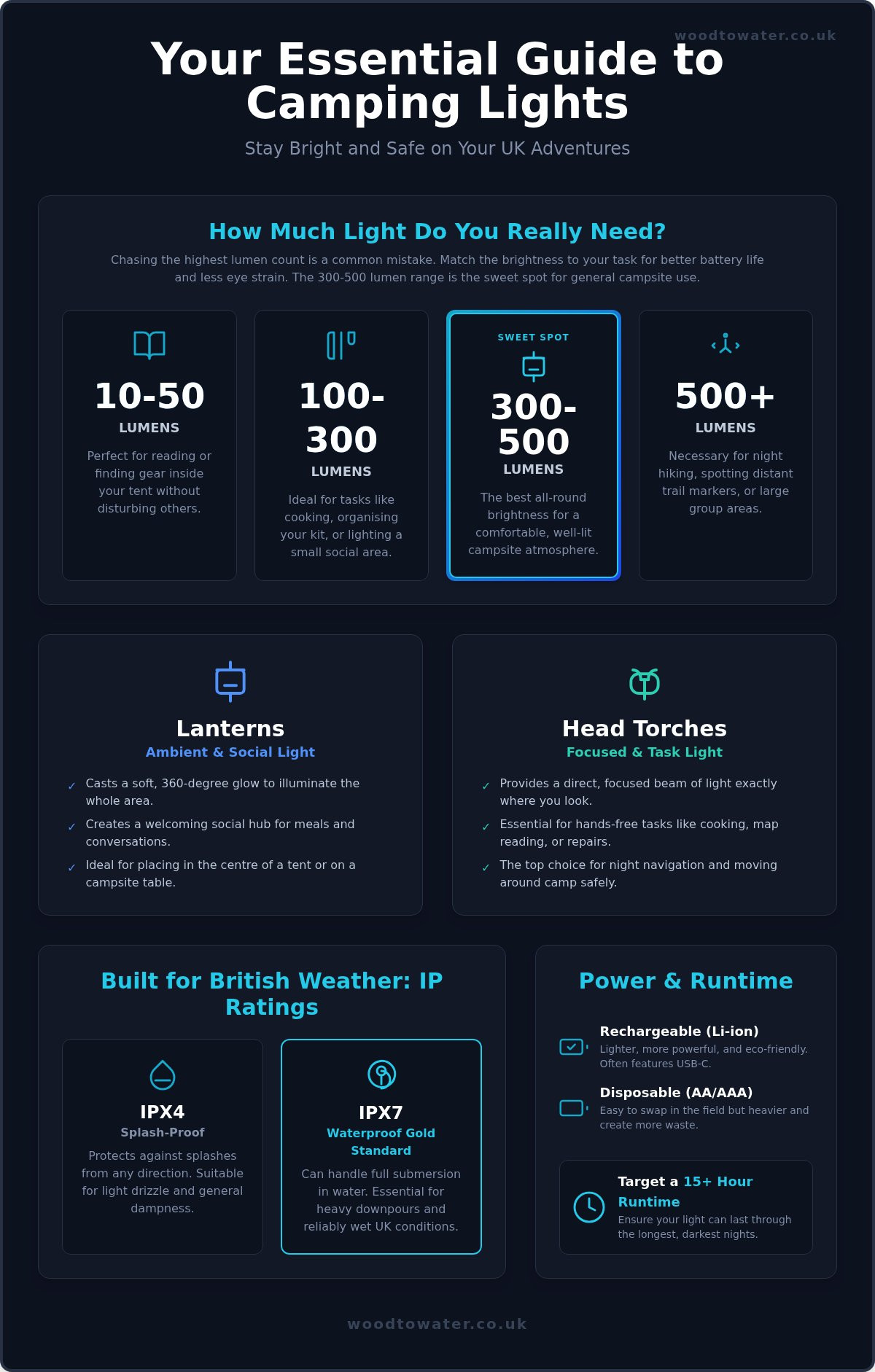
Lanterns are your social hub. They cast a soft, 360-degree glow that makes a campsite feel like home. These are perfect for group meals, planning the next day's route, or just socialising after sunset. Conversely, headlamps and torches provide a focused beam for night hiking or precise tasks like checking a map. You really need a mix of both for a well-organised camp. A lantern sets the mood and defines the space, whilst a headlamp ensures you have light exactly where your eyes are looking.
The UK Factor: Weatherproofing and IP Ratings
British weather is notoriously fickle. If you're heading to a damp Lake District valley or a misty Scottish glen, a basic "water-resistant" light won't cut it. You need to understand IP ratings. An IPX4 rating protects against splashes from any direction, which is fine for a light drizzle. However, IPX7 is the gold standard; it can handle a full dunking in a puddle or a heavy downpour. Condensation is another silent killer of electronics, especially in the tight confines of 1-man tents where moisture builds up overnight. Choosing gear with high-quality seals and robust housings ensures your light stays bright even when the air is thick with humidity. Reliability in the rain isn't a luxury; it's a safety requirement for the UK explorer.
Technical Specs Decoded: Lumens, Runtime, and Power
Many explorers fall into the "Lumen Trap", believing that a higher number always equals a better experience. In reality, blast-furnace brightness inside a small tent just leads to eye strain and ruins your night vision. When you're researching how to choose a camping lantern, you'll quickly realise that light quality matters more than raw power. A 1000-lumen light might sound impressive on the box, but it's often overkill for a standard pitch and drains batteries at an alarming rate. We prefer lights that offer a range of modes, allowing you to dial the intensity down to suit the moment.
Calculating runtime is a balancing act between brightness and longevity. Most modern camping lights & lanterns utilise rechargeable Lithium-ion (Li-ion) batteries. These are significantly lighter and more powerful than traditional AA or AAA cells; however, they can be sensitive to the extreme cold of a British winter. Traditional batteries are easy to swap in a pinch, but they're less environmentally friendly and add unwanted weight to your pack. The rise of USB-C charging has been a game-changer for the trail. It allows you to top up your gear using a power bank, ensuring you aren't left in the dark on multi-day treks away from the grid.
How Many Lumens Do You Actually Need?
Selecting the right brightness depends entirely on your environment and task. Having too much light can be just as problematic as having too little.
- 10–50 Lumens: This is the sweet spot for reading or finding your gear inside 2-man tents. It's enough to see by without dazzling your tent-mate.
- 100–300 Lumens: This range is ideal for cooking, organising your kit, or lighting up a small social area. It provides clear visibility for tasks without being antisocially bright to neighbouring campers.
- 500+ Lumens: Save these high settings for navigating dense woodland at night or search-and-rescue situations where long-range visibility is a safety requirement.
Beam Distance and Spread: Finding the Balance
The way light is projected is just as vital as the lumen count. Flood beams offer a wide, even spread of light; they are perfect for setting up camp or lighting a communal table. Spot beams focus the light into a tight, long-reaching cylinder for spotting trail markers or potential hazards in the distance. Beam throw is the distance light reaches before the intensity drops to the level of light provided by a full moon. Finding a device that offers both flood and spot modes gives you the most versatility in the field. If you're looking for innovative, lightweight solutions that master this balance, our Flextail gear collection offers some of the most efficient power-to-weight ratios currently available.
Comparing Lighting Styles: Lanterns, Head Torches, and Strips
Selecting the right mix of camping lights & lanterns depends entirely on how you move through the landscape. If you're car camping with the family, you'll prioritise a warm, inviting glow that mimics a comfortable living room. If you're solo hiking, you'll need a focused beam that cuts through the mist. Many beginners overlook the psychological impact of light colour; a harsh, blue-toned LED can feel clinical and cold, whilst a warmer, yellow-toned light creates a cosy atmosphere that helps you relax after a long day. This sense of 'home' is vital for mental recovery on the trail.
Head torches are the ultimate hands-free tool. They are indispensable when you're preparing a late-night meal on camping gas stoves, allowing you to stir the pot whilst checking your fuel levels. For larger setups, modern LED strips and string lights are becoming popular. These are fantastic for illuminating large awnings or providing a consistent glow under camping tarps, ensuring every corner of your shelter is visible without the harsh shadows cast by a single central bulb. Choosing between these styles isn't about finding the 'best' one; it's about building a versatile lighting kit that adapts to your specific activity.
Why Head Torches are a Hiker's Best Friend
Weight is the primary concern for any backpacker. Much like the TOAKS Titanium Cookware philosophy of shedding every unnecessary gram, choosing a lightweight head torch prevents neck strain during long night hikes. Look for models with an adjustable tilt so you can aim the beam at your feet or your book without straining. A dedicated red light mode is also essential; it preserves your night vision and won't disturb your tent-mates if you need to find your water bottle at 3 am.
Lanterns for the Social Campsite
Lanterns act as the central 'hub' of light for a group. They provide the 360-degree illumination needed for card games or socialising. If pack space is tight, collapsible designs are a brilliant solution as they shrink down to a fraction of their size when not in use. Dimmable features are equally important. They allow you to transition from a bright dinner setting to a soft, low-level glow that signals it's time to sleep. Many modern lanterns also feature magnetic bases or integrated hooks, giving you the freedom to mount them on tent poles or hang them from a branch. This versatility ensures your camping lights & lanterns work for you, no matter where you pitch.
Standout Picks from the Wood To Water Collection
Selecting the right gear means looking beyond the generic options found on high-street shelves. Our curated range of 100+ camping lights & lanterns focuses on brands that understand the specific demands of the UK environment. We've personally vetted the inventory to ensure it meets a high standard for durability and utility. Whether you are prepping for a local weekend trip or a serious expedition, having gear that won't quit when the weather turns is an absolute priority.
Flextail gear represents the cutting edge of multi-functional design. Their units often combine high-output lighting with other trail essentials; some models even feature integrated air pumps for sleeping mats. This integration reduces the number of items in your pack without compromising on performance. For those who prioritise rugged reliability, Fire-Maple gear offers robust campsite solutions that feel at home in any bushcraft camp. These tools are built to last; they handle the knocks and damp conditions of a typical British expedition with ease.
The Best All-Rounders for Family Camping
Family trips require gear that can handle a bit of rough treatment. Nearly 30% of camping accidents result from equipment failure, which makes choosing a reliable lantern a priority for safety. We look for robust designs that won't shatter if they're accidentally dropped by children on a hard campsite floor. A standout feature in this category is the USB output. Many of our larger lanterns double as emergency power banks, allowing you to top up a phone or tablet if your primary battery runs low. It's a practical safety net that keeps everyone connected and the campsite functional.
Ultralight and Tactical Lighting for Bushcraft
When you're deep in the woods, your lighting needs become more specialised. Focusable lights are essential for forest exploration; they allow you to tighten the beam to cut through thick canopy or widen it to search for firewood. These minimalist torches fit perfectly into any bushcraft essentials kit. They offer the durability required for wild camping whilst remaining incredibly light. Many models also feature 'stealth' or low-intensity modes. These are perfect for maintaining a low profile and respecting the environment during a wild camp. If you're using a fast-paced Jetboil cooking setup, a compact lantern is the perfect companion for those quick trail-side meals.
Ready to upgrade your illumination? Explore our full range of camping lights & lanterns at Wood To Water to find your perfect match.
Maintenance and Safety: Getting the Most from Your Gear
Quality camping lights & lanterns are essential safety tools, not just conveniences. To ensure they perform when you're miles from the nearest road, regular maintenance is vital. After a muddy trek, always clean your gear with a damp cloth to maintain light clarity. Grit and dried mud on the lens can significantly reduce your effective lumen output; it can even find its way into charging ports, compromising the unit's water resistance.
During the off-season, battery health should be your priority. Avoid storing lithium-ion devices with a completely flat or fully charged battery for long periods. Aiming for a 50% to 70% charge helps prevent degradation. If your gear uses traditional AA or AAA batteries, remove them before storage to prevent corrosive leaks that could ruin your favourite torch. Always carry a secondary backup light source on every expedition. With nearly 30% of camping accidents resulting from equipment failure, having a redundant light is a simple way to stay safe.
Battery safety is particularly important in the unpredictable British climate. Modern 2026 regulations ensure built-in lithium batteries are tested for safety between -20°C and 50°C, but extreme cold still impacts performance. Keeping your electronics away from the tent floor and shielded from frost will help maintain a steady power flow throughout the night. Reliability is everything when the mist rolls in.
Extending Your Battery Life on the Trail
Managing your power efficiently can easily double your runtime. Use lower brightness settings for tasks like cooking or reading; only switch to high power when you need to spot a distant trail marker. In winter, keep spare batteries or power banks in an inside pocket to keep them warm. To prevent your light from accidentally activating and draining its battery inside your pack, engage the electronic lock-out mode or slightly unscrew the battery cap before you start hiking.
Final Checklist: Before You Head Out
A quick check before you leave can prevent a dark night in the wild. Verify that all devices are fully charged and that you have packed any necessary spare cells. Inspect the rubber seals on your charging ports to ensure they are free from debris, as even a small grain of sand can break the waterproof barrier. If you've realised your current kit is lacking, browse our Flextail gear collection to find innovative, rechargeable solutions that won't let you down.
Ready for Your Next Night Under the Stars?
Mastering your campsite setup starts with understanding that the right light is about quality over raw power. You've seen how balancing beam throw with a warm colour temperature can transform a dark pitch into a welcoming home. Whether you're navigating a misty forest with focusable beams or socialising under a tarp, the right gear ensures safety and comfort. Our expert reviews and curated selection focus on durability; we feature leading brands like Flextail and Fire-Maple that are specifically built for the UK's rugged conditions.
Don't let a dying battery or a dim torch cut your adventure short. From specialist lighting for forest and cave exploration to technical headlamps, we've vetted every item to ensure it meets our high standards. Browse our full range of camping lights & lanterns today to find the perfect match for your 2026 expeditions. It's time to step into the wild with confidence. Happy camping!
Frequently Asked Questions
How many lumens do I need for a camping lantern?
For effective campsite illumination, a light output of 300 to 500 lumens is generally recommended. This range provides enough brightness to light a social area or cook safely without being antisocially intense. If you're just reading inside your tent, as little as 10 to 50 lumens will suffice. Always look for models with adjustable settings to balance your immediate visibility needs with the 15-hour battery runtime advisable for a full night's use.
Is it better to have a rechargeable or battery-powered camping light?
Choosing between rechargeable Li-ion and traditional batteries depends on your trek length. Li-ion systems are lighter and offer better energy density, which is ideal for multi-day hikes. They can also be topped up via power banks on the trail. However, traditional AA or AAA batteries are useful as a backup because they're easy to swap instantly. Many modern camping lights & lanterns now offer hybrid power options to give you the best of both worlds.
What does the IPX rating on my camping light mean?
An IPX rating indicates how well your gear resists water and dust. For the unpredictable British climate, an IPX4 rating is the minimum you should consider, as it protects against splashes from any direction. If you're heading to the Lake District or Highlands where heavy rain is likely, look for IPX7. This rating ensures the device can survive being submerged in a puddle, providing essential reliability when the weather turns truly rugged.
Can I use my camping lantern as a power bank?
Yes, many high-quality lanterns now feature a USB output port that allows them to function as a power bank. This is a brilliant multi-functional feature for charging your smartphone or GPS device in an emergency. Brands like Flextail specialise in these versatile designs, which help you reduce overall pack weight by combining two essential tools into one. Just remember that charging other devices will significantly reduce your remaining lighting runtime.
Why do some camping lights have a red light mode?
Red light is used to preserve your natural night vision because it doesn't cause your pupils to constrict like white light does. It's an essential feature for checking maps or finding gear in the middle of the night without waking your tent-mates. Additionally, red light is less likely to attract insects and is much more polite to use in busy campsites where you don't want to dazzle your neighbours during a midnight stroll.
How do I prevent my torch from turning on in my rucksack?
Most technical torches feature an electronic lock-out mode that is activated by holding the power button for several seconds. This prevents the light from accidentally switching on inside your rucksack and draining the battery before you reach camp. If your model doesn't have a digital lock, you can achieve a mechanical lockout by slightly unscrewing the battery cap. This breaks the circuit and ensures your camping lights & lanterns stay off until you're ready.
What is the difference between a flood and a spot beam for camping?
A flood beam provides a wide, even spread of light that is perfect for illuminating your immediate surroundings, such as a cooking area or the inside of a tent. In contrast, a spot beam focuses the light into a tight, powerful cylinder designed for long-distance visibility. Spot beams are vital for night navigation or spotting trail markers in dense woodland. Having a light that can toggle between both settings offers the most versatility for UK explorers.
How should I store my camping lights when not in use?
To maintain battery health, store your lights in a cool, dry place away from direct sunlight. If your device uses Lithium-ion batteries, it's best to store them at roughly 50% to 70% charge rather than leaving them completely flat. For lights that take traditional alkaline batteries, always remove the cells before long-term storage. This simple step prevents corrosive leaks from damaging the internal components, ensuring your gear is ready for your next adventure.