

Camping First Aid & Survival Kits: How to Choose the Right Kit
The biggest kit isn’t automatically the best choice for your next trip. The right camping first aid & survival kits depend on where you’re going, what you’ll be doing and how much space you can spare in your pack.
First aid and survival kits are designed for different needs, and a long contents list doesn’t necessarily make a kit more suitable. A family camping weekend and a longer walk call for different preparations. A compact kit may be more practical than extra equipment you won’t carry or can’t reach easily.
This guide explains the difference between first aid and survival kits, then compares options by activity, contents and carry format. You’ll find practical checks for choosing a kit, packing it and reviewing it before a trip. From compact tins and pouches to individual emergency accessories, the aim is to help you choose what fits your plans.
Key Takeaways
- Choose camping first aid & survival kits around the risks and demands of your outing, not the longest contents list.
- Read the stated contents and compare the format with your packing needs. Don’t assume what’s inside from a product name alone.
- Match your choice to the trip, whether you’re camping with family, going on a day walk or planning a longer expedition.
- Consider who may need to use the kit and how easily you can reach it when choosing a tin, pouch or bag.
- Before setting off, review the contents, check the kit’s condition and make sure it’s accessible.
Camping first aid and survival kits: what does each type prepare you for?
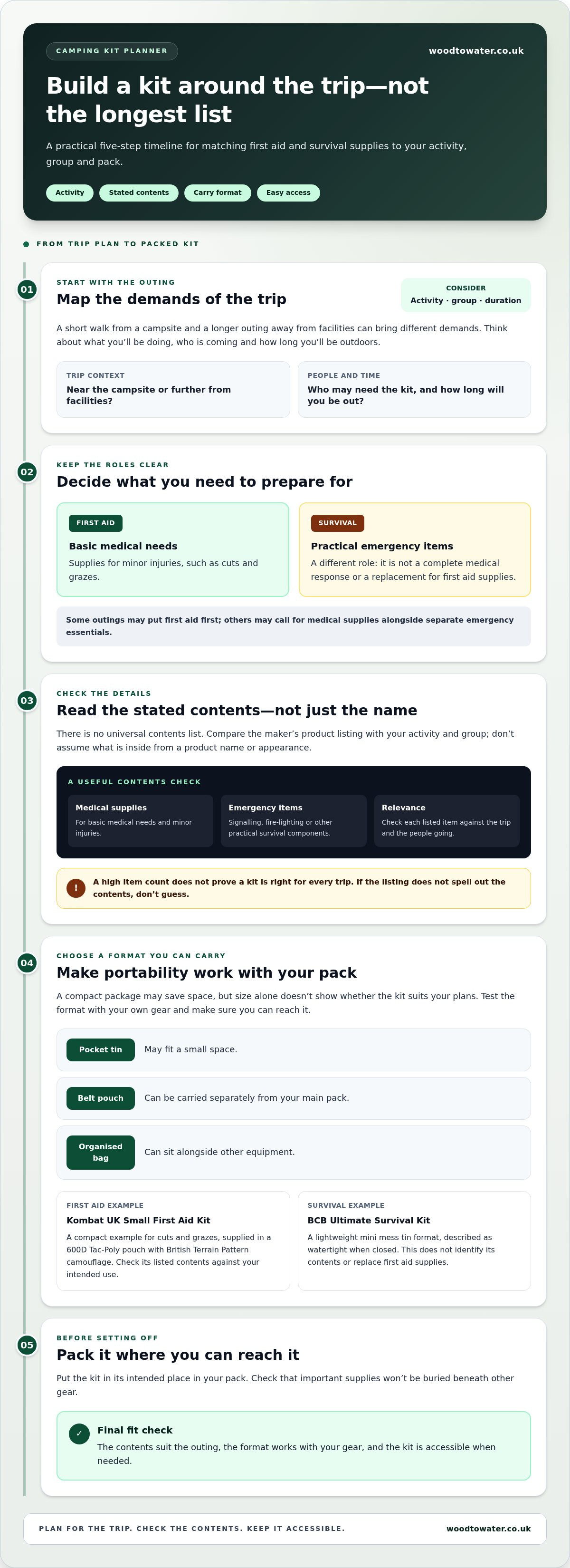
A first aid kit and a survival kit prepare you for different situations outdoors. A first aid kit contains supplies for basic medical needs and minor injuries, such as cuts and grazes. A survival kit focuses on practical emergency items. It isn’t a complete medical response and shouldn’t be treated as a replacement for first aid supplies.
That distinction matters when choosing camping first aid & survival kits. A short walk from a campsite and a longer outing away from facilities can bring different demands. Consider the activity, who is coming and how long you’ll be outdoors. Rather than assuming one kit covers every situation, plan for medical supplies and any other emergency essentials your trip calls for.
There’s no universal contents list. Kits vary by purpose and format, so read the product’s stated contents instead of relying on its name or appearance. For background on what first aid kits are and how they vary, consult First aid kit Wikipedia. Use that overview as general context, then assess the specific kit you’re considering.
When is a camping first aid kit the right starting point?
Start with first aid if minor injuries and basic medical needs are your main concern. Think about the group and the time you’ll spend outdoors: more people may mean more potential users, while a longer outing makes it particularly important to know where supplies are and how to reach them. The Kombat UK Small First Aid Kit is a compact example for cuts and grazes. It comes in a supplied 600D Tac-Poly pouch with British Terrain Pattern camouflage. Check its stated contents against your intended use and the needs of your group.
When might a survival kit add useful preparation?
A survival kit may suit an outing where you also want practical emergency items beyond basic medical supplies. The BCB Ultimate Survival Kit is an example in a lightweight mini mess tin format. Its tin is described as watertight when closed. That describes the closed tin only; it doesn’t tell you what the kit contains or make it a substitute for first aid. Review the listed contents and consider whether they fit your plans.
For some outings, a first aid kit may be the main priority; for others, it may make sense to carry medical supplies alongside separate emergency essentials. Keep the roles clear as you plan. First aid supplies address basic medical needs, whilst survival items support other practical requirements. Compare the exact contents, format and intended use, then consider whether you can carry the kit somewhere accessible.
Use the product details to judge what a kit can help you prepare for. A name can suggest its purpose, but the stated contents let you assess its fit. Match those details to your activity and group before deciding what belongs in your pack.
Which camping kit features matter most: contents, organisation and portability?
Compare a kit’s purpose, stated contents and carry format. A compact package may save space, but its size alone won’t tell you whether it suits your plans. Check the details before deciding, and don’t infer specific contents from a product name.
| Kit type | Format | Stated contents | Intended use |
|---|---|---|---|
| First aid kit | Pouch, tin or bag | Check the maker’s product listing | Basic medical needs and minor injuries |
| Survival kit | Tin or other compact format | Check the maker’s product listing | Practical emergency preparation |
| First aid bag | Organised bag | Check the maker’s product listing | Carrying medical supplies in a format that suits your gear |
How should you compare kit contents?
Start with your activity and likely needs, then read every item the maker lists. Separate medical supplies from signalling, fire-lighting or other survival components: they serve different purposes, even when packed together. A high item count doesn’t prove that a kit is right for every trip. The Ready.gov emergency kit checklist offers broader emergency-preparedness context, though it isn’t a substitute for assessing a camping product’s stated contents.
Use these checks to compare camping first aid & survival kits:
- Purpose: Does the kit match the kind of preparation you need?
- Contents: Are the listed items relevant to your activity and group?
- Format: Can you carry it where you can reach it easily?
If the listing doesn’t spell out what’s inside, don’t guess from words such as “survival” or “complete”. Compare products with clear contents so you can make an informed choice.
What do packaging and weight tell you?
Choose a format that works with the way you carry your gear. A pocket tin may fit a small space; a belt pouch can be carried separately from your main pack; an organised bag may sit alongside other equipment. Each has practical trade-offs, so test the chosen format with your own pack and check that you can reach it when needed.
The Exped Clear Cube First Aid Bag has transparent TPU panels and weatherproof construction. These features may help you compare the bag’s format with your needs, but they don’t tell you what first aid supplies are inside. Check its product listing for contents, as you would with any kit.
Before setting off, put the kit in its intended place in your pack. Check that important supplies won’t be buried beneath other gear. A compact format is useful only if its contents suit the outing; a larger bag is practical only if you can carry and access it. For a closer look at options, browse camping first aid kits and compare each product’s stated details with your packing needs.
How to match camping first aid and survival kits to your trip
A kit that suits a campsite may not be the best fit for a long walk. Make a practical choice with four checks: define the trip, identify likely needs, compare the stated contents, then check the carry format. This helps you assess the kit without assuming one option suits every group or activity.
- Define the trip. Note the activity, route, time outdoors and how close you’ll be to your usual supplies.
- Identify needs. Consider who is going and what kinds of preparation are relevant to them.
- Compare contents. Read the maker’s list and distinguish medical supplies from other emergency items.
- Check the format. Decide where the kit will sit and whether you can reach it without unpacking everything.
What should a short camping trip kit cover?
For a family campsite or short stay, start with the likely minor injuries and the needs of the people in your group. A compact format can be easier to fit into your camping gear, but make sure you can locate and reach its contents. The compact Kombat UK Small First Aid Kit is an example intended for minor cuts and grazes. Review its product details and consider whether the group’s needs call for additional supplies. For medical guidance on what to carry or how to use first-aid items, consult suitable, current UK first-aid advice rather than relying on a product label alone.
On a day walk, space may be tighter, so decide where you’ll carry the kit before setting off. Check that its contents match your planned activity and that its format fits your pack or other carry system. Don’t judge suitability by compactness alone: a small kit is useful only if its contents meet your needs.
What changes for longer walks or remote outings?
For a longer route or more remote outing, consider the space you have, how long you’ll be away and how quickly you could reach the kit. The BCB Lightweight Trekking Essentials Survival Kit is described for longer-distance walking and expedition use, including DofE training. Its stated 13 essential items offer a starting point for comparison, not a guarantee that it suits every route. Read the listed contents and intended use, then assess them against your activity and packing plan.
Before you leave, put the kit in its intended place and check it won’t be buried beneath other gear. A broader camping checklist can help you plan the rest of your equipment, but keep the kit decision tied to your trip. If you’re unsure about first-aid requirements, seek guidance from a suitable UK first-aid source. The right choice is the one whose stated contents and format make sense for the people, activity and time outdoors.
Standout camping first aid and survival kits: which options suit different needs?
There’s no single winner for every trip. A dedicated first aid pouch, a broader survival kit and an individual emergency accessory each have a different role. Compare options by intended use and format, then check the product’s current details before deciding what belongs in your pack. These examples offer a practical shortlist, not a ranking or a guarantee of safety.
Compact first aid and trekking options
Kombat UK Small First Aid Kit: A compact pouch option described for minor injuries such as cuts and grazes. Consider it when a small first aid kit suits the outing, and compare its stated contents with your group’s needs.
BCB Lightweight Trekking Essentials Survival Kit: Intended for longer-distance walks and expedition use, including DofE training. It’s described as containing 13 essential items, but that number alone doesn’t show whether the kit suits your route. Compare its stated contents and format with what you plan to carry.
These options have different purposes: one is a first aid kit, whilst the other is a trekking survival kit. Don’t treat them as interchangeable. If your trip calls for basic medical supplies and other emergency items, consider whether you need a separate accessory or additional kit instead of assuming one product covers everything.
Emergency accessories and broader survival kits
BCB Howler Emergency Whistle: A loud, compact, battery-free accessory for emergency signalling. It can be considered alongside a kit, but it isn’t a first aid pouch or a complete survival kit.
BCB Foil Hypothermia Space Blanket: A compact-format emergency accessory with a stated heat-retention purpose. Check its product information and consider whether this type of item fits your wider packing plan. Its stated purpose isn’t a guarantee of protection in every situation.
BCB Ultimate Survival Kit: Presented in a lightweight mini mess tin, described as watertight when closed. The tin format may suit someone looking for a contained survival kit. Read the current contents list to understand what it includes rather than inferring from the name or packaging.
Use these distinctions to narrow your shortlist: choose a dedicated pouch for first aid, a broader kit for the survival items it states it contains, or an individual accessory for a specific purpose. Check format and contents together. A small item may be easy to carry, but it still needs to suit the outing. The camping first aid and survival kits collection brings these options together for comparison by intended use and stated details.
Choose and pack your camping kit with a final buying checklist
Before choosing a kit, review the details that determine whether it will work for your outing. Look for an option you understand, can carry and can reach, with contents suited to the people and activity involved. Use this checklist to make your final comparison:
- Trip: Consider the activity, how long you’ll be out and how remote the route or campsite is.
- Users: Think about who is coming and whether the kit suits the group’s needs.
- Purpose: Decide whether your priority is first aid, survival equipment or a combination.
- Contents: Read the product’s current stated contents before packing. Don’t assume items from the product name.
- Format: Check that the pouch, tin or bag fits the space available in your pack.
- Access and maintenance: Choose a place you can reach easily, then check the kit’s condition and contents before setting out.
What should you check before choosing a kit?
Compare the product details with your group, activity and available pack space. A compact option may be convenient, but only if its stated contents suit your plans. Check how it closes and where it will sit in your gear. If you expect to need it, avoid packing it somewhere that requires you to unpack other equipment first.
Review the kit before each outing. Confirm its current contents, check that nothing has been used or damaged, and make sure anything you rely on is still present. If the kit includes items with use-by dates, inspect those too. Keep the maker’s information available, and seek suitable UK first-aid guidance if you need advice on medical supplies or their use.
How can you make the kit part of a wider camping setup?
Choose a consistent place for the kit and tell your companions where it is. This makes it easier for someone else to find if needed. As you organise the rest of your equipment, consider how the kit fits alongside your wider bushcraft essentials for an expedition, without letting other gear block access.
Revisit the checklist when your plans change. A family campsite, day walk and longer expedition can call for different combinations, so reassess the users, contents and carry position rather than assuming the same setup suits every outing. Reviewing your gear before departure also gives you time to spot missing or unsuitable items.
These checks make it easier to compare camping first aid & survival kits and choose a format that fits your plans. The camping first aid and survival kits collection can be compared against your checklist before packing.
Make your next outing a more considered one
Preparedness works best as part of your trip planning, not as a last-minute addition to your pack. Let the outing guide your choice, then reconsider it whenever your plans change. A different route, a new activity or a change in who’s coming can affect what you want to carry. Treat your kit as part of your wider outdoor setup and adjust it to the adventure ahead.
Choosing between camping first aid & survival kits doesn’t mean carrying every possible item. Aim for a practical fit with the trip ahead and take time to understand the option you choose. That preparation can help you feel more organised and ready to enjoy your time outdoors.
Explore the camping first aid and survival kits collection to compare options and find one that suits your next adventure. Browse camping first aid and survival kits.
Frequently Asked Questions
Can a survival kit replace a camping first aid kit?
No. A survival kit is not a substitute for medical supplies. It may include practical emergency items, but that doesn’t mean it contains what you need to respond to an injury. If you want both types of preparation for a trip, pack a first aid kit alongside any survival equipment you’ve chosen. Check the contents of each separately so you understand what each is intended to help with.
What should I check before packing a camping first aid kit?
Read the current contents list and check that the packaging is intact and the supplies appear clean and usable. Look for use-by dates where applicable, and replace items that are missing, damaged or past their date. Make sure you can find the maker’s instructions if the kit includes them. For advice on appropriate first-aid contents or use, consult a suitable UK source.
How often should I check the contents of an outdoor first aid kit?
Check it before each trip and after any use. This gives you a chance to replace supplies that have been used and spot damage before the kit goes back into your rucksack. If it’s stored between outings, include it in your regular gear check rather than assuming it’s still ready. Pay attention to packaging and dates where shown, and follow the maker’s care guidance.
Can I add my own supplies to a pre-packed camping kit?
Yes, you can add items that suit your group, provided you keep the kit organised and distinguish your additions from the maker’s original contents. Keep personal items clearly identifiable and avoid removing useful supplies just to make room. If you add anything with storage or expiry instructions, keep those details with it. For medicines or specific medical needs, follow professional advice and the product instructions.
Where should I keep a first aid kit in my rucksack?
Choose a consistent, easy-to-reach pocket, such as an outer compartment, rather than the bottom of the main section beneath clothing and cooking gear. The best spot depends on your rucksack and how you pack, so test access before setting off. Make sure companions know where it is, especially if you’re walking as a group. Keep it protected from items that could crush or damage its packaging.
Is a foil blanket useful to carry when camping?
It can be a useful compact emergency accessory to consider if it fits the conditions and plans for your outing. A foil blanket isn’t a replacement for suitable clothing, shelter or getting appropriate help if someone is unwell. Check the maker’s stated purpose and instructions, and store it where you can reach it easily. The BCB Foil Hypothermia Space Blanket is described as compact and intended to help retain heat.
Do I need first aid training as well as a camping first aid kit?
A kit and the knowledge to use its contents are different parts of preparation. Training can help you understand how to respond and when a situation needs professional assistance; a packed kit alone can’t provide that knowledge. Consider suitable first-aid training for your experience and activities, and refresh what you’ve learnt over time. Always follow current professional guidance and the instructions supplied with any item.