

Best Camping Gas Stove: High-Performance UK Gear Guide
Imagine you’ve just finished a long day on the trail, the rain is starting to set in, and your stomach is growling for a hot meal. You reach for your camping gas stove, only to find it flickering and dying against a moderate breeze. It’s a common frustration that can turn a great expedition into a miserable night. We know the feeling of staring at a cold pot of water whilst the wind howls; it's the last thing you need when you're exhausted.
We agree that your cooking kit should be the most reliable part of your pack, not a source of stress. This expert guide is here to ensure you never struggle with a failing flame or a heavy, inefficient setup again. You’ll discover how to choose a stove that balances portability with raw power, ensuring fast boil times even in the unpredictable UK climate. We’ll break down the essentials of fuel efficiency, explain the EN417 canister standard, and help you pick a lightweight system that won’t weigh you down on the trail.
Key Takeaways
- Identify the best connection types for your journey; we'll explain why screw-on burners are the top choice for weight-conscious hikers.
- Avoid cold-weather failure by learning how butane and propane mixes react to the UK's shifting seasons.
- Use our expert checklist to find the "sweet spot" between a stable cooking base and a lightweight pack.
- Explore why a high-performance camping gas stove from brands like Jetboil or Fire-Maple is worth the investment for trail reliability.
- Gain a clear understanding of the EN417 standard so you never buy the wrong fuel canister again.
What is a Camping Gas Stove and Why is it Essential?
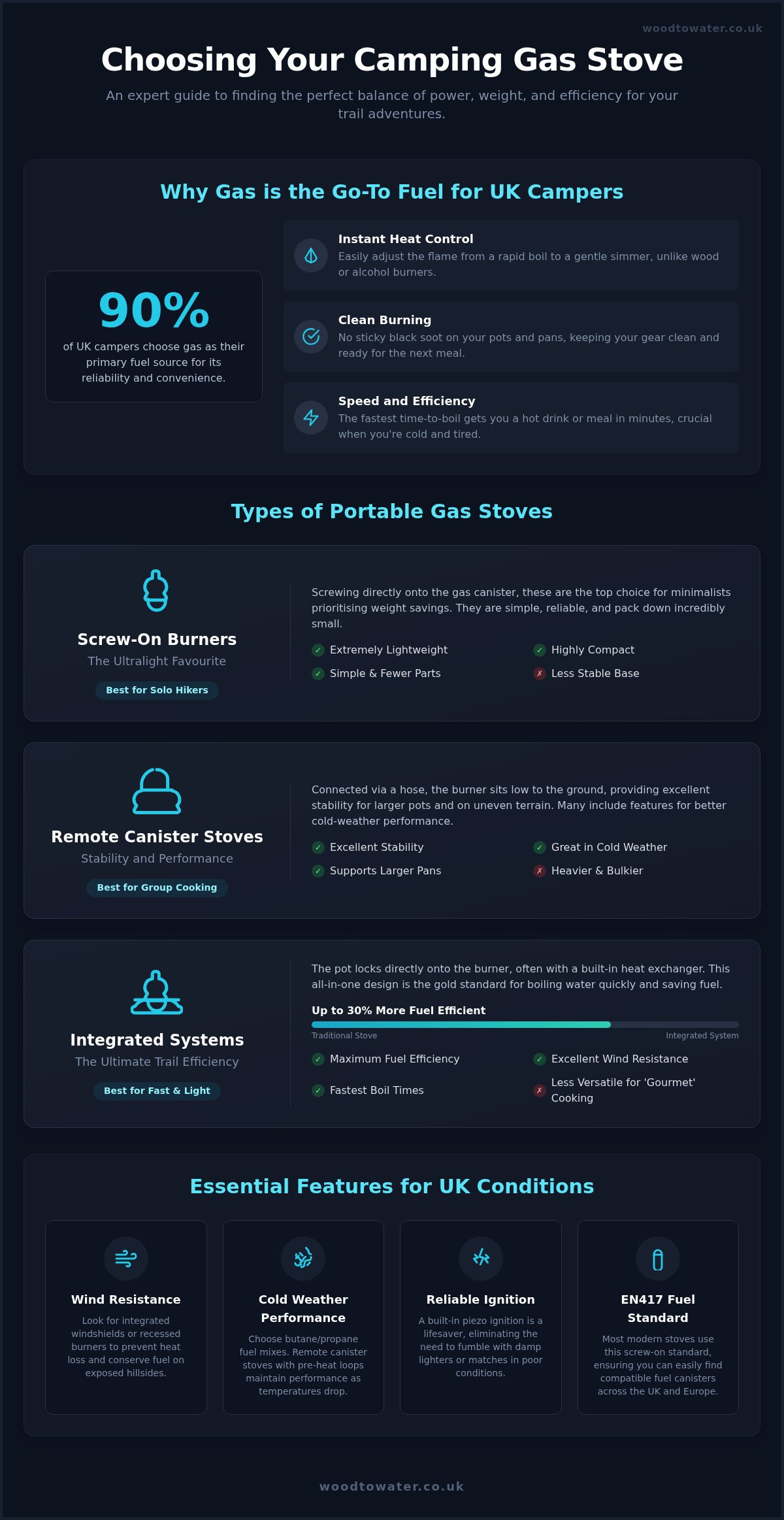
A camping gas stove is a portable device designed to provide controlled heat for outdoor cooking using pressurised gas. It is defined as the perfect balance of weight, power, and fuel efficiency. Whilst traditionalists might enjoy the ritual of a wood fire, approximately 90% of UK campers now choose gas as their primary fuel source. This preference isn't just about convenience; it's about having a reliable heat source that performs regardless of how damp the wood is or how hard the rain falls.
Beyond just heating a tin of beans, your stove is a critical piece of safety equipment. In the British hills, a hot meal or drink is often your first line of defence against hypothermia during a sudden weather shift. It also ensures you can boil water for safe hydration when natural sources are questionable. Having a dependable heat source allows you to maintain your core temperature and keep your morale high when the clouds close in. It's the heart of your camp, turning a cold night into a comfortable experience.
The Advantages of Gas Over Other Fuel Types
Gas offers several practical benefits that wood or spirit burners simply can't match on the trail. It's clean, fast, and incredibly easy to manage.
- Instant heat control: Unlike wood fires or simple alcohol burners, you can adjust a gas flame instantly. This makes simmering delicate meals just as easy as a rapid boil.
- Cleanliness: Gas burns clean. You won't find your Jetboil or titanium pots covered in sticky black soot after a single use.
- Speed: When you're tired, you want a brew quickly. Gas canisters provide the fastest "time to boil," getting you fed and warm in minutes rather than waiting for a fire to catch.
UK Environments and Stove Requirements
Cooking in the UK presents unique challenges that require specific gear features. Reliability in the damp is paramount. We always recommend stoves with a built-in piezo ignition; it saves you fumbling with damp matches or cold lighters when your hands are numb. Wind resistance is another essential for the British coast and moorlands. Look for recessed burners or integrated windshields to prevent the wind from stripping away your heat and wasting precious fuel. Finally, consider your portability needs. A solo wild camper prioritises a tiny footprint, whilst a family at a basecamp might favour a more stable, multi-burner setup that handles larger pans.
Understanding the Different Types of Portable Gas Stoves
Selecting the right camping gas stove starts with how it connects to your fuel. There isn't a one-size-fits-all solution for the British hills. Your choice depends on whether you're racing to the summit or settling in for a slow camp. We generally categorise these tools into three main designs: top-mounted burners, remote canister setups, and integrated systems. Most modern options in the UK use the EN417 screw-on standard, which ensures a safe and reliable seal every time you cook.
Screw-On Burners: The Ultralight Favourite
These tiny powerhouses are the go-to for minimalist backpackers. They screw directly onto the top of a gas canister, often weighing less than a set of house keys. Because they've got fewer moving parts, there's less to go wrong whilst you're out amongst the fells. They fit easily into the palm of your hand and tuck away into a small titanium mug. We recommend these for solo hikers who prioritise weight savings above all else. They're simple, effective, and take up almost no room in your pack. Our curated Fire-Maple gear includes some of the best examples of these compact, high-performance burners.
Remote Canister Stoves: Stability and Performance
If you're worried about tipping your dinner onto the grass, a remote canister stove is the answer. These connect to the fuel via a flexible hose, allowing the burner to sit much lower to the ground. This lower centre of gravity provides excellent stability on uneven terrain. Many of these models feature pre-heat loops; these are essential for maintaining performance when British temperatures drop towards freezing. They also offer wider pot supports, making them ideal for group cooking or using heavier cookware. If you prefer a more stable base for your camp kitchen, these are the most versatile choice for year-round use.
Integrated Systems: The Ultimate Trail Efficiency
Integrated systems are the modern gold standard for a high-performance camping gas stove setup. These designs feature a pot that locks directly onto the burner, usually incorporating a heat exchanger at the base. This clever bit of engineering can reduce fuel consumption by up to 30% compared to traditional setups. Everything nests together, storing the burner and gas inside the pot for a tidy pack. If you want the fastest brew time possible, you should explore our Jetboil collection for high-speed trail cooking. They're purpose-built to handle the wind and deliver hot water in record time, making them a firm favourite for UK expeditions.
Fuel Efficiency and Performance: Getting the Most from Your Gas
Understanding the chemistry inside your canister is just as vital as the camping gas stove itself. Most canisters contain a specific blend of Butane, Isobutane, and Propane. Propane is the powerhouse that provides high pressure in cold weather, whilst Butane is more cost-effective but struggles as the temperature drops. Isobutane is the middle ground, offering better performance than standard Butane in cooler conditions. For most UK expeditions, a high-quality Isobutane-Propane mix is the gold standard for reliability.
You might notice that "summer gas" fails during a crisp UK autumn or winter. This happens because Butane has a boiling point of around 0°C; if the canister gets colder than that, the gas stays liquid and won't reach your burner. You're left with a weak, sputtering flame that can't even simmer water. For year-round adventures, we always recommend 4-season blends that maintain pressure even when the frost sets in. To get your pack weight exactly right, read our ultimate guide to camping gas for deeper fuel insights.
Calculating your fuel for a three-day expedition is a simple bit of trail maths. On average, a person uses about 25g to 30g of gas per day for a hot dinner and two brews. For a solo 72-hour trip, a small 100g canister is often sufficient, but we suggest a 230g canister if you're cooking more complex meals or dealing with freezing temperatures. Having that extra margin ensures you aren't eating cold rations on your final night.
Managing Boil Times in British Weather
The unpredictable British climate can play havoc with your stove's performance. Wind is the primary culprit. A mere 5mph breeze can double your fuel consumption by stripping heat away from the base of your pot. We recommend these simple habits to keep your efficiency high:
- The Lid On rule: Always keep your pot covered. This simple habit saves gas and reduces boil times by up to 20%.
- Find a lee: Even a small rock or a backpack can act as a vital windbreak for a camping gas stove.
- Use heat reflectors: A lightweight foil reflector can help bounce heat back towards the pot, maximising every gram of fuel.
Canister Compatibility and Safety
Safety starts with the right connection. The standard screw-thread you will find at Wood To Water Outdoors is the EN417 specification, which is the most reliable option for UK hikers. This allows you to safely disconnect your stove for easier packing. We strongly advise against older pierceable canisters; once they are attached, they cannot be removed until empty, which is a significant safety risk in a cramped tent or pack. Always store your canisters in a cool, dry place and keep them away from sharp tools that could compromise the metal casing.
Practical Considerations: How to Choose Your Perfect Stove
Choosing a camping gas stove isn't just about picking the lightest one on the shelf. You need to consider your specific outdoor behaviour. Are you a solo peak-bagger or a group leader? Finding your personal "sweet spot" means balancing a low pack weight with enough stability to actually cook a meal. If you enjoy real cooking rather than just rehydrating pouches, look for a stove with excellent simmer control. A burner that only has "off" or "jet engine" settings will scorch your dinner in seconds. We recommend testing the control valve before you head out; a smooth, responsive dial is the mark of a quality build.
Maintenance is often overlooked but it's essential for trail reliability. Keep your kit organised. A stray bit of grit or pocket lint can easily block the tiny jet of your stove. We suggest storing your burner in its own protective bag before nesting it inside your cookware. This simple habit keeps the internals pristine and prevents your pots from getting scratched during transit.
Stability and Pot Support Design
Look closely at the span of the pot supports. Larger pans need a wider reach to stay balanced, especially if you're stirring a heavy stew. Serrated supports are a brilliant feature; they provide extra grip to stop your pot from sliding off on a slight incline. Ground-level remote stoves are the superior choice for wild camping on uneven UK moorlands, whilst canister-mounted stoves are perfectly fine for flatter, prepared campsite benches.
Ignition Systems: Manual vs. Piezo
Piezo ignitions offer fantastic convenience in the rain. A simple push-button spark is much easier than fumbling with matches when your fingers are cold. However, you should always carry a backup fire steel or a lighter. Piezo systems can be temperamental at high altitudes or in extreme humidity. If your piezo stops sparking, check if the small ceramic electrode has moved; often, a tiny adjustment with a multitool is all it takes to get it clicking again.
Packability and System Weight
Think about "Total System Weight." This includes the burner, your fuel, and your pot. High-performance setups allow for nesting, where the stove and a 100g canister fit perfectly inside your TOAKS Titanium Cookware. This saves valuable space and keeps your pack's centre of gravity close to your back. Choosing a stove that fits inside your backpack's side pockets or lid ensures you can grab it for a quick brew without unpacking your entire kit.
Browse our curated range of high-performance stoves to find the perfect companion for your next UK adventure.
Top-Tier Cooking Systems: Why Jetboil and Fire-Maple Lead the Pack
At Wood To Water Outdoors, we don't believe in stocking every camping gas stove on the market. Instead, we act as a knowledgeable curator, only selecting gear that we've personally vetted for the harsh UK climate. We focus on brands like Jetboil and Fire-Maple because they offer the reliability you need when you're miles from the nearest road. A cheap clone might look similar on a screen, but it often lacks the regulator quality and wind resistance required for a safe expedition. We prioritise equipment that delivers high performance and longevity, ensuring your investment lasts for years of adventure.
Selecting a top-tier system means you're buying into a proven design. Jetboil changed the game with integrated systems that prioritise speed and fuel economy. Fire-Maple, on the other hand, offers an incredible balance of professional features and value, making high-end trail cooking accessible to everyone. Both brands understand that a stove is more than just a burner; it's an essential tool for maintaining your morale and safety in the wild.
Jetboil: The Gold Standard for Speed
If your primary goal is to get hot water as quickly as possible, Jetboil is the undisputed king. The Jetboil Flash is a firm favourite for its lightning-fast boil times, often reaching a rolling boil in just over 100 seconds. This efficiency is driven by their patented FluxRing technology. This clever heat exchanger captures the energy that other stoves lose to the air, directing it straight into your pot. It's a massive advantage in the wind, as the burner is largely protected from the elements. This makes it a top choice for DofE participants and solo hikers who want a reliable, "boil and go" setup that minimises fuel weight.
Fire-Maple: Innovative Gear for the Modern Explorer
Fire-Maple has built a reputation for creating rugged, dependable designs that are perfectly suited to the demands of UK bushcraft. Their stoves are built to be used, not just carried. You can browse Fire-Maple gear to find everything from ultralight titanium burners to robust remote canister systems. What sets them apart is their focus on high-power outputs. Whilst some integrated systems are specialised for boiling water, many Fire-Maple models offer the flame control needed to cook real meals from scratch. They provide a professional level of engineering that handles the messy, real-world conditions of a wild camp with ease.
Finding the right balance for your pack is a personal journey. Whether you need the record-breaking speed of a Jetboil or the versatile power of a Fire-Maple, we've curated the best of the best to support your next trip. Shop our full range of camping gas stoves to find your next essential piece of expedition kit.
Ready for Your Next Trail Adventure?
Choosing the right camping gas stove is the difference between a cold, frustrating night and a warm, restorative meal. We've explored how stability, fuel efficiency, and brand reliability play vital roles in the unpredictable UK climate. Remember to match your stove to your specific trip style; whether that's an ultralight solo trek or a group wild camp. Understanding the EN417 standard and cold-weather fuel mixes ensures you're never left without a flame when the temperature drops.
As part of the Great Out Doors retail group, we take pride in offering an inventory that's been expertly vetted for UK trails. We don't just sell gear; we use it ourselves. You can rely on our fast national shipping to get your essential kit delivered right to your door before your next departure. We're here to help you build a kit list that you can trust in any weather.
View our curated collection of Camping Gas Stoves and find the perfect partner for your pack. We'll see you out on the fells!
Frequently Asked Questions
What is the best gas for a camping stove in the UK winter?
An isobutane-propane mix is the best choice for a UK winter. Standard butane has a boiling point near 0°C, meaning it stays liquid and won't reach your burner in a frost. Propane has a much lower boiling point, providing the pressure needed to keep your camping gas stove running in the cold. We always recommend 4-season blends for hill walks between November and March to ensure a reliable flame when the temperature drops.
Can I use any gas canister with my camping stove?
You cannot use any canister with any stove. Compatibility is determined by the valve type. Most high-performance gear we stock uses the EN417 screw-on standard. Other systems might use clip-on or puncture-style canisters, which are not interchangeable. Always check your stove's manual and ensure the canister matches the connection type perfectly to avoid dangerous gas leaks or damaging the delicate seals on your burner. Using the wrong fuel source can be hazardous.
How long does a 230g gas canister last?
A 230g gas canister typically lasts for 60 to 90 minutes of total burn time. This usually equates to boiling around 15 to 20 litres of water. For a solo hiker cooking one main meal and two hot brews a day, a single camping gas stove setup should last roughly 7 to 9 days. Wind and ambient temperature will impact these figures; using a lid and windshield helps extend your fuel life significantly on the trail.
Are camping gas stoves allowed on aeroplanes?
Gas canisters are strictly prohibited on all aeroplanes in both hold and cabin luggage. You must purchase your fuel upon arrival at your destination. However, the stove itself is generally allowed if it's completely disconnected and cleaned of any fuel residue. We recommend packing your stove in your hold luggage to avoid any delays at security. Always check with your specific airline for their latest safety regulations before you head to the airport for your trip.
How do I clean a blocked camping stove jet?
You should use a dedicated jet cleaning tool or a very fine wire to clear a blockage. These jets are precision-engineered; avoid using thick needles or safety pins that could enlarge the hole and ruin efficiency. If you don't have a tool, a blast of compressed air can sometimes dislodge debris. Prevent future blocks by keeping your burner in a protective bag and ensuring your pots are clean before you place them over the flame.
Is it safe to use a camping gas stove inside a tent?
It is generally unsafe to use a stove inside a tent due to the risk of carbon monoxide poisoning and fire. If extreme weather forces you to cook in the porch, you must ensure maximum ventilation by leaving the door partially open. Always use a stable, flat surface to prevent tipping. Never leave a lit stove unattended in a confined space. It's better to cook outside or under a tarp whenever possible to keep your area safe.
What is the difference between a screw-on and a clip-on gas canister?
The primary difference is the connection mechanism. Screw-on canisters use an EN417 threaded valve that allows you to safely attach and remove the stove multiple times. This makes them very packable for hikers. Clip-on canisters, often found with "Easy Clic" systems, use a push-and-twist connection without threads. Whilst both are resealable, they are not interchangeable. Screw-on systems are the standard for the high-performance brands like Jetboil and Fire-Maple that we curate for UK expeditions.
Can I recycle empty camping gas canisters in the UK?
Yes, you can recycle empty canisters in the UK, but they must be prepared correctly first. Most local recycling centres require the canister to be completely empty and punctured to show it's no longer pressurised. You can use a specialised tool like the Jetboil CrunchIt to safely vent and pierce the metal. Once prepared, they can usually be placed in your household metal recycling bin. Always verify the specific rules with your local council to ensure they accept them.
