

Water Bottles and Flasks: How to Choose the Right Outdoor Hydration Gear
The biggest water bottle isn’t always the best choice for a day outdoors. The right option depends on how you’ll carry it, when you can refill and whether you want a quick drink on the move or a warm brew at camp. Water bottles and flasks range from simple reusable bottles to bladders and filter bottles, so it’s worth focusing on the features you’ll actually use.
Choosing outdoor hydration gear means balancing capacity with bulk, insulation with weight, and convenience with easy cleaning. A bottle that suits a short walk may be less practical on a longer hike, while a bladder or filter bottle can suit a different routine.
This guide compares the main options by activity, pack and refill habits. We’ll look at bottles such as Nalgene, insulated drinkware including the DD Thermal Water Bottle, LifeStraw filter bottles and Hydrapak bladders, alongside practical details such as carrying comfort, leak risk and cleaning. By the end, you’ll have a clearer idea of what to take on your next walk or camping trip.
Key Takeaways
- Match your hydration gear to the outing: a day walk, longer hike and campsite each place different demands on what you carry.
- Compare water bottles and flasks by capacity, access, pack fit and refill routine, not capacity alone.
- Choose a carry style that makes drinking convenient without adding unnecessary bulk or awkwardness to your pack.
- Plan for care as well as use; a design that’s straightforward to clean is easier to keep ready for the next trip.
- For some outings, pairing a personal bottle with a bladder or larger water carrier can make a more practical setup.
Water Bottles and Flasks: Which Type Suits Your Outdoor Plans?
A bottle that works well on a day walk may not be right for a longer camping trip. Choose a format based on how you’ll carry water, how easily you want to drink and where you can refill. A simple bottle is easy to keep in a pack pocket; a bladder makes sipping on the move more convenient, while a larger carrier is better suited to storing water at camp.
Each option has a different purpose. First decide whether you need water for the trail, a warm drink at a rest stop or a shared supply at camp. For background on different types of water bottles, including materials and their environmental impact, see Wikipedia’s overview.
Bottle, flask or bladder: what is the difference?
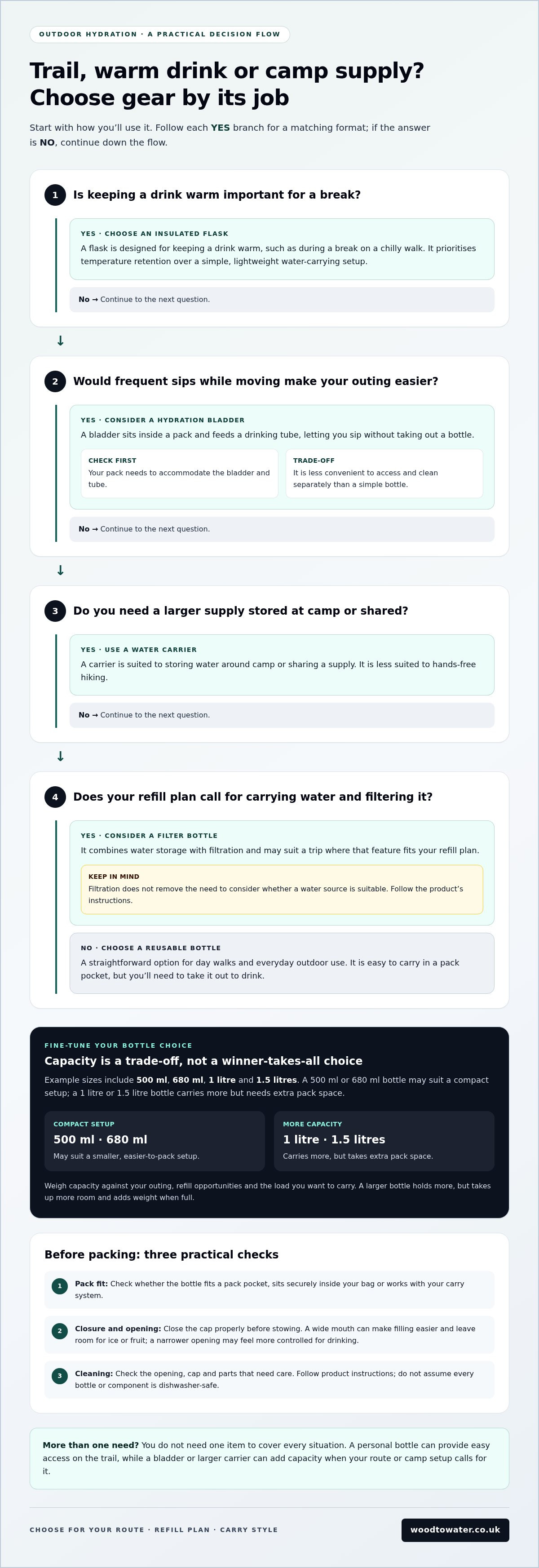
A reusable bottle is a straightforward container for carrying drinking water. An insulated flask is designed for situations where keeping a drink warm matters, such as a break on a chilly walk. A hydration bladder sits inside a pack and feeds a drinking tube, so you can sip without taking out a bottle. That’s useful while moving, provided your pack can accommodate the bladder and tube.
When does a filter bottle or water carrier make sense?
A filter bottle combines water storage with filtration, which may suit a trip where that feature fits your refill plan. Filtration doesn’t remove the need to consider whether a water source is suitable or to follow the product’s instructions. A water carrier has a different role: it holds a larger supply around camp or for a group, rather than providing hands-free access while hiking.
| Format | Typical use | Carry style and trade-off |
|---|---|---|
| Reusable bottle | Day walks and everyday outdoor use | Easy to carry in a pack pocket; you’ll need to take it out to drink. |
| Insulated flask | Keeping a drink warm for a break | Carried in or attached to a pack; prioritises temperature retention over a simple, lightweight water-carrying setup. |
| Hydration bladder | Hiking or other activities where frequent sips are useful | Pack-based with a drinking tube; less convenient to access and clean separately than a simple bottle. |
| Filter bottle | Trips where combining storage and filtration fits the refill plan | Portable like a bottle, but requires attention to product instructions and source suitability. |
| Water carrier | Storing water at camp or sharing a supply | Useful as a larger supply, but less suited to hands-free hiking. |
You don’t need one item to cover every situation. A personal bottle can provide easy access on the trail, while a bladder or carrier can add capacity when your route or camp setup calls for it. Choose the format that fits how you’ll drink, carry and refill.
How to Choose Water Bottles and Flasks: Capacity, Carry and Cleaning
The right choice depends on your routine, not simply the largest capacity on the shelf. Use these five steps to compare water bottles and flasks with the way you spend time outdoors.
- Start with the activity. For a short walk, a compact bottle may be easier to pack and reach. Longer hikes or time at camp may call for more water or a second container.
- Think about duration. Consider how long you’ll be out and how much space and weight you’re comfortable carrying. A larger bottle holds more, but takes up more room and adds weight when full.
- Plan your refills. If convenient refill opportunities are part of your plan, a smaller bottle may be practical. If refills are uncertain, choose capacity to suit your outing rather than relying on a universal amount.
- Choose how you’ll carry it. Check whether the bottle fits a pack pocket, sits securely inside your bag or works with your preferred carry system. Easy access matters when you want a quick drink on the move.
- Be realistic about cleaning. Check the opening, cap and any parts that need care. A design that’s awkward to reach or reassemble may be less convenient after a muddy weekend outdoors.
Match capacity and shape to your activity
Examples in the range of bottle sizes include 500 ml, 680 ml, 1 litre and 1.5 litres. A 500 ml or 680 ml bottle may suit a compact setup, while a 1 litre or 1.5 litre format carries more but needs extra pack space. Neither is automatically right: weigh capacity against the outing, expected refill opportunities and the load you want to carry. For a broader guide to how to choose a water bottle, REI also discusses capacity and features.
Check the cap, opening and cleaning routine
A secure closure matters if you’re packing a bottle alongside spare layers or other kit. Make sure the cap is properly closed before stowing it, rather than assuming it can’t leak. A wide mouth can make filling easier and leave room for ice or fruit; a narrower opening may feel more controlled for drinking. Whichever shape you prefer, follow the product’s care instructions. Don’t assume every bottle or component is dishwasher-safe.
Once you know which capacity and opening suit your routine, browse water bottles and flasks to compare options for your next outing.
Outdoor Water Bottles and Flasks Compared: Standout Options
This shortlist shows how different water bottles and flasks can suit different routines, from quick access on a walk to warm drinks or water storage at camp. It compares formats and stated features rather than naming one universal winner. For another perspective, explore Outdoor Gear Lab’s water bottle reviews.
Reusable bottles for walks and everyday carry
Nalgene bottles come in different capacities and opening styles. The 32oz / 1L Wide Mouth Sustain Water Bottle has a wide opening, while the Nalgene Sustain Narrow Mouth Bottle 1L offers a narrower opening at the same stated capacity. The Nalgene On-the-Fly Lock-Top Sustain Bottle 24oz 680ml is worth considering if one-hand access is a priority.
| Option | Format and supplied capacity or feature | Best-fit use |
|---|---|---|
| Nalgene 32oz / 1L Wide Mouth Sustain Water Bottle | Reusable bottle, wide mouth, 1L | Walks and everyday carry when a wide opening suits your filling routine. |
| Nalgene On-the-Fly Lock-Top Sustain Bottle 24oz 680ml | Reusable bottle, lock-top, 680ml | Outings where convenient one-hand access is useful. |
| Nalgene Sustain Narrow Mouth Bottle 1L | Reusable bottle, narrow mouth, 1L | Those who prefer a narrower opening to a wide-mouth design. |
| Insulated Stainless Steel Flask | Thermal drinkware for warm drinks | Taking a warm drink along for a break outdoors. |
| LifeStraw Go Renew Series Stainless Steel Water Bottle | Stainless steel filter bottle | Carrying water in a bottle format with filtration included. |
| LifeStraw Peak squeeze bottles | Squeeze-bottle format with filtration | Those considering a squeeze-style option rather than a rigid bottle. |
| Hydrapak Pioneer 6L / 10L | Packable water storage in 6L and 10L options | Keeping a larger supply at camp. |
Thermal, filtered and higher-volume hydration
An insulated stainless steel flask is suited to carrying a warm drink; check its product details for the stated duration. LifeStraw Go Renew Series Stainless Steel combines a bottle format with filtration, while LifeStraw Peak squeeze bottles offer a different shape. These options serve distinct purposes, so consider how you’ll carry and use them rather than treating their features as interchangeable. Follow the relevant product instructions.
For camp, the Hydrapak Pioneer comes in 6L and 10L options for packable water storage. It has a different role from a personal bottle: consider it for a shared or camp supply, rather than an everyday bottle to keep within easy reach on a walk.
Common Water Bottle Buying Mistakes to Avoid Outdoors
It’s tempting to look for one bottle that does everything, but the most practical setup depends on the activity and how you carry your kit. A bottle that’s easy to reach in a day-pack pocket may be awkward inside a full camping pack. Likewise, a large carrier that works well at camp isn’t designed for the same job as a personal bottle on the trail.
Avoid choosing capacity without considering the route
Capacity matters in context. Think about how long you’ll be out, what you’ll be doing and whether you have planned refill opportunities. A compact bottle might suit a shorter day walk with a refill stop, while a longer outing or camp may call for more storage. These are examples, not fixed rules. Plan water carriage alongside the rest of your kit, so a full container doesn’t take up space you need for other essentials.
A camping checklist helps you see the whole load at once. Include where you’ll carry water during the walk and where any additional supply will sit at camp. This makes it easier to decide whether you need a personal bottle, a larger storage option or a combination, rather than choosing capacity in isolation.
Don’t overlook access, compatibility and care
A bottle can hold the right amount and still be a poor fit if its shape doesn’t sit securely in your pack or its opening doesn’t suit how you drink. Decide whether you prefer to lift out a bottle for a sip or use a pack-based system. Bladders, filter bottles and accessories are specific systems, not automatically interchangeable parts. Follow the product instructions, including guidance on cleaning and care.
Check what a product is designed to do. A bottle isn’t necessarily insulated, equipped with a filter or suitable for hot drinks just because it’s described as outdoor drinkware. Match the stated features to your plans, and don’t assume a filter makes every water source suitable. Checking the intended use and care instructions can help you avoid an inconvenient mismatch once you’re out.
For a broader look at assembling outdoor kit, explore the bushcraft essentials guide. Then compare water bottles and flasks for your next trip and choose a format that fits your route, pack and refill plan.
Build Your Outdoor Hydration Setup and Choose a Bottle or Flask
A practical hydration setup doesn’t have to be complicated. Start with the outing, then choose gear that makes carrying, drinking and refilling straightforward. Use this checklist before settling on a bottle or flask:
- Activity: Is this for a short walk, a longer hike or time at camp?
- Capacity: How much water makes sense for the outing and your refill plan?
- Carry style: Do you prefer a bottle in a pack pocket, a bladder in your pack or a carrier stored at camp?
- Refills: Where do you expect to top up, and does your chosen format suit that routine?
- Care: Can you clean and store the bottle or system as its instructions recommend?
Choose a simple setup for day walks and hikes
For a casual outing, a reusable bottle in a familiar capacity and shape may be all you need. Choose an opening and carry position that feel comfortable for the way you drink. If you’d rather sip without reaching for a bottle, a bladder could suit your pack and walking routine. A filter bottle is another option if its stated function fits your plans; follow its instructions for use.
You can also combine formats. A personal bottle offers a separate, easy-to-access supply, while a bladder can serve as your main drinking system on the move. That pairing may suit a longer hike, provided the added gear and weight make sense for your route. Keep the setup comfortable and avoid carrying features you don’t need.
Choose a practical setup for camping and shared water
At camp, think about drinks and storage separately. A thermal bottle may suit you if taking a warm drink is part of the plan. A packable water carrier can hold a larger supply around camp, while a personal bottle remains useful for moving about or heading out for a walk. Match the carrier to your storage needs and the rest of your packed kit.
The right combination can be simple or more involved. A short walk may call for a single bottle, while a camping trip could benefit from a personal bottle alongside a bladder or larger carrier. Let your activity, capacity, carry style, refill plan and care routine guide your choice.
Ready to put together a setup that suits your next outing? Explore water bottles and flasks and start with the format that fits your plans.
Choose Hydration Gear That Fits Your Next Trip
A good hydration setup starts with how you’ll use it. Match capacity to your outing and refill plans, then consider how the bottle or system will sit in your pack and how easily you can drink from it. What works for a day walk may differ from what suits camp.
You don’t need to make one item cover every need. A reusable bottle can work alongside a bladder for convenient access on the move, or a water carrier for a larger supply at camp. Choose a filter bottle when its stated function fits your trip, and follow the product’s care instructions.
The collection brings together reusable bottles, thermal drinkware, filter bottles, bladders and water carriers, with examples from Nalgene, LifeStraw, Hydrapak and DD. Start with your activity, then compare formats that suit your routine.
Ready to find a practical match for your next walk or camping trip? Browse water bottles and flasks for your next outdoor adventure. Choose what fits, pack with confidence and enjoy your time outside.
Frequently Asked Questions
How do I choose the right water bottle for hiking?
Choose a bottle that suits your route, refill opportunities and preferred way of carrying water. For a shorter walk with convenient refills, a compact bottle may be enough; for a longer hike, consider the capacity you need alongside the extra weight and pack space. Check that the shape fits your pack and that its opening is comfortable to drink from. Easy care matters too, especially on multi-day trips.
What is the difference between a water bottle and a hydration bladder?
A water bottle is a separate container that you carry in a pack pocket or inside your bag, then take out when you want a drink. A hydration bladder sits inside a pack and usually provides access through a drinking tube, which can be convenient while walking. The best choice depends on your pack and routine. A bottle is easy to remove and refill; a bladder is a pack-based system that needs its own care.
Are insulated flasks suitable for camping?
Yes, an insulated flask can be useful for camping if you want to take a warm drink along or have one during a break. Choose it for that purpose rather than assuming every bottle will keep drinks warm. Consider how it fits with the rest of your kit, and follow the product’s instructions for use and care. For carrying drinking water, a separate reusable bottle or water carrier may better suit your setup.
Can I use a filtered water bottle for outdoor trips?
Yes, a filter bottle can suit an outdoor trip if its stated function fits your refill plan. A filter combines water storage and filtration, but don’t assume it makes every source suitable to drink from. Check the product’s instructions and consider the water source before relying on it. A filter bottle is a specific tool, not a substitute for planning where you’ll refill or understanding how your chosen product should be used.
What size water bottle should I take camping?
There’s no single size that suits every camping trip. Think about how long you’ll be out, whether you expect to refill, and how much space and weight you can carry. A personal bottle can be handy for walks around camp, while a larger water carrier can store a shared supply at your pitch. Plan both roles as part of your kit, rather than choosing one large bottle to do everything.
How do I stop a water bottle leaking in my rucksack?
Make sure the cap is correctly closed before packing, and check that the opening and closure are clean and properly fitted. If you’re unsure how it seals, test the bottle upright before putting it in your rucksack. Pack it where it’s less likely to be knocked open, and keep it separate from items that must stay dry. Don’t assume a bottle is leak-proof; follow its care instructions and check the closure regularly.
Are collapsible water bottles and carriers useful for camping?
Flexible water carriers can be useful at camp when you want to store a larger supply without carrying a rigid bottle for that job. They suit storage better than hands-free drinking on a walk, so pair one with a personal bottle if you need water close at hand. For any collapsible bottle or carrier, consider how you’ll fill, carry and clean it, and follow the product’s instructions for use and care.