

Top 10 Hikes in Scotland: Essential Routes & Gear Guide
You're standing on a rugged ridge in the Highlands as the mist rolls in, and suddenly that "waterproof" shell feels a lot less reliable. It's a scenario many walkers face when tackling the Top 10 Hikes in Scotland, where the weather can shift from sun to sleet in minutes. We know the feeling of staring at a map, torn between the lure of bagging one of the 282 Munros and the fear of being under-prepared for remote terrain. It's easy to feel overwhelmed by kit choices and access rules when you just want to be out there amongst the heather.
We've spent years testing gear in these exact conditions to ensure you don't have to learn the hard way. This guide promises to reveal Scotland’s most breathtaking trails paired with expert gear advice to ensure you're ready for the Highlands. We'll walk you through a bucket list of scenic routes, from the Isle of Skye to the Cairngorms, whilst building your confidence in gear selection. You'll also gain a firm understanding of the Scottish Outdoor Access Code; this ensures your next adventure is both safe and responsible.
Key Takeaways
- Learn the distinction between Scotland's 282 Munros and scenic lowland glens to better match your fitness level with the terrain.
- Explore our curated list of the Top 10 Hikes in Scotland, featuring iconic ridges like the CMD Arête and hidden gems like the Lost Valley.
- Discover how to build a reliable layering system and why specific kit like gaiters is a non-negotiable requirement for the Highlands.
- Gain the confidence to wild camp responsibly by mastering the Scottish Outdoor Access Code and finding the best spots for your hammock.
- Prepare for unpredictable weather with British-tested advice on managing fire, waste, and navigation in remote environments.
Understanding the Scottish Terrain: From Munros to Lowland Glens
Scotland's landscape is a masterclass in diversity. You might find yourself scrambling across the jagged ridges of the Highlands one day and wandering through the rolling, pastoral hills of the Southern Uplands the next. It's this variety that makes the Top 10 Hikes in Scotland so compelling for walkers of every stripe. Whether you're drawn to the Jurassic coastlines of the Islands or the deep, glacial glens of the interior, the terrain demands respect. You'll often encounter "four seasons in one day" here; it's a genuine reality where a sunny morning can transform into a freezing gale by lunchtime. Expect to find everything from peat bogs that swallow boots to sharp, unstable scree slopes. Preparation isn't just a suggestion; it's the difference between a successful summit and a dangerous retreat.
What is a Munro? A Beginner’s Guide to the 282 Peaks
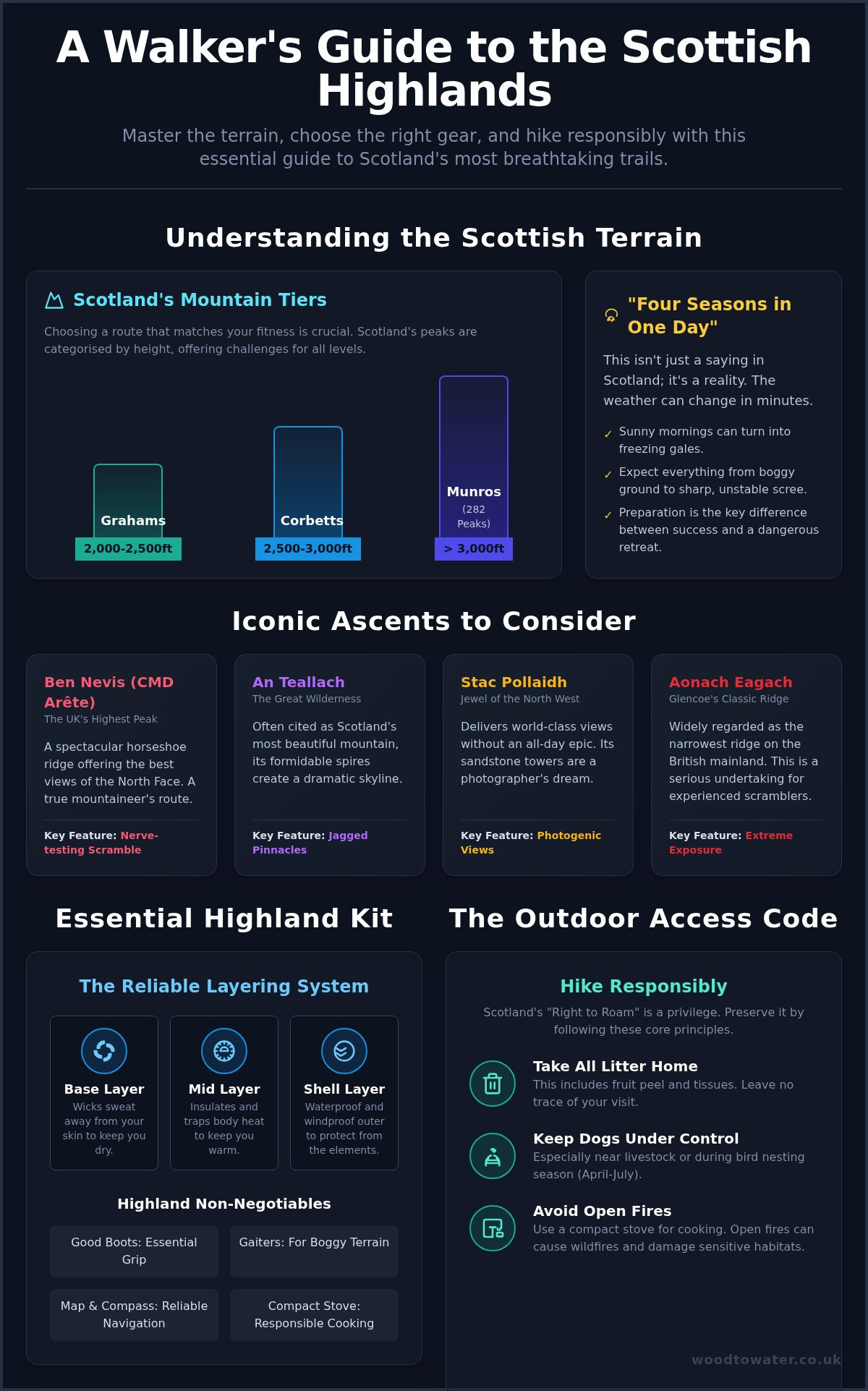
A Munro is a mountain in Scotland with a height over 3,000ft (914.4m). There are currently 282 of these peaks, and "bagging" them has become a national obsession. For many, it's more than just a hobby; it's a lifelong quest that builds a deep emotional connection to the wilderness. The community is welcoming and full of advice for newcomers. If you find the popular summits a bit crowded, you can always look toward Corbetts (2,500 to 3,000ft) or Grahams (2,000 to 2,500ft). These smaller peaks often offer quieter trails and equally stunning views of Scotland's Munros and mountain ranges. They're perfect for days when the high tops are trapped in cloud and you still want a decent workout.
The Scottish Outdoor Access Code: Your Rights and Responsibilities
Scotland enjoys a "Right to Roam" that is significantly more liberal than the laws in England. This means you have a statutory right to access most land and inland water, provided you do so responsibly. The Scottish Outdoor Access Code (SOAC) serves as the essential framework for this mutual respect between hikers and land managers. Understanding these rules is vital before you set off on any of the Top 10 Hikes in Scotland. Preservation is key, so following "Leave No Trace" principles is non-negotiable. This includes:
- Taking all litter home with you, including fruit peels and tissues.
- Keeping dogs under close control, especially during bird nesting season or near livestock.
- Using a compact stove like Jetboil systems rather than lighting open fires in sensitive areas.
Staying safe also means being self-reliant in remote terrain. The code encourages you to take responsibility for your own actions whilst respecting the environment. By respecting the land, you ensure these breathtaking routes remain open for everyone to enjoy.
The Iconic Ascents: Scotland’s Must-Bag Summits and Ridges
If you're looking for the Top 10 Hikes in Scotland, you've likely got the high tops in your sights. Scotland's ridges offer a mix of exposure and exhilaration that's hard to find elsewhere in the UK. These aren't just walks; they're experiences that require a cool head and reliable kit. Many people underestimate the physical toll of these vertical kilometres. You're not just fighting gravity; you're often fighting the wind too. Preparation is everything.
Ben Nevis: Conquering the UK’s Highest Peak via CMD Arête
While thousands plod up the "Mountain Track", the Carn Mor Dearg (CMD) Arête offers a far superior experience. It's a spectacular horseshoe providing the best views of the mountain's North Face. You'll need steady nerves for the scrambling and clear visibility to stay on line. The summit has a harsh microclimate where temperatures often plummet. We recommend a technical layering system to handle the wind chill effectively.
An Teallach and Stac Pollaidh: The Jewels of the North West
Heading north to Dundonnell feels like entering a different world; it's the gateway to the "Great Wilderness". An Teallach is often cited as the most beautiful mountain in the country; its jagged spires create a formidable silhouette. For world-class views without an eight-hour epic, Stac Pollaidh is the answer. Its sandstone pinnacles are a dream for photographers at golden hour. Parking is limited. Aim for an early start to ensure you have enough daylight.
Don't overlook the Aonach Eagach in Glencoe. It's widely regarded as the narrowest ridge on the British mainland. It is not for the faint-hearted. Proper mountain boots with good grip are essential here; slipping is not an option. Navigating these technical routes requires confidence in your equipment. When planning your Top 10 Hikes in Scotland, the rugged peaks of Assynt simply cannot be ignored. They offer a sense of isolation that is rare in the modern world. For those planning an overnight stay in the glens after a long day on the ridges, checking out our range of 1-man tents is a smart move for keeping your pack weight down. It allows you to stay mobile without sacrificing comfort.
Hidden Valleys and Coastal Treks: Exploring Off-the-Beaten-Track
Whilst bagging summits is a thrill, some of the most memorable entries in our Top 10 Hikes in Scotland take you deep into ancient valleys or along dramatic coastlines. These routes offer a different kind of challenge; they trade vertical gain for complex navigation and rich historical narratives. You'll find that moving away from the high peaks doesn't mean leaving the drama behind. In fact, the atmosphere in a sheltered glen or on a Jurassic cliff edge can be even more intense than on a wind-swept summit.
Glencoe’s Secrets: The Lost Valley and Beyond
Coire Gabhail, famously known as the Lost Valley, is a historic hideout nestled between the Three Sisters of Glencoe. It was here that the MacDonald clan once hid their rustled cattle, and later, where survivors of the 1692 massacre sought refuge. Reaching the valley floor requires a bit of effort. You'll need to navigate a river crossing and a short section of mild scrambling over large boulders. Because the valley is sheltered and can become quite humid, we recommend wearing moisture-wicking technical apparel to keep you comfortable during the ascent.
Island Wonders: The Quiraing and Sgùrr na Strì
The Isle of Skye offers landscapes that feel genuinely otherworldly. The Quiraing is a prime example; it's a massive geological landslip on the Trotternish Ridge that continues to move today. Walking amongst its strange rock formations like the "Needle" and the "Prison" feels like stepping into a Jurassic film set. For those seeking the ultimate reward, Sgùrr na Strì is often cited as the best viewpoint in the UK. From its summit, you look directly down into the dark waters of Loch Coruisk, framed by the jagged peaks of the Black Cuillin.
Skye is notoriously wet and boggy. Even on a clear day, the approaches to these iconic spots can be a muddy ordeal. This is exactly why reliable gaiters are non-negotiable for island trekking. They keep the peat and water out of your boots, ensuring your feet stay dry through the long miles. If you're staying in the capital, don't miss Arthur’s Seat. At 251m, this extinct volcano provides a wild heart in the centre of Edinburgh, offering a perfect "city hike" to test your legs before heading north on your journey through the Top 10 Hikes in Scotland.
Essential Kit for the Highlands: Preparing for All Four Seasons
Walking the Top 10 Hikes in Scotland isn't like a stroll in the Peaks. The weather here is a different animal entirely. You need a kit list that functions as a survival system, not just a wardrobe. A solid layering system is your first line of defence. It starts with a synthetic or wool base layer to pull moisture away from your skin. You then add a mid-layer for insulation; finally, you seal it all in with a technical hardshell. This setup ensures you don't overheat on the ascent or freeze when you stop for lunch on a wind-whipped ridge.
Managing Moisture: Gaiters and Waterproofing
Scottish bogs are legendary for their ability to soak a hiker to the bone. Our Origin Outdoors 'Drytogo' gaiters are the perfect solution for preventing "bog-foot" on long, saturated treks. They provide a durable barrier that stops water, mud, and heather from entering your boots. We also suggest wearing technical socks with reinforced heels and toes; these are vital for blister prevention over rough terrain. Investing in a high-quality, breathable hardshell is the single most important decision you'll make for your comfort in the Highlands.
Trail Nutrition: Cooking with Speed and Efficiency
Speed is safety when the temperature drops. The Jetboil systems, like the Jetboil Flash, outperform conventional stoves by boiling water in roughly 100 seconds. Their integrated heat exchangers make them incredibly efficient in the high-altitude winds found on Ben Nevis or An Teallach. For those on multi-day expeditions, ready meals offer a hot, nutritious dinner with zero cleanup. If you're aiming for an ultralight pack, check out our guide on TOAKS Titanium Cookware to see how to shed unnecessary weight without losing durability.
Reliable navigation completes your essential kit. Whilst digital apps are convenient, they aren't a substitute for a traditional map and compass. Electronics can struggle in the Scottish cold; a paper backup is a non-negotiable safety requirement. Being prepared means you can focus on the spectacular scenery rather than worrying about your gear's performance. It's about having the confidence to push further into the wild.
Don't let the weather dictate your adventure. Equip yourself with a professional Jetboil stove and stay warm on every summit of the Top 10 Hikes in Scotland.
Wild Camping and Bushcraft in Scotland: Elevating Your Adventure
Completing one of the Top 10 Hikes in Scotland is a massive achievement; however, spending a night under the stars truly cements your connection to the Highlands. Wild camping is a legally protected right here, but it comes with a heavy responsibility to protect the environment. Mastering the art of the stealth camp allows you to blend into the landscape without leaving a footprint. This approach isn't just about being discreet; it's about respecting the silence and the wildlife that make these glens so special. It transforms a simple walk into a true wilderness expedition.
Hammock Camping in the Glens
Finding flat, dry ground in Scotland is often a fool's errand. This is where a hammock setup excels over a traditional tent. The DD Frontline Hammock is a game-changer for the Highlands because it keeps you off the uneven, boggy ground. You don't need to worry about sharp rocks or damp peat; you just need two sturdy trees. Of course, a reliable camping tarp is essential for the inevitable drizzle that often accompanies a Scottish evening. Always use "tree-friendly" suspension straps to ensure you don't damage the bark of ancient Caledonian pines or birch trees.
The Bushcraft Mindset: Essential Tools for the Trail
Adopting a bushcraft mindset means being prepared for every eventuality with minimal, high-quality kit. There are several bushcraft essentials that every hiker should carry, from reliable cutting tools to water purification. Safety is paramount, especially as light fades quickly in the northern latitudes. A reliable headlamp with a rechargeable battery is vital for setting up camp or navigating an unexpected late descent. It gives you the confidence to manage your site even when the mist rolls in.
Whilst the idea of a crackling campfire is romantic, it can be devastating to peat-rich soil. We strongly encourage the use of portable stoves or a BE bushbox to minimise your impact on the ground. Managing waste is equally important; if you can't find a bin, it must go in your pack. By following these "Leave No Trace" ethics, you ensure that the Top 10 Hikes in Scotland remain pristine for the next generation of explorers. It's about leaving nothing but footprints and taking nothing but memories from the wild heart of the country.
Start Your Highland Journey Today
Tackling the Top 10 Hikes in Scotland is a rite of passage for any outdoor enthusiast. From the jagged ridges of the Northwest to the historic silence of the Lost Valley, these trails offer a level of drama that is truly world-class. You've seen how the right preparation, like mastering the Scottish Outdoor Access Code and choosing a reliable layering system, can transform a challenging day into a triumph. Whether you're bagging your first Munro or finding a perfect spot for your hammock, your choice of kit is what keeps you safe whilst the weather shifts.
We're here to help you get it right the first time. As specialists in DD Frontline Hammocks and Jetboil systems, we provide expert-vetted hiking and bushcraft gear designed specifically for rugged environments. You can rely on our fast UK-wide delivery for all your expedition needs. Equip your next Scottish adventure with Wood To Water Outdoors and step out with confidence. The hills are waiting for you; we'll see you on the trail!
Frequently Asked Questions
Is wild camping legal on all Scottish hiking trails?
Wild camping is generally legal on most unenclosed land in Scotland thanks to the Scottish Outdoor Access Code. You must follow "leave no trace" principles and stay away from enclosed fields or historic sites. Be aware that Loch Lomond & The Trossachs National Park has specific Camping Management Zones where you need a £4.50 permit between March and September. Always check local bylaws before you pitch your tent or hang your hammock.
What is the best time of year to hike in Scotland to avoid midges?
The best time to avoid midges whilst enjoying the Top 10 Hikes in Scotland is usually late April, May, or September. These biting insects thrive in the warm, humid, and still conditions of mid-summer, particularly from June to August. By walking in the shoulder seasons, you'll also enjoy cooler temperatures and the stunning colours of the changing landscape without the constant distraction of a swarm.
Do I really need a map and compass if I have a GPS app?
You absolutely need a physical map and compass as a reliable backup. While GPS apps are fantastic for quick checks, they rely on batteries that drain quickly in the cold and signals that can vanish in deep glens. Navigation is a core skill for the Highlands. If your phone dies or the screen shatters on a rocky scramble, a traditional map is the only tool that will get you home safely.
How long does it take to hike Ben Nevis for an average walker?
An average walker should allow between seven and nine hours to complete Ben Nevis via the Mountain Track. This includes time for breaks and soaking in the views at the summit. If you choose the more technical CMD Arête mentioned earlier, expect the journey to take ten hours or more depending on your pace and the weather conditions. Always start early to ensure you aren't descending in the dark.
Are there many dangerous animals to watch out for while hiking in Scotland?
Scotland has very few dangerous animals, but you should stay alert for adders and ticks. The adder is our only venomous snake; they are shy and bites are rarely fatal but require medical attention. Ticks are a more common concern as they can carry Lyme disease. Always check your skin after a walk and use a proper removal tool if you find one attached to your skin.
What are the best hikes in Scotland for beginners?
For those new to the Top 10 Hikes in Scotland, Conic Hill at Loch Lomond or Arthur’s Seat in Edinburgh are perfect starting points. They offer incredible rewards for relatively modest effort. If you want a taste of the Highlands, Ben Lomond is widely considered one of the more straightforward Munros. It features a very clear path and is less technically demanding than the jagged ridges of the north.
Can I hike in the Scottish Highlands during the winter?
Hiking in winter is possible but it transforms the mountains into a serious mountaineering environment. You'll need specialist equipment like an ice axe and crampons, along with the knowledge of how to use them. Daylight is extremely limited, and temperatures on the tops can be lethal. Unless you have winter navigation skills and the right technical kit, it's best to stick to lowland glens during the snowy months.
How much water should I carry for a full day of Munro bagging?
You should carry at least two to three litres of water for a full day of Munro bagging. The physical exertion of steep ascents means you'll dehydrate faster than you realise. While Scotland has plenty of streams, it's safer to use a purification method before drinking from them to avoid bacteria or parasites. Carrying a collapsible bottle or a hydration bladder ensures you can sip regularly throughout the climb.