

Single Blade Knives: How to Choose the Right Pocket Knife
Could a smaller pocket knife be a better fit than a larger, more rugged-looking option? The right choice depends on what you’ll use it for, how you prefer to carry it and how much care you’re prepared to give the blade. When comparing single blade knives, it’s easy to get caught between carbon and stainless steel, compact everyday carry designs and outdoor-focused models, or locking and non-locking mechanisms.
This guide will help you weigh those choices against the tasks you do most. We’ll look at blade material and maintenance, size and carry preference, and how locking style affects handling. You’ll also find examples from the collection, from compact Whitby EDC options such as the SPRINT, LEVEN and MINT to outdoor-oriented choices including the Kombat Brecon bushcraft knife and Opinel No.12 Explore. By the end, you’ll have a clearer idea of which features matter for everyday carry or time outdoors.
Key Takeaways
- A single blade describes how many blades a knife has, not whether it folds or locks.
- Match blade size, handle and mechanism to the tasks you do most, from everyday carry to outdoor use.
- Compare carbon and stainless steel with your care habits; carbon steel needs attentive drying and care.
- When comparing single blade knives, consider how a locking or non-locking design suits your handling needs.
- Use collection examples such as compact Whitby EDC models and outdoor-focused options to narrow your shortlist.
What counts as a single blade knife, and which tasks suit one?
A single blade knife has one main cutting blade. It may fold into its handle or have a fixed blade, so the term describes the number of blades, not the knife’s size or mechanism. A folding knife may lock open or remain non-locking; these are separate design choices. For a wider overview of folding styles and terminology, see this guide to the pocket knife.
This distinction helps make sense of search results that mix dedicated knives with utility cutters and multi-tools. Start by listing your most frequent jobs. Opening parcels and making light cuts call for a different balance of portability and grip from preparing food at camp or handling more demanding bushcraft tasks. No single design is ideal for every job, so choose around your routine rather than an imagined all-purpose use.
How does a single blade knife differ from a multi-tool?
A dedicated single blade knife centres on one cutting blade. A multi-tool combines a blade with other functions, such as additional implements. Neither is automatically the better choice. A simple knife may suit regular cutting without extra tools, while a multi-tool can be useful if you often need several functions together. Think about what you actually reach for during a typical day or trip. If most jobs involve cutting, a dedicated blade may be the straightforward option; if you regularly use other implements, those added functions may matter more.
Which everyday and outdoor jobs can a single blade knife handle?
For everyday carry, common jobs include opening packaging, cutting cord or trimming small materials. At camp, a suitable knife can help with light preparation and general cutting. More demanding outdoor work calls for a purpose-built tool matched to the task, with a handle and blade design that feel appropriate in use. Don’t assume a compact everyday knife is suited to heavier work simply because it has a sharp edge.
Good handling matters in every setting. Work on a stable surface, keep fingers clear of the cutting path and use a controlled motion. Store the knife safely when it’s not in use. Before carrying a knife in public, check current official UK guidance for the specific knife and circumstances; this section isn’t an interpretation of the law.
If you’re putting together equipment for time outdoors, the Bushcraft Essentials collection is a useful place to explore related kit. Start with the jobs you expect to do most, then compare knife designs for portability, grip and intended use. That makes it easier to narrow down the single blade knives that fit your plans.
How to compare single blade knives: steel, size and locking style
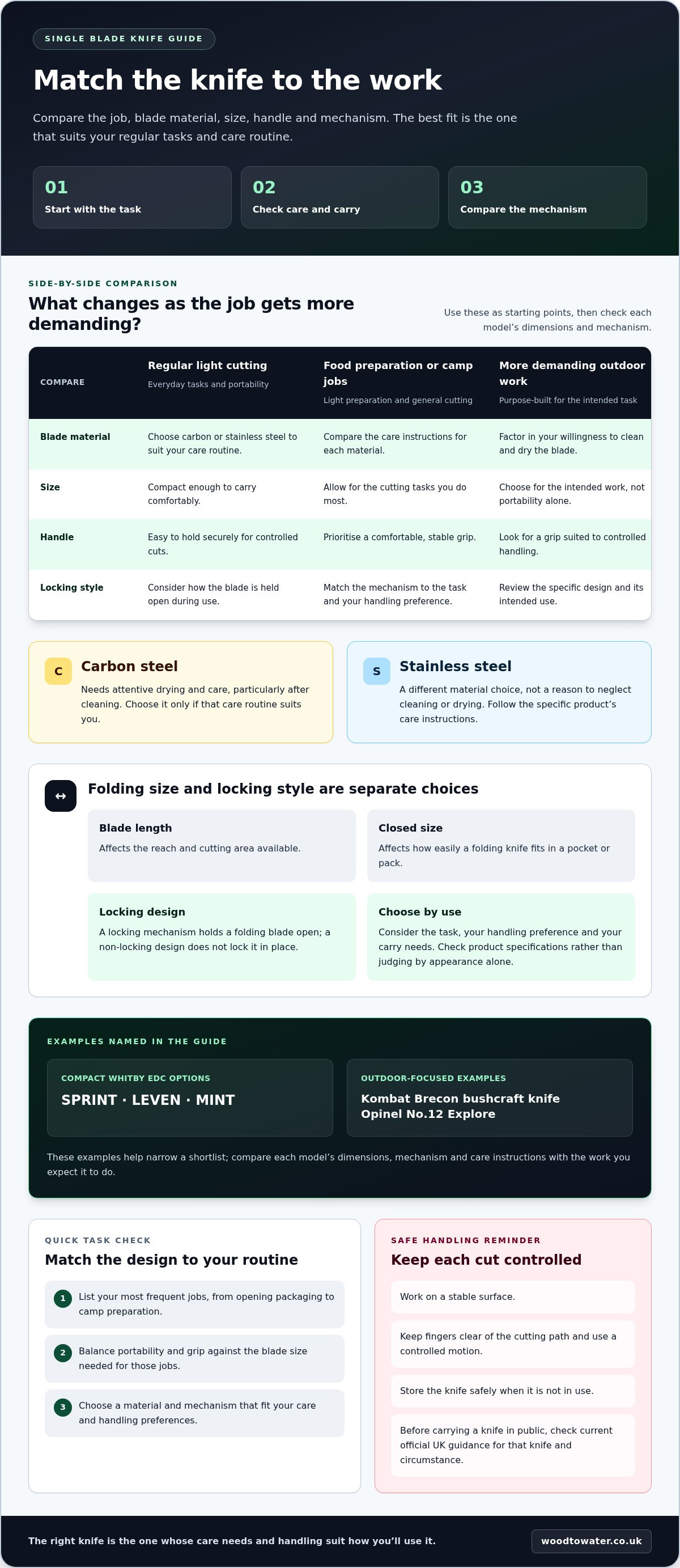
Compare a knife against the jobs you expect it to do, not just its appearance. Use the table as a starting point, then compare each model’s dimensions and mechanism to see how it fits your tasks and carry preference.
| Intended task | Blade material | Size | Handle | Locking style |
|---|---|---|---|---|
| Regular light cutting | Choose carbon or stainless steel to suit your care routine | Compact enough to carry comfortably | Easy to hold securely for controlled cuts | Consider how the blade is held open during use |
| Food preparation or camp jobs | Compare the care instructions for each material | Allow for the cutting tasks you do most | Prioritise a comfortable, stable grip | Match the mechanism to the task and handling preference |
| More demanding outdoor work | Factor in your willingness to clean and dry the blade | Choose for the intended work, not portability alone | Look for a grip suited to controlled handling | Review the specific design and its intended use |
Choose the material and size around your regular tasks. The right knife is one whose care needs and handling suit how you’ll use it.
Carbon steel or stainless steel: which suits your care routine?
Wood To Water Outdoors’ Opinel Classic Originals include carbon steel and stainless steel options. Carbon steel needs attentive drying and care, particularly after cleaning. Stainless steel is a different material choice, not a reason to neglect cleaning or drying. Neither is the automatic pick for everyone: weigh the care you’re prepared to give the blade against your preferences. Follow the care instructions for the specific product and dry the blade after cleaning.
Does a folding knife need a locking blade?
A locking mechanism holds a folding blade open; a non-locking design doesn’t lock it in place. This affects how the knife feels and functions during use, so consider the task, your handling preference and your carry needs before choosing. The collection includes both non-locking EDC designs and lock knives. Rather than assuming one style suits every job, compare the mechanism of each model with the way you expect to use it.
Blade length affects the reach and cutting area available, while the closed size affects how easily a folding knife fits in a pocket or pack. A larger design may be less convenient to carry; a compact one may not suit every task. Compare product specifications rather than judging by appearance alone. To put these criteria into practice, browse the single blade knife selection and shortlist designs that fit your use and care routine.
Which single blade knife suits your use: EDC, camping or bushcraft?
Start with where and how often you’ll use the knife. A pocket-friendly design for occasional light cutting has different priorities from a knife intended for camp preparation or more demanding bushcraft tasks. Consider portability, how securely the handle sits in your hand, the blade size you need for your usual jobs and the care you’re willing to give it. The best fit is the one suited to your own use, not a universal pick.
What should you prioritise in an everyday carry knife?
For regular light tasks such as opening packaging or cutting cord, a compact design can be easier to carry and reach for. The Whitby SPRINT, LEVEN and MINT are examples of compact EDC options in the collection. Compare their product listings for details such as closed dimensions, handle design and mechanism, since compact knives can differ in these features.
Think about your routine, too. A knife carried often should feel comfortable to hold and convenient to store, while its blade and mechanism should suit the jobs you expect it to handle. Product descriptions may include carry-related wording, but that isn’t a substitute for checking current official UK guidance before carrying a knife in public. Review each model’s mechanism, dimensions and age guidance.
What makes a knife more suitable for camping or bushcraft?
Outdoor use can involve a wider range of cutting jobs than everyday carry. For light camp preparation, choose a design that feels manageable for the tasks you actually do. More demanding bushcraft work calls for a purpose-suited knife and a secure, controlled grip; don’t assume that an everyday pocket knife is built for heavier tasks.
The Kombat Brecon is a bushcraft-oriented example in the collection. The Opinel No.12 Explore and Opinel No.8 options offer other outdoor product examples to compare. Look at each model’s stated intended use and features rather than inferring blade size, locking style or other specifications from its name.
Plan the rest of your equipment around the activity, too. A Bushcraft Gear UK guide can help with broader kit planning, but it can’t replace checking the specifications and care instructions for a particular knife. For any of these single blade knives, match the product to the work, review its dimensions and mechanism, and consider how you’ll clean and store it after use.
Single blade knife examples: compare standout options in the collection
A useful shortlist starts with your main task and the features you’re prepared to look after. These examples cover different needs, from compact EDC designs to outdoor-focused knives. Compare the individual listings for specifications and care instructions before choosing.
| Option | Suited to | Confirmed distinguishing feature | Care note |
|---|---|---|---|
| Opinel Classic Originals, carbon steel | Shoppers considering a carbon steel blade | Available in the carbon steel range | Dry after cleaning and follow the product care guidance |
| Opinel Classic Originals, stainless steel | Shoppers comparing blade materials | Available in the stainless steel range | Clean and dry according to the specific care instructions |
| Opinel No.8 carbon steel gift set | Those looking at a knife-and-sheath option | The stated set includes a No.8 carbon steel knife with a sheath | Give the carbon steel blade attentive drying and care |
| Whitby SPRINT, LEVEN or MINT | Shoppers seeking a compact EDC option | These are compact EDC models | Check the listing for model-specific materials and care |
| Kombat Brecon | Shoppers comparing bushcraft-oriented knives | Listed as a bushcraft knife | Follow the care guidance for its specific materials |
| Buck Bantam BLW | Shoppers considering a lightweight locking design | Described as a lightweight lock-back design with a textured handle | Review its product-specific care instructions |
Which Opinel single blade knife should you compare first?
Begin with the material that best matches your care routine. The Classic Originals carbon steel and stainless steel ranges provide a direct comparison, while the No.8 carbon steel gift set adds a sheath to the stated contents. The collection also includes the outdoor-focused Opinel No.12 Explore. Compare each listing for variant-specific dimensions, mechanism and care details rather than assuming these are identical across the range.
How do Whitby and outdoor-focused options differ?
The Whitby SPRINT, LEVEN and MINT are compact EDC examples; compare their individual listings for design features. For a more outdoor-oriented shortlist, consider the Kombat Brecon and Opinel No.12 Explore, and match their stated uses to the tasks you have in mind. The Buck Bantam BLW offers a different feature set, with its stated lock-back design and textured handle. Compare each listing’s mechanism, dimensions and age guidance before deciding.
Use these examples to narrow your criteria, then browse the single blade knife collection and compare the product details.
How to choose, care for and buy your single blade knife
A good choice starts with the jobs you’ll actually do and ends with a care routine you can stick to. Use this process to compare single blade knives without getting distracted by appearance alone:
- 1. Define your tasks. Note whether you mainly need a knife for light everyday cutting, camp preparation or more demanding outdoor work.
- 2. Choose a practical size. Compare the open blade dimensions with the work you’ll do and the closed size with your carrying or packing preference. Use the product listing rather than estimating from photographs.
- 3. Compare blade material. Consider the care each material needs and whether you’ll reliably clean and dry the blade after use.
- 4. Check the mechanism. Confirm whether the knife locks open or is non-locking, then consider how that design suits your handling and intended use.
- 5. Review care instructions. Check the manufacturer’s guidance for cleaning, drying, sharpening, lubrication and handle care before buying.
Don’t choose by looks alone. A striking design won’t necessarily suit your regular jobs or carry preference. Nor should you assume that all single blade knives use the same steel or mechanism. A stated feature describes a product, but it doesn’t mean the knife will suit every task or be appropriate to carry in every situation. Check current official UK guidance for carry rules relevant to the knife and circumstances.
How can you keep a single blade knife in good condition?
After use, clean the blade in line with its care instructions and dry it thoroughly before storing it. Give particular attention to drying carbon steel, and don’t treat stainless steel as maintenance-free. Keep the knife closed or otherwise safely secured when it’s not in use, and store it dry and out of reach of children. For safer handling, work on a stable surface, keep your fingers clear of the cutting path and use controlled strokes.
Follow the manufacturer’s directions for sharpening, lubrication and handle upkeep. Opinel Maintenance Oil is one collection example for blade and handle maintenance; use it only as directed by its product instructions. Taking a moment to care for the knife after a trip or day’s work helps make maintenance part of your routine, rather than an afterthought.
Ready to compare options? Browse the single blade knife collection and review each listing’s specifications, mechanism and care guidance to find a suitable match for your needs.
Find the knife that fits your next outing
The right choice comes down to your regular tasks, carry preference and willingness to care for the blade. Compare size and locking style alongside steel: carbon and stainless options have different care considerations, and no single design suits every job.
The collection brings together options from Opinel, Whitby, Kombat UK and Buck, including compact EDC choices and outdoor-focused examples. Use those differences to build a shortlist, then read each product listing for its specifications and care guidance before deciding.
Ready to compare? Browse single blade knives and compare the options to find a practical match for everyday tasks or time outdoors. With your priorities clear, you can make a confident choice and get ready for the jobs ahead.
Frequently Asked Questions
What is a single blade knife?
A single blade knife has one main cutting blade. It may be a folding knife or a fixed-blade design; “single blade” describes the blade count, not whether the knife folds. A folding model may also lock open or use a non-locking mechanism. Compare these features separately, then consider whether the knife’s size and intended use suit your regular tasks. The individual product listing describes the specific design.
Is a single blade knife suitable for camping?
A single blade knife can suit camping if its design and specifications match the jobs you plan to do. A knife for light camp preparation may not be appropriate for more demanding outdoor work. Think about blade size, grip, mechanism and care requirements in relation to your tasks. Outdoor-focused examples in the collection include the Kombat Brecon and Opinel No.12 Explore; compare their stated features and intended uses in the product listings.
Are single blade knives legal to carry in the UK?
Whether you can carry a particular knife in the UK depends on the knife and the circumstances, so avoid relying on a general rule or a product description alone. Check current official UK government guidance before carrying a knife in public. Make sure you understand how the guidance applies to the specific knife and situation. If you’re unsure about your circumstances, seek appropriate authoritative advice rather than assuming a knife is suitable to carry.
What is the difference between carbon steel and stainless steel knife blades?
The key difference for everyday care is the attention each material needs. Carbon steel requires attentive drying and care, so consider whether you’ll clean and dry the blade after use. Stainless steel is another material option, but it shouldn’t be treated as maintenance-free or immune to corrosion. Opinel Classic Originals are available in both carbon and stainless steel ranges, giving shoppers a practical material comparison. Follow the care instructions for the specific knife.
Should I choose a locking or non-locking pocket knife?
A locking mechanism holds a folding blade open, while a non-locking design doesn’t lock the blade in place. Choose by considering the tasks you expect to do, your handling preferences and your carry needs. Don’t assume that every single blade knife uses the same mechanism. Product listings can help you identify a model’s design, but a stated feature doesn’t determine whether carrying it is appropriate. Check current official UK guidance for your circumstances.
How do you maintain a single blade knife?
Clean the knife after use and dry it thoroughly before storing it. Give particular attention to drying carbon steel, and don’t assume stainless steel needs no care. Follow the manufacturer’s instructions for sharpening, lubrication and handle upkeep, as guidance can vary between models and materials. Store the knife safely when it’s not in use. Regular, suitable care helps keep the blade and handle in good condition without relying on guesswork or one routine for every knife.
Which single blade knife is best for everyday carry?
The best everyday carry choice depends on what you need to cut and how you prefer to carry a knife. Prioritise a manageable size, comfortable handling and a mechanism that suits your intended use. The Whitby SPRINT, LEVEN and MINT are examples of compact EDC options in the collection. Compare each listing’s dimensions, materials and mechanism, then consider the care it needs and check current official UK guidance before carrying it.