

How to Choose the Best Camping Sleeping Mat: Expert Guide
Have you ever invested in a top-tier sleeping bag only to wake up at 3 am with a shivering back and a damp chill seeping through your bones? It’s a common frustration amongst UK campers who realise too late that the ground, not the air, is often the biggest thief of body heat. Learning how to choose a Camping Sleeping Mat is about more than just finding a bit of padding for your hips; it’s about building a technical thermal barrier between you and the cold earth.
We agree that the technical jargon of R-values and mat constructions can feel like a chore when you just want to get outside. This guide will simplify the science, explaining why the ASTM F3340-22 standard matters for your year-round comfort. You’ll discover how to balance pack weight against luxurious comfort, whilst finally understanding the real-world differences between self-inflating and air mats. Whether you’re squeezing into a 1-man tent or setting up a bushcraft basecamp, we’ll help you build a reliable sleep system that handles everything the British weather throws at it.
Key Takeaways
- Understand why your sleeping mat is a vital piece of thermal equipment that prevents the cold ground from stealing your body heat.
- Master the technical details of R-values and the ASTM F3340-22 standard to ensure you stay warm throughout the unpredictable British seasons.
- Learn exactly how to choose a Camping Sleeping Mat by balancing the trade-offs between ultralight packability and the thickness required for a restorative sleep.
- Compare the rugged durability of closed-cell foam against the cushioned support of self-inflating mats to find your perfect bushcraft companion.
- Discover expert maintenance tips to protect your investment, whilst learning why your inflation method is critical for preventing internal mould.
Understanding the True Purpose of a Camping Sleeping Mat
You've found the perfect wild camping spot. The view is incredible, the air is crisp, and your sleeping bag is rated for the frost. Yet, without a proper barrier, you'll likely spend the night shivering. Many enthusiasts don't realise that the ground is the biggest thief of body heat. Learning how to choose a Camping Sleeping Mat is the first step in protecting yourself from the cold earth. It's about more than just a bit of padding; it's about thermal safety.
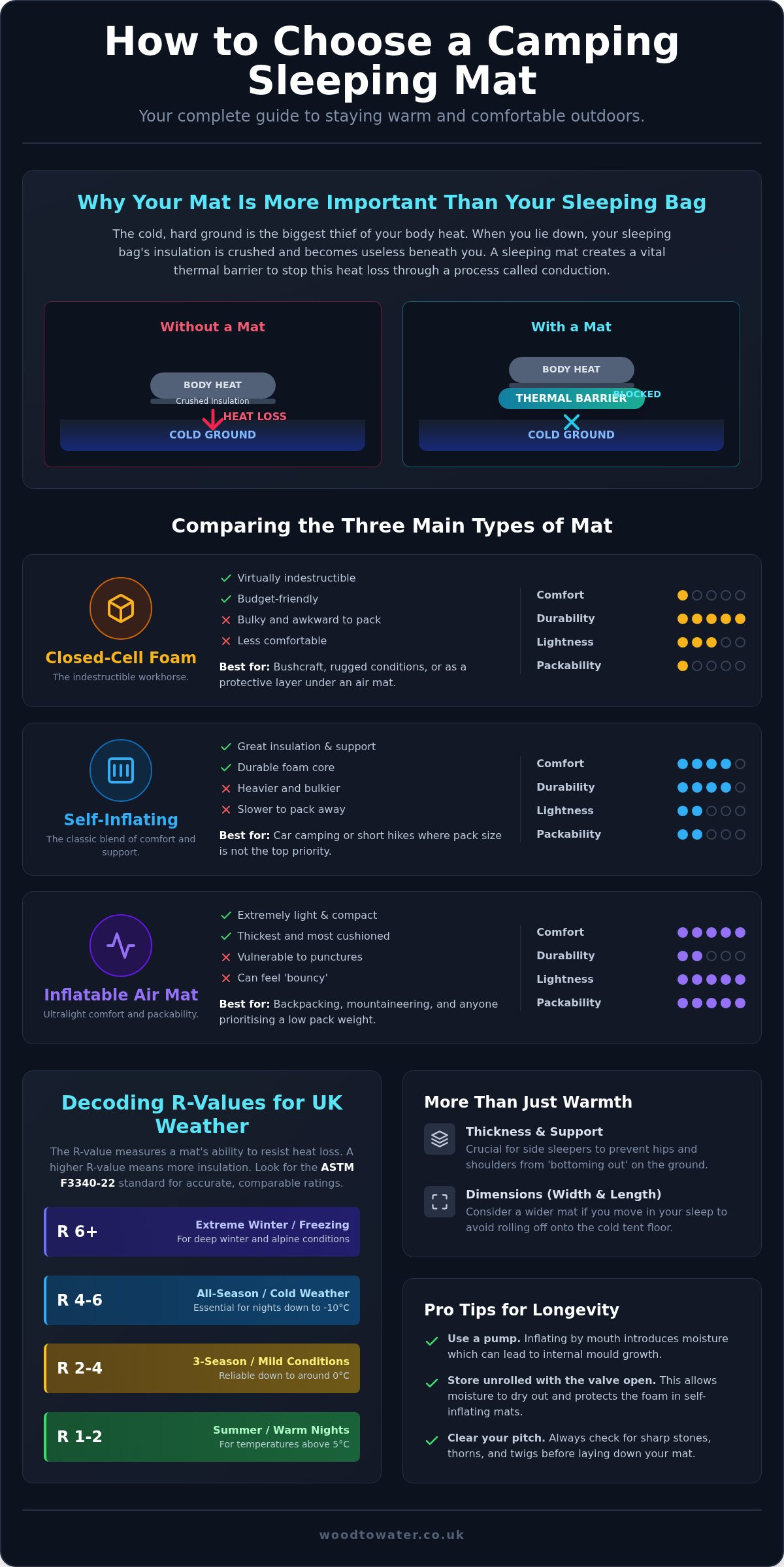
The primary purpose of a sleeping pad is thermal insulation. Whilst comfort is a welcome bonus, the mat's main job is to stop conduction. When you lie in a sleeping bag, your body weight crushes the down or synthetic fill beneath you. This compression removes the air pockets that keep you warm; effectively, you have zero insulation between your back and the freezing ground. A mat provides the structural insulation that your bag cannot.
Conduction vs. Convection: Why the Ground Steals Your Heat
The ground acts as a massive heat sink. It will relentlessly pull warmth from your body until temperatures equalise. Conduction is this direct transfer of heat through contact. Unlike the air around you, which moves via convection, the ground is dense and unforgiving. A quality mat uses layers of foam or chambers of trapped air to break this contact. These air pockets are poor conductors of heat, making them the ultimate insulators for a night in the woods. In many UK scenarios, a high-spec mat is actually more essential for a warm night than an expensive sleeping bag.
Comfort Factors: Beyond Just Being Soft
Support is just as vital as warmth. Side sleepers often find themselves "bottoming out," where their hip or shoulder pushes through the mat to touch the floor. To avoid this, look for mats with a bit more depth. Width is another practical consideration; if you move around during the night, a standard narrow mat might leave you waking up on the cold tent floor. Always check the dimensions to ensure your mat fits comfortably inside your 1-man tents or 2-man tents. A sleep system is the functional synergy between your mat, bag, and base layers. By matching these components, you create a reliable barrier against the elements.
Comparing the Three Main Types of Sleeping Mats
When you're deciding how to choose a Camping Sleeping Mat, the first step is identifying which of the three main categories fits your specific adventure. Each style offers a distinct trade-off between weight, comfort, and reliability. Understanding how to choose a sleeping pad starts with matching these categories to your typical terrain and the British seasons you'll be facing.
Closed-Cell Foam: The Bushcraft Favourite
Closed-cell foam (CCF) mats are the workhorses of the outdoor world. Made from dense foam filled with tiny, trapped air bubbles, they are virtually indestructible. You can strap them to the outside of your rucksack, sit on them by the fire, or use them on rocky ground without a second thought. For those building a kit of bushcraft essentials, a foam mat is a staple because it simply cannot fail. Many seasoned hikers use a thin CCF pad as a protective layer beneath a more delicate inflatable mat to guard against thorns and sharp stones.
Self-Inflating vs. Manual Inflation
Self-inflating mats (SIMs) provide a classic balance of durability and comfort. They feature an open-cell foam core that expands when the valve is opened, drawing air in naturally. This foam provides a structured, supportive feel that many campers prefer over the "bouncy" sensation of pure air. However, the foam core makes them heavier and bulkier than modern alternatives. If you're camping in 1-man tents where space is at a premium, you might find a SIM takes up too much room in your pack.
Inflatable air mats are the gold standard for weight-to-warmth ratios. They rely entirely on air for loft, allowing them to pack down to the size of a water bottle. Whilst they offer the most cushioning for side sleepers, they are the most vulnerable to punctures. To save your breath and keep moisture out of the mat, we recommend using Flextail gear for quick, effortless inflation at the end of a long day's trek.
- Closed-Cell Foam: Budget-friendly, indestructible, but bulky and less comfortable.
- Self-Inflating: Excellent insulation and support, moderate puncture risk, but heavier.
- Inflatable Air Mats: Extremely packable and comfortable, but require careful handling to avoid leaks.
Deciphering R-Values: Staying Warm in the UK Climate
Once you’ve identified the type of mat that suits your rucksack, you need to look at the numbers. The R-value is the industry standard for measuring thermal resistance; essentially, it tells you how well a mat resists heat flow from your warm body to the cold ground. Understanding these ratings is the most technical part of learning how to choose a Camping Sleeping Mat, but it's the difference between a restful night and a shivering ordeal.
Since 2020, the industry has followed the ASTM F3340-22 standard. This ensures that every mat is tested under the same laboratory conditions, allowing you to compare brands like 3FULGear and Onewind with total confidence. Before this, manufacturers used their own internal metrics, which made it nearly impossible to know if one brand's "four-season" mat was actually warmer than another's "three-season" offering. Now, the data is reliable and transparent.
One of the most useful features of R-values is that they are additive. If you have a lightweight air mat with an R-value of 2.0 and you place it on top of a closed-cell foam mat rated at 2.0, your total insulation becomes R4.0. This is a brilliant trick for UK campers who don't want to buy a dedicated winter mat; simply stack your summer gear to boost your protection when the frost hits.
R-Value Ranges for the Four Seasons
Choosing the right rating depends entirely on when and where you camp. For typical UK conditions, follow these guidelines:
- R1 to R2 (Summer): These mats are designed for warm ground and mild nights. An R-value of 2.0 is generally suitable for temperatures down to approximately -1°C, making it perfect for July backpacking trips.
- R3 to R4 (Three-Season): This is the sweet spot for UK spring and autumn. A mat with an R-value of 4.0 handles temperatures down to approximately -12°C, providing a vital safety margin for those unpredictable October nights.
- R5+ (Winter): When the ground is frozen or you're camping on snow, you need serious insulation. An R-value of 6.0 is rated for temperatures as low as -26°C, ensuring you stay warm in the harshest Scottish winters.
The Limitations of R-Values
Whilst the numbers provide a great baseline, they aren't the only factor. If you're a "cold sleeper" who feels the chill easily, you should always aim for a higher R-value than the seasonal average suggests. External factors like damp ground or high humidity can also make a mat feel less effective than its rating implies. A mat with an R-value of 5.0 provides exactly twice the thermal resistance of a mat rated at 2.5, directly halving the rate of heat loss to the ground. This mathematical certainty helps you build a sleep system that prioritises your safety in the wild.
Matching Your Mat to Your Adventure
Knowing how to choose a Camping Sleeping Mat requires an honest look at your typical weekend. A mat that’s perfect for a lightweight trek through the Lake District might be completely unsuitable for a fixed bushcraft basecamp in the Highlands. Your choice should be dictated by your mode of transport and the specific environment you’ll be sleeping in.
For backpacking and long-distance trekking, weight and packability are your main priorities. You want a mat that disappears in your rucksack and doesn't weigh you down on steep inclines. In these scenarios, "mummy" shaped mats are popular because they taper at the feet to save precious grams. However, if you are car camping or setting up a base camp where the vehicle does the heavy lifting, don't compromise on comfort. Opt for maximum thickness and a rectangular width that allows you to stretch out without falling off the edge.
Bushcraft and wild camping place different demands on your gear. You are often sleeping on unprepared ground where twigs, stones, and thorns are common. Durability and puncture resistance become more important than saving a few grams of weight. This is where a robust, high-denier mat becomes a vital part of your kit.
Choosing a Mat for Hammocks
Standard rectangular mats often struggle in a hammock; they tend to slide around or create awkward pressure points as the hammock fabric curves. Specialised mats from Onewind Outdoors are designed to handle these unique contours, often featuring non-slip surfaces or specific shapes that stay put. Using a sleeping mat in your hammock is also a brilliant, cost-effective alternative to a dedicated underquilt, providing a solid thermal barrier against the "cold butt syndrome" caused by wind passing beneath you.
Shape and Size Considerations
Shape and size are not just about comfort; they are about thermal efficiency. A tapered mummy mat saves weight but can feel restrictive if you toss and turn. Taller campers should look for "Large" or "Wide" versions to ensure their feet and arms stay on the insulated surface. Conversely, experienced ultralight hikers sometimes use short, 3/4 length mats. These only cover the torso and hips, with the hiker using their empty rucksack to pad out the area beneath their legs. It’s a clever way to cut weight if you can handle the minimalist setup.
Browse our full range of bushcraft-ready gear to find the perfect foundation for your next night under the stars.
Essential Accessories and Maintenance for Longevity
Investing in high-quality gear is just the start. If you want your equipment to last through years of wild camping, you need to treat it with respect. Learning how to choose a Camping Sleeping Mat is a waste of effort if you let mould or poor storage ruin the materials after a single season. Proper maintenance ensures your thermal barrier remains effective and your nights stay comfortable.
Inflation methods are the first thing to consider. Whilst many campers rely on mouth inflation, this introduces warm, moist air directly into the mat's core. Over time, this moisture leads to internal mould growth and can even delaminate the internal structures. Pump sacks are a great alternative, but for ultimate convenience, portable electric pumps have become the modern standard for the prepared adventurer.
The Rise of Portable Pumps
Flextail Gear has transformed the way we set up camp at the end of a long day. Using a small electric pump avoids the light-headedness that often follows a strenuous, high-altitude hike. These tiny devices don't just save your breath; they also help deflate mats to the smallest possible pack size. By vacuum-sealing the air out, you ensure the mat fits perfectly back into your rucksack every time.
Storage is where most mats meet their end. You should never store a self-inflating mat compressed in its stuff sack for long periods. This crushes the open-cell foam and ruins its ability to "self-inflate" in the future. Instead, keep it unrolled with the valve open under a bed or behind a wardrobe. This preserves the foam's loft and allows any trapped moisture to evaporate naturally.
Punctures happen, even to the most careful hikers. Finding a leak in the field is easiest with a bit of water and a dash of camp soap; just look for the tell-tale bubbles. Always carry a dedicated repair kit with adhesive patches. Ensure the area is bone dry and clean before applying the patch to create a permanent, airtight seal.
Cleaning and Protection
Keep your mat clean by wiping it down with a damp cloth and mild soap. Avoid harsh detergents that could damage the DWR coating or internal laminates. To prevent punctures before they occur, always use a groundsheet or a robust tarp from our Camping Tarps collection. This extra layer of protection is essential on rough, flinty ground. As a final rule of thumb, always test your mat for leaks 48 hours before a trip. Inflation tests in the living room are much better than discovering a slow leak at midnight in a rainy forest.
Ready for Your Next Night Under the Stars?
A great night's sleep in the wild isn't just about padding; it's about building a technical barrier against the cold ground. By mastering the ASTM R-value standards and matching your mat to your specific shelter, you've taken the most important step in perfecting your sleep system. Whether you're relying on the indestructible nature of foam for a bushcraft basecamp or the ultralight packability of an air mat for a mountain trek, the right choice ensures you wake up ready for the day's adventure.
We've simplified the science of how to choose a Camping Sleeping Mat so you can focus on the journey ahead. At Wood To Water Outdoors, we are passionate outdoor experts who have personally vetted every piece of gear we stock. We specialise in equipment that survives the real-world UK environment, featuring reputable brands like Onewind, Flextail, and 3FULGear. If you need tailored advice for your next expedition, our team is always here to help you get it right.
Browse our curated range of Sleeping Mats and Accessories and prepare for your warmest camp yet. We'll see you out there!
Frequently Asked Questions
Is a thicker sleeping mat always warmer than a thin one?
No, thickness is not a direct indicator of warmth. Whilst a thicker mat provides more cushioning for your hips, its thermal performance is determined by its R-value. A chunky air bed filled only with cold air will offer less protection than a thin, high-spec mat containing foam or reflective insulation. When you're deciding how to choose a Camping Sleeping Mat, prioritise the technical R-value rating over the physical depth of the pad.
Can I use a yoga mat for camping in the UK?
We don't recommend using a yoga mat for camping in the UK. Yoga mats are designed for grip and joint protection on flat gym floors, but they offer almost no thermal resistance. The cold British ground will quickly drain your body heat through conduction, leaving you shivering regardless of your sleeping bag's quality. For a safe and comfortable night outdoors, you need a dedicated camping mat engineered to trap air and provide insulation.
How do I stop my sleeping mat from sliding around the tent floor?
Sliding around is a common nuisance, but you can fix it easily. Applying a few small dots or lines of silicone sealant to the bottom of your mat creates enough friction to keep it in place. Alternatively, placing a thin closed-cell foam mat underneath provides a non-slip surface whilst boosting your total R-value. This is a practical tip for anyone using silnylon tent floors, which are notoriously slippery when wet or tilted.
What is the best way to find a puncture in an inflatable mat whilst in the wild?
Finding a puncture in the wild requires a bit of patience and some soapy water. Mix a tiny amount of biodegradable soap with water and wipe it across the inflated mat. Look closely for growing bubbles that indicate escaping air. If you are near a still lake or stream, you can submerge sections of the mat to spot the air stream. Once found, dry the area thoroughly before applying your repair patch.
Do I need a different sleeping mat for hammock camping?
You don't strictly need a different mat, but specialised hammock mats are much more comfortable. Standard rectangular mats are often too stiff to follow the natural curve of a hammock, leading to them sliding out from under you. Hammock-specific designs are more flexible and often wider at the shoulders to prevent the hammock fabric from compressing your insulation. They are a great way to stay warm without the bulk of an underquilt.
Why does my inflatable mat seem to lose air during a cold night?
Most of the time, your mat isn't leaking; it's simply the air cooling down. When you inflate a mat, the air inside is usually warmer than the night air. As the temperature drops, that air contracts and takes up less space, making the mat feel soft or "deflated." To avoid waking up on the ground, always give your mat a final top-up of air just before you climb into your sleeping bag.
Should I choose a self-inflating mat or a manual air mat for my first trip?
For your first trip, consider your transport and budget. A self-inflating mat is a brilliant, durable choice if you are car camping and want a bed-like feel. However, if you are backpacking and learning how to choose a Camping Sleeping Mat for hiking, a manual air mat is usually better. They pack down much smaller and are significantly lighter, making them easier to carry over long distances whilst still offering excellent comfort.
How long should a high-quality camping sleeping mat last?
A high-quality mat can easily last a decade if you treat it with care. The lifespan depends heavily on the fabric's denier and how you store it between trips. Mats stored unrolled with the valves open in a dry place last the longest. Conversely, leaving a mat compressed in a damp garage will significantly shorten its life. Always check for delamination or valve leaks annually to ensure your gear remains reliable for years.