

Expert Guide: How to Choose the Perfect Sleeping Bag
Your sleeping bag isn't actually a heater; it's a high-performance insulator designed to trap your own body heat against the damp, biting chill of a British night. If you've ever spent a miserable 3 AM shivering in a tent while questioning your life choices, you know that the wrong gear can ruin even the most beautiful expedition. Learning how to choose a sleeping bag that actually works for the UK's unpredictable climate is the difference between a restorative adventure and a cold, sleepless ordeal.
We understand the frustration of staring at complex ISO temperature ratings and wondering if that luxury down fill will survive a humid morning in the hills. It's easy to feel overwhelmed by technical jargon, but we're here to help you cut through the noise. This guide will master the essentials of insulation types, bag shapes, and those recognised ISO 23537 standards to ensure you stay warm and comfortable. You'll gain the confidence to invest in gear that lasts for years; ensuring every night under the stars is as cosy as your own bed.
Key Takeaways
- Understand the vital differences between Comfort, Limit, and Extreme ratings under the ISO 23537 standard to avoid shivering through the night.
- Master how to choose a sleeping bag by balancing the lightweight warmth of down with the moisture-resistant reliability of synthetic insulation in damp UK weather.
- Discover why selecting the correct shape and size is essential for eliminating cold spots and maximising your bag's thermal efficiency.
- Learn why your sleeping bag is only half the story and how a curated sleep system keeps the biting ground chill at bay.
- Protect your gear's performance by following expert storage rules that preserve the essential loft of your insulation for years to come.
Understanding Temperature Ratings and Seasonality
Choosing the right insulation starts with understanding the numbers on the tag. The current international standard, ISO 23537, ensures you aren't just guessing when you head into the hills. It replaced the older EN 13537 system but uses similar testing; a copper manikin with sensors measures heat loss in a controlled cold chamber. This gives us a reliable baseline, though it doesn't account for a howling wind or a damp Lakeland valley. When learning how to choose a sleeping bag, these figures are the foundation of your decision.
Decoding Comfort vs. Limit of Comfort
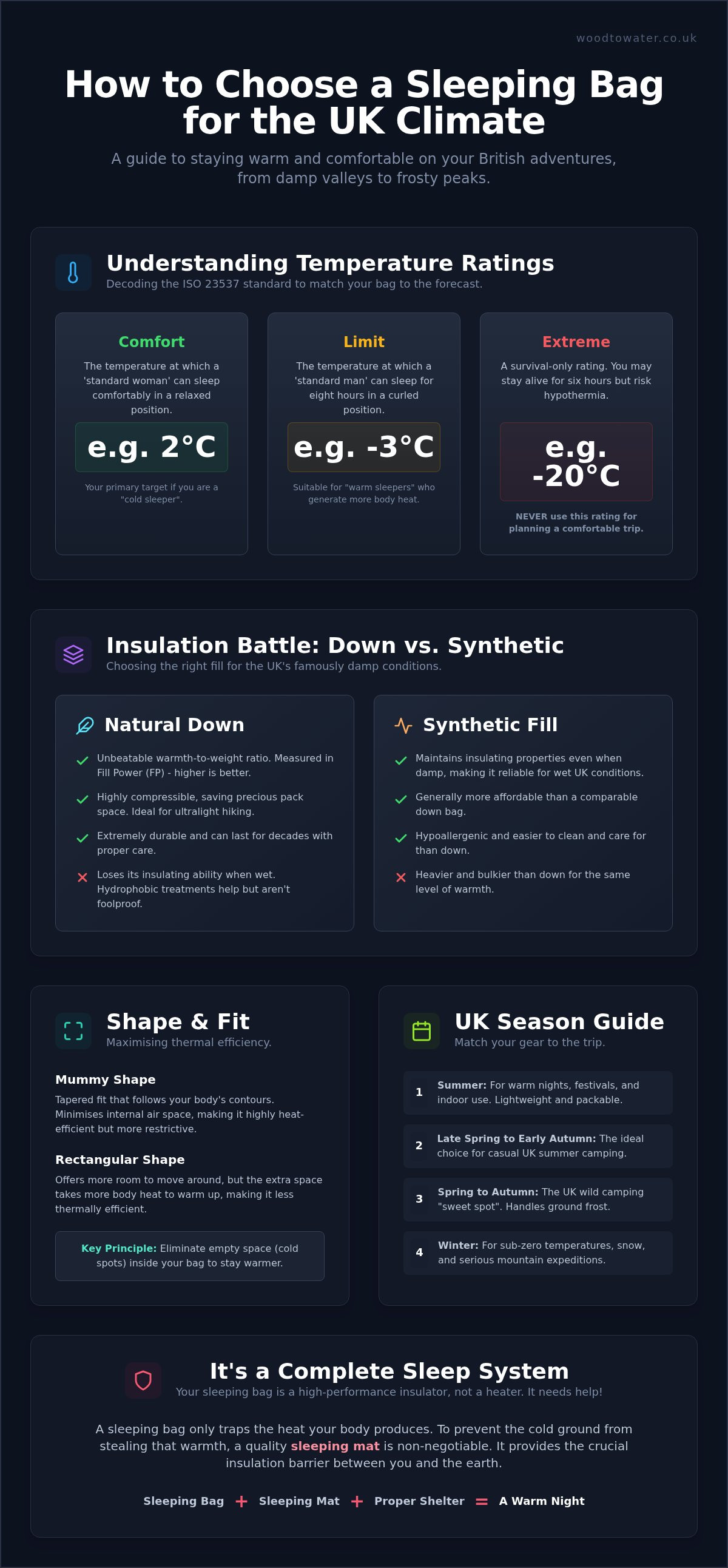
You'll usually see three main figures on any quality bag. The Comfort rating is your primary target if you're a "cold sleeper"; it's the temperature at which a standard woman can sleep soundly in a relaxed position. The Limit of Comfort is aimed at "warm sleepers", usually standard men, who can sleep for eight hours in a curled position without waking. Never buy a bag based on the Extreme rating. This is a survival figure only; it indicates the point where you'll stay alive for six hours but might still suffer from hypothermia. It's not a guide for a pleasant night's sleep.
Personal metabolism plays a massive role in your overnight warmth. Some of us are human radiators, whilst others feel the chill the moment the sun goes down. The UK's high humidity also makes these ratings feel different than they would in a dry environment. Damp air draws heat away from your body faster. If you're camping in a misty Welsh valley, it's wise to pick a bag with a Comfort rating a few degrees lower than the expected forecast. Knowing your own "running temperature" helps you decide how to choose a sleeping bag that truly fits your needs.
The UK Four-Season System Explained
Manufacturers often categorise bags by season to simplify the selection process. These ratings align roughly with the British calendar:
- 1-Season: Best for summer festivals and indoor use whilst travelling. These are lightweight and highly packable but won't stand up to a cold snap.
- 2-Season: Ideal for late spring to early autumn UK camping. These handle mild nights comfortably and are a great choice for casual summer trips.
- 3-Season: The "sweet spot" for UK wild camping. These cover you from March to October and are designed to handle the occasional ground frost.
- 4-Season: Essential for winter expeditions amongst the British peaks. These are heavy-duty insulators built to survive sub-zero temperatures and snow.
Selecting the right season rating ensures you aren't carrying unnecessary weight in August or shivering through a surprise frost in May. It's about matching the gear to the specific reality of the British outdoors.
Insulation Battle: Down vs. Synthetic in the UK Climate
The UK's notorious dampness is the ultimate test for any insulator. When you're deciding how to choose a sleeping bag, the debate usually boils down to weight versus weather resistance. Natural down is the gold standard for pure warmth; however, synthetic fills have become a robust contender for those of us spending nights in misty woodlands or humid coastal spots. Understanding how these materials behave when the dew point drops is vital for your comfort.
The Benefits of Natural Down
Down is prized for its incredible warmth-to-weight ratio. It's the go-to for ultralight hikers who pair their sleep systems with TOAKS Titanium Cookware to keep pack weights at a minimum. The quality of down is measured by "Fill Power" (FP). This metric defines how many cubic inches one ounce of down can loft to. A higher FP means more trapped air and more warmth for less weight. It also compresses beautifully; this makes it perfect for the limited space inside 1-man tents. If you keep it dry and organise your kit well, a high-quality down bag can last for decades.
To combat the "wet down" disaster, many modern bags use hydrophobic down. These feathers are treated with a water-resistant coating to help them resist clumping when things get humid. It's a game-changer for UK wild camping. Even treated down cannot quite match the sheer resilience of synthetic when things get properly soaked, but it bridges the gap significantly for mountain marathons and long-distance treks.
Why Synthetic Fills Win in the Damp
Synthetic insulation is the unsung hero of the British bushcraft scene. Unlike down, synthetic fibres don't collapse when they get wet. They keep on trapping heat even whilst damp. This makes them the reliable choice for bivvy bag adventures or nights in a camping hammock where condensation is a constant companion. They dry much faster than natural down and are far easier to clean after a muddy expedition. You won't need to worry as much about "loft rot" if you can't get your bag perfectly bone-dry before the next night's camp.
Synthetic bags are also typically more budget-friendly. This is a massive advantage for those starting their outdoor journey who want reliable performance without a massive initial investment. If you're looking for high-performance gear that balances weight and cost, exploring the 3FULGear range is a smart move. Ultimately, your choice depends on whether you value the ultralight packability of feathers or the rugged, "never-fail" nature of man-made fibres. When learning how to choose a sleeping bag, always consider how much moisture you'll realistically face on the trail.
Shape, Size, and Fit: Finding Your Comfort Zone
Learning how to choose a sleeping bag involves more than just checking a temperature rating; the physical fit is what determines how effectively your body can heat the space inside. Your bag doesn't create warmth; it merely traps the heat your body generates. If the bag is too large, your body will struggle to warm the "dead air" surrounding you, leading to a restless, chilly night even in a high-rated bag. Conversely, a bag that is too tight can compress the insulation, creating cold spots where your shoulders or knees press against the fabric.
Mummy vs. Rectangular vs. Tapered
The shape you select dictates the balance between thermal efficiency and personal comfort. Mummy bags are the standard for serious wild camping; they accounted for 38.5% of the market in 2025 because their contoured design minimises empty space. By tapering at the legs and featuring a snug hood, they trap heat with incredible efficiency. Rectangular bags are better suited for casual summer camping or those who feel claustrophobic in tighter designs. They offer plenty of room to move whilst sleeping but are heavier and less thermally efficient. Tapered or "egg-shaped" bags provide a clever compromise; they offer extra width at the knees for side sleepers whilst maintaining a closer fit than a traditional rectangle.
Getting the length right is just as vital. If a bag is too long, you'll have a pocket of cold air at your feet that never warms up. If it's too short, your feet will push against the end and crush the insulation, allowing the cold to seep in. Most manufacturers offer "regular" and "long" versions; always check the internal length measurements to ensure you have just enough room to point your toes without stretching the fabric.
Hammock-Specific Sleeping Systems
If you prefer sleeping off the ground, you'll quickly realise that traditional bags can be tricky to use in a DD Frontline Hammock. Zipping yourself into a mummy bag whilst suspended is a balancing act that often leads to frustration. Furthermore, the insulation underneath you gets compressed by your body weight, rendered almost useless against the biting wind that circulates beneath a hammock. This is why many experienced hangers ditch the bag entirely in favour of a quilt system.
A dedicated hammock setup usually consists of a top quilt and an underquilt. The underquilt hangs outside the hammock, allowing the insulation to loft fully and trap heat beneath you. Brands like Onewind Outdoors have specialised in this gear, offering top quilts with footboxes that are far easier to get into than a standard bag. When deciding how to choose a sleeping bag for your specific adventures, consider if a modular quilt system might actually serve your British bushcraft needs better than a traditional zip-up design.
The Sleeping System: Why Your Bag is Only Half the Story
Many campers spend weeks researching how to choose a sleeping bag only to spend their first night shivering because they neglected the rest of their kit. Your bag is just one component of a "sleep system" that includes your mat, liner, and even what you wear to bed. Heat loss occurs through four methods, but conduction, the direct transfer of heat to the cold ground, is your biggest enemy. Without a solid barrier beneath you, the most expensive insulation in the world will fail as the earth literally steals your body heat.
The Crucial Role of Sleeping Mats and R-Values
Your sleeping mat isn't just for comfort; it's a thermal shield. This performance is measured by an "R-value", which indicates the material's resistance to heat flow. A higher number means better insulation. For summer trips, an R-value of 1 to 2 is usually sufficient. However, for UK wild camping from autumn through to spring, you should look for a mat with an R-value of 3.5 or higher. In winter, even a 5-season bag is useless without a mat rated R5 or above. Foam mats are durable and reliable for rugged terrains, whilst inflatable mats like those from Flextail Gear offer superior comfort and packability for long-distance treks.
Liners and Layering for Extra Warmth
Adding a liner is one of the most effective ways to customise your warmth. Silk liners are lightweight and can add a few degrees of comfort, whilst fleece or thermal liners can boost a bag's rating significantly. Beyond warmth, liners serve an essential hygiene function. They protect your bag's insulation from body oils and sweat, which can cause down to clump and lose loft over time. It's much easier to wash a liner than it is to deep-clean a technical sleeping bag.
What you wear inside the bag matters too. A high-quality merino wool base layer is the gold standard for moisture management and warmth. A common mistake is wearing too many bulky layers. If you stuff your bag with thick jumpers, you'll compress the insulation of the bag itself, reducing its ability to trap air. Wear just enough to stay warm without feeling restricted. If you're looking to upgrade your entire setup, browse our curated sleep systems to find the perfect match for your next expedition. Understanding these components is just as vital as knowing how to choose a sleeping bag in the first place.
Care, Storage, and Longevity
Once you've mastered how to choose a sleeping bag, the next step is ensuring that investment lasts for a decade of expeditions. High-quality insulation is delicate; it relies on the "loft" or fluffiness of the fill to trap air and keep you warm. If you neglect maintenance, that loft will eventually collapse, leaving you with a heavy, cold blanket rather than a technical piece of gear. Proper care is the difference between a bag that fails after two seasons and one that remains a reliable companion for years.
Washing and Drying Your Bag Correctly
Washing a technical bag is a major event. Don't use standard household detergents; they strip the natural oils from down and can clog the fibres of synthetic fills. Always use a dedicated technical cleaner designed for outdoor gear. When drying, the "tennis ball trick" is essential for restoring performance. Toss two or three clean tennis balls into the tumble dryer on a low heat setting. As they bounce, they break up any clumps of insulation and ensure the fill is distributed evenly. For minor marks or muddy spots, spot cleaning with a damp cloth and a bit of technical soap is often better than a full wash, as it puts less stress on the seams and face fabric.
Proper Storage and Trail Maintenance
The "Golden Rule" of storage is simple: never leave your bag in its compression sack at home. Constant compression crushes the insulation fibres and permanently reduces their ability to loft. At home, use a large mesh storage sack or hang the bag in a dry wardrobe to let the fibres breathe. This ensures that when you head out on your next trip, the bag is ready to perform at its full temperature rating.
On the trail, moisture management is vital for maintaining warmth. Air your bag out every morning whilst you boil the Kelly Kettle for your morning brew. Even ten minutes of sunlight or a light breeze can drive off the night's condensation and sweat. If you suffer a small tear from a stray spark or a sharp branch, a quick field repair with a patch of tenacious tape will stop the insulation from escaping. These simple habits protect your gear and ensure you stay comfortable amongst the elements. Knowing how to choose a sleeping bag is only the beginning; looking after it is what guarantees a warm night's sleep for the long haul.
Gear Up for a Warm Night Under the Stars
You now have the technical knowledge to conquer the cold. A truly restorative night's sleep depends on the synergy between your bag, your mat, and the unpredictable British weather. Whether you opt for the ultralight loft of down or the damp-resistant reliability of synthetic, your choice should always reflect your specific sleeping style and the local conditions you'll face.
Mastering how to choose a sleeping bag is the first step toward years of successful outdoor adventures. Don't let a bit of Lakeland mist or a Highland frost dampen your spirits. With the right care and the correct gear, you'll wake up refreshed and ready for the trail every single morning.
Ready to upgrade your kit? Explore our expertly curated range of sleeping bags and hammocks at Wood To Water. We only stock gear we've vetted ourselves for the rugged British climate. Our team of fellow enthusiasts is always on hand to offer friendly, professional advice; plus, you can enjoy free UK delivery on qualifying orders. We'll see you out there!
Frequently Asked Questions
What is the best temperature rating for a UK 3-season sleeping bag?
A Comfort rating between 0°C and -5°C is the sweet spot for a UK 3-season bag. This ensures you stay warm during late spring frosts and chilly autumn nights in the hills. Whilst some manufacturers focus on the Limit rating, always prioritise the Comfort figure if you're a cold sleeper. It’s better to have a slightly warmer bag that you can vent during a mild August night than to shiver through a surprise October cold snap.
Can I use a down sleeping bag for wild camping in the rain?
You can certainly use down in the rain, but you must keep it dry inside your pack and shelter. Down loses its insulating power if it gets soaked through. Use a high-quality waterproof dry bag for transport and ensure your tent or tarp is properly pitched. If you're worried about the humid British climate, choosing a bag with hydrophobic down provides an extra layer of security against damp air and condensation.
How do I know if a sleeping bag will fit in my backpack?
Look at the compressed volume or pack size measurements in the product specifications. Down bags typically compress much smaller than synthetic alternatives, making them ideal for the limited space in backpacking rucksacks. If your bag is a tight fit, consider using a high-quality compression sack to reduce its size; however, remember to never store it compressed for long periods at home as this permanently damages the delicate insulation fibres.
Is it better to buy a bag that is slightly too warm or too cold?
It is always better to buy a bag that is slightly too warm. When learning how to choose a sleeping bag, remember that you can easily unzip a warm bag to let air circulate if you get too hot. If your bag is too cold, you're stuck wearing every layer of clothing you own and still potentially shivering. A bag with a slightly lower temperature rating offers far more versatility for the unpredictable British weather.
What is the difference between a top quilt and a sleeping bag for hammocks?
A top quilt is essentially a sleeping bag without the back or a full-length zip. It's designed specifically for hammock users to avoid the struggle of zipping up whilst suspended in a DD Frontline Hammock. Because a hammock underquilt provides the insulation beneath you, the back of a traditional bag is redundant and just adds unnecessary weight. Quilts are much easier to get into and allow for better movement in a confined space.
How often should I wash my sleeping bag to maintain its warmth?
You should wash your bag as infrequently as possible, ideally only once a year or after a particularly long, muddy expedition. Every wash cycle puts stress on the insulation and the face fabric. To maintain warmth for the long term, spot clean minor marks and use a liner to keep body oils away from the fill. If the bag starts to lose its loft or develops a persistent odour, it’s finally time for a technical wash.
Do I really need a sleeping bag liner for UK camping?
Whilst not essential, a liner is one of the best investments you can make for UK camping. It acts as a barrier against sweat and oils, significantly extending the time between full washes. In the damp British climate, a silk or thermal liner also provides a useful boost to your bag's temperature rating. It’s an easy way to customise your sleep system for different seasons without needing to buy multiple expensive bags.
What does fill power actually mean for down sleeping bags?
Fill power (FP) measures the quality and loft of the down insulation. It represents the number of cubic inches one ounce of down can occupy. A higher fill power, such as 800 or 900, means the down is higher quality and can trap more air for its weight. This results in a warmer, lighter, and more compressible bag. Understanding this metric is a key part of how to choose a sleeping bag for ultralight expeditions.